
How Do You Pay Credit Cards Back: A Step-by-Step Guide
The statements have arrived, payday is approaching, and several cards need attention. One has the largest balance, another has the highest rate, and a store promotion is nearly over. Sending a little extra to each account feels productive, but it can leave the most expensive debt largely untouched.
Paying credit cards back works best with a clear order: protect every minimum payment, choose one target for the surplus, and check whether a promotional deadline or cash shortage changes that target. The practical challenge is not just finding extra money. It's directing that money without creating another missed payment or another round of borrowing.
Table of Contents
- Credit Card Payoff Methods Compared
- Build Your Card Inventory and Payment Order
- Promo Balances and Tight Budgets Change the Order
- Automate Minimums Without Losing Ground
- Track Your Timeline and Confirm the Order
Credit Card Payoff Methods Compared
Pay at least the minimum on every card, then send available extra money to one target card.
Payoff methods compared
| Method | Where extra money goes | Interest cost | Best when |
|---|---|---|---|
| Minimum payments only | Nowhere extra | Highest under unchanged terms, potentially continuing for years | Cash is very tight and accounts must stay current |
| Avalanche | Highest-APR card first | Lowest total interest under the same rates and payment budget | Balances are large and the borrower can stay disciplined |
| Snowball | Smallest balance first | Higher than avalanche when it prioritizes cheaper debt | Quick wins help maintain motivation |
| Balance transfer | A lower-rate card holds the transferred balance, which receives extra payments | Transfer fee plus interest charged during and after the promotion | Credit is good and payoff fits the promotional window |
| Hardship arrangement | Lender-approved reduced payment | Reduced if the lender lowers interest or waives charges | Income dropped and minimums are at risk |
Read the interest cost column first. Minimum-only payments protect account status, but they don't establish an efficient route out of debt.
The Consumer Financial Protection Bureau explains credit card interest calculations: many issuers calculate interest daily using the average daily balance, so an earlier additional payment reduces the balance used to calculate subsequent interest. The explanation of credit card APR helps distinguish the annual rate from the charges appearing on a monthly statement.
Choose the method that can survive the budget
Consider a hypothetical $6,000 balance at 24% APR. Minimum-only repayment can stretch well beyond a decade under some minimum-payment formulas, but a reliable payoff date requires the actual agreement, no-new-purchase assumptions, and a calculation. The balance and APR alone aren't enough.
Avalanche suits borrowers who can keep paying consistently without needing an account to disappear immediately. Snowball trades some interest efficiency for a quicker account-level win. That trade can be worthwhile if it prevents abandonment of the plan.
A balance transfer requires more than a low advertised rate. The transfer fee, available credit, and realistic monthly payment determine whether it helps. A hardship arrangement serves a different purpose: stabilizing payments when ordinary repayment is no longer affordable.
Avalanche is the default starting point, not an instruction to ignore promotional deadlines or essential household expenses.
Build Your Card Inventory and Payment Order
The numbers come before the payment decision. For every card, collect the current balance, APR, minimum payment, and due date from the latest statement and account screen. Add the statement closing date and any separate promotional balances.
A spreadsheet is enough. Keep separate columns for separate facts rather than putting several rates or deadlines into a notes field that won't sort correctly.
Turn statements into a payment queue
The following is a hypothetical inventory, not a set of quoted card offers. Its balances are $4,800 for the travel rewards card, $2,150 for the store card, and $900 for the credit union card; actual due dates would be entered from their statements.
Sample card inventory sorted by APR
| Card | APR | Minimum due |
|---|---|---|
| Travel rewards card | 27.49% | $120 |
| Store card | 21.99% | $64 |
| Credit union card | 16.24% | $30 |
| Total | Not applicable | $214 |
With a hypothetical $400 monthly debt budget, the minimums consume $214, leaving $186 for the travel rewards card. That card receives $306 altogether, while the store and credit union cards receive their required minimums.
This approach separates two decisions that borrowers often mix together:
- Account protection: Reserve enough money to cover every required minimum.
- Interest reduction: Direct the remaining affordable amount to the highest-APR target.
- Payment continuity: When a balance reaches zero, move its former payment to the next target rather than shrinking the overall budget.
The payment order shouldn't follow the largest balance merely because it looks intimidating. Nor should the smallest account receive extra money accidentally because its payment screen is easiest to use.
Check allocation rather than trusting a label
Under Regulation Z's payment-allocation provisions, issuers generally must apply amounts above the required minimum to the highest-APR balance first, while allocation of the minimum itself may follow issuer rules. This matters when a single card contains purchases, cash advances, or transfers at different rates.
Track the additional payment as principal reduction in the spreadsheet, but don't assume a payment memo overrides the agreement. The next statement must show where the issuer applied it.
For borrowers comparing calculator layouts, the debt tools from My Money Mentor Plus provide a useful starting point. The useful tool is the one that accepts the actual rates and preserves the full payment budget after each payoff.
Payment-order rule: The highest-APR card gets the surplus by default, not automatically the card with the largest balance.
Promo Balances and Tight Budgets Change the Order
The default order has exceptions. A deferred-interest deadline can deserve priority over a currently higher APR, and a threatened minimum payment can deserve priority over either.
The key distinction is between a low introductory rate and deferred interest. With deferred interest, avoiding the charge may require clearing the promotional balance by its deadline. A borrower shouldn't treat an interest-free advertisement as proof that the balance can safely wait.
A deadline can change the target
Consider a hypothetical $2,000 store purchase on a 12-month deferred-interest offer. Under the federal payment-allocation rule, excess payments generally must go first to the deferred-interest balance during the final two billing cycles, and accrued interest can become payable when qualifying promotional conditions aren't met, including a minimum payment becoming more than 60 days late.
In that example, the final cycles may correspond approximately to months eleven and twelve, but the statement's billing dates control. The borrower should confirm the promotional payoff amount and deadline rather than scheduling around a purchase anniversary.
A balance transfer needs different arithmetic. Consider a hypothetical $3,000 transfer with 0% introductory APR for 15 months and a 3% fee:
- Upfront fee: The transfer costs $90.
- Fee paid separately: Payments of $200 monthly clear the transferred principal within the introductory period.
- Fee added to the card: The opening balance becomes $3,090, requiring $206 monthly to clear within that period.
- Lower payment: Paying $150 monthly leaves $750 of transferred principal, plus any unpaid fee, when the introductory rate ends.
These are illustrative terms, not an available offer. A transfer that isn't fully repaid can still save interest, but it won't deliver the same result as a complete promotional-window payoff.
Cash-flow safety comes before optimization
A borrower who can't cover an upcoming minimum should contact the issuer before missing it and ask about reduced payments, hardship terms, and the consequences for account use. The FTC's debt guidance recommends contacting creditors when repayment becomes difficult.
An aggressive extra payment isn't helpful if it leaves rent unpaid or forces groceries back onto a card. Interest savings must be weighed against late fees, potential penalty rates, credit damage, and lost liquidity.
When the deadline or cash flow changes, the right next payment changes too.
Automate Minimums Without Losing Ground
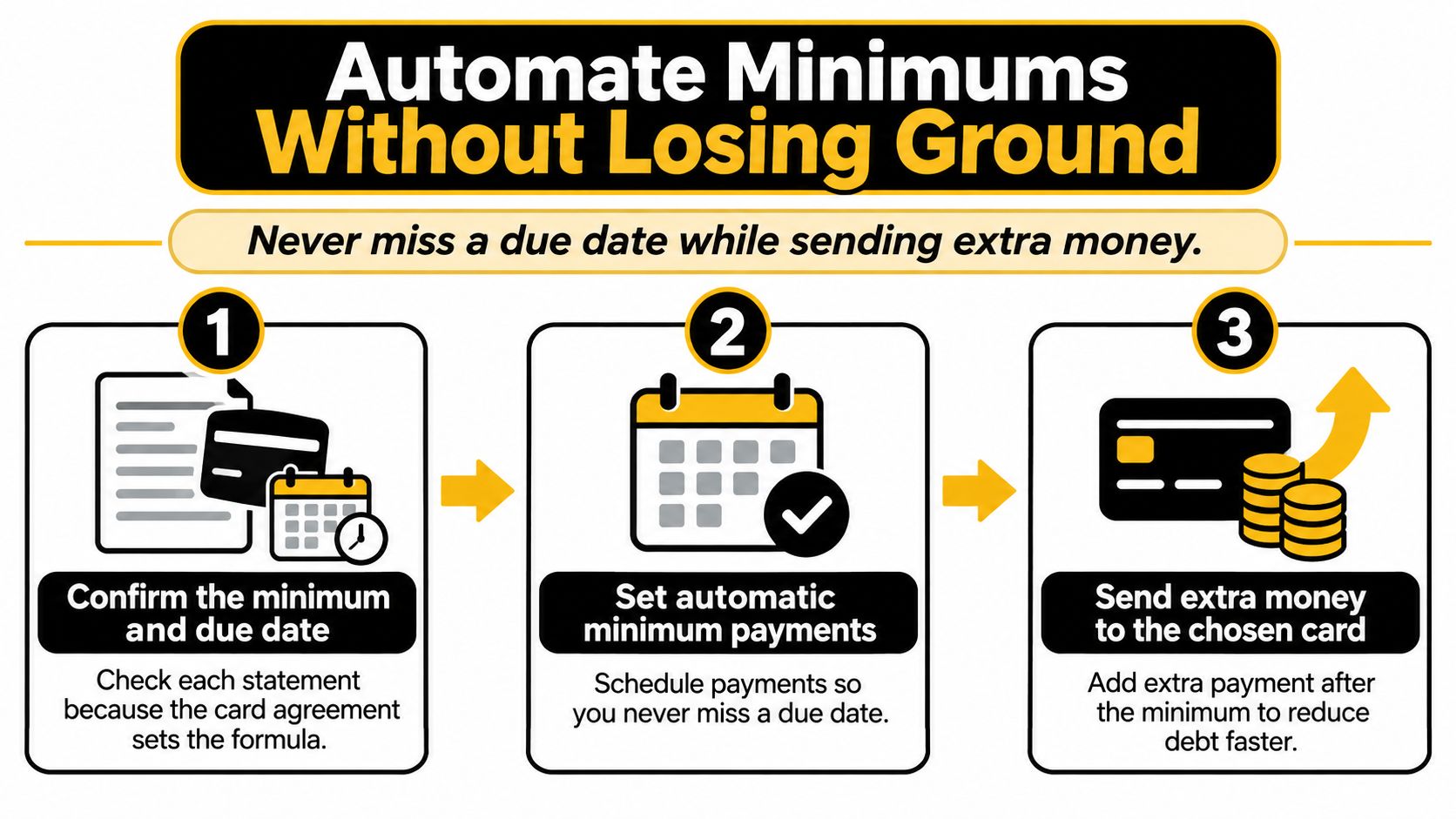
The operating goal is straightforward: never miss a due date while sending extra money toward repayment. Autopay handles the safety layer; a separately tracked additional payment handles progress.
The process works best when statement checks remain part of the routine.
Set the routine around available cash
Confirm the statement minimum and due date. One CFPB-published card agreement_04.01.2026-256612.pdf) illustrates a minimum equal to the greater of 1% of the balance plus applicable interest and fees, or $25, making a $1,200 statement with $15 interest and no late fee a $27 minimum. That is an agreement-specific example, not a universal formula.
Enable minimum-payment autopay from a funded account. Schedule payment several business days early where the issuer allows it, and check the issuer's processing rules. A credit card payment due date guide can help distinguish the deadline from the statement closing date.
Keep a checking-account buffer. A practical starting point is enough to cover an additional minimum payment, adjusted upward when income is irregular. The buffer isn't spending money or part of the target-card surplus.
Make the additional payment separately. Schedule it after essential cash needs are covered and record it as principal reduction in the payoff tracker. Confirm whether a manual payment changes the issuer's pending automatic withdrawal.
Reconcile the next statement. Match both withdrawals to posted payments rather than relying solely on confirmation emails. Under the CFPB's penalty-fee regulation, a late fee generally can't exceed the required minimum payment associated with the violation, though other limits also apply.
Protect purchase grace periods where available. The CFPB's grace-period guidance explains that issuers aren't required to offer one and that carrying a balance can cause new purchases to accrue interest from their purchase dates. In its practical scenario, paying a $1,000 statement in full can avoid purchase interest when the grace period applies; paying $300 leaves $700 unpaid and may also expose new purchases to interest.
Keep the routine visible
A calendar reminder to review the statement matters even with autopay enabled. Annual charges, changing minimums, and payment-account changes can disrupt an otherwise sound setup.
For borrowers working to build more disciplined money habits, Africhange's guidance offers a useful companion to the mechanical setup. Consistency means checking the result, not merely enabling automation.
A clean month has every minimum posted, the additional payment visible, and a target balance moving downward.
Track Your Timeline and Confirm the Order
A repayment plan needs a current record, not just an optimistic finish date. Keep balances, APRs, minimums, due dates, promotional deadlines, and planned payments together, then reconcile that record after each statement.
A statement review should compare the account records with the calculator rather than accepting either in isolation.

Check the outputs that affect decisions
A spreadsheet can handle the inventory. A payoff calculator becomes useful when the borrower needs to compare different payment amounts, changing rates, or competing deadlines.
The decision view should identify:
- The debt-free date: When repayment finishes at the current payment level, assuming the inputs hold.
- The next target: Which balance should receive the next additional payment.
- The interest comparison: How much interest the proposed plan saves against a clearly identified alternative.
- The assumptions: Whether the projection includes new purchases, transfer fees, promotional expiration, and changing minimums.
For Toya AI, the first step is securely linking credit cards and loans through Plaid with read-only access. Toya AI calculates the debt-free date from current payments and shows which debt should receive extra money and how much interest the user will save. It models existing accounts; it doesn't consolidate debt or move balances between lenders.
The distinction matters. A calculator can identify a better allocation, but the borrower still needs to confirm payments through the issuer and maintain adequate cash in the funding account.
Test a change before committing
Using the hypothetical inventory, increasing the monthly budget from $400 to $500 adds $100 to the travel card's payment while the other minimums remain protected. The surplus rises from $186 to $286, and the travel card's total payment rises from $306 to $406.
Run both versions through a credit card payoff calculator with amortization. Compare the projected finish dates, total interest, and month-by-month balances rather than assuming the larger payment produces a particular number of months saved.
An earlier finish date is useful only if the larger payment can continue. If the increase leaves no money for an upcoming insurance bill, the safer choice may be a smaller recurring increase plus occasional payments from genuine surplus.
Household expense reviews should use actual renewal quotes, not hoped-for savings. For readers examining insurance costs alongside credit concerns, QuoteFii, LLC's guide to car insurance with a 560 credit score addresses that specific situation; any payment-budget adjustment should follow confirmed costs.
A visual explanation can complement the written payment comparison.
Review whenever the inputs change
A new card, a closed account, reduced income, or a moved due date can make an old projection unreliable. Recalculate after those changes and check that a promotional expiration hasn't altered the target.
Keep a monthly review appointment with a short checklist:
- Confirm payment coverage: Every account has a funded minimum-payment arrangement.
- Name one target: The additional payment has a specific destination, selected by APR or a justified exception.
- Update account terms: Current rates, promotional deadlines, and balances match the statements.
- Verify progress: Posted payments and actual balances agree with the tracker.
The expected result is concrete: minimums arrive on time, the extra payment appears on the statement, and the target balance is lower than last month. If that last result doesn't occur, investigate new purchases, fees, interest, or a payment-allocation issue before increasing the budget.
Toya AI offers a personalized payoff plan showing the debt-free date, the next payment target, and the effect on interest. Visit Toya AI to connect existing accounts and compare a repayment plan against the payments the household can realistically sustain.
Ready to start your debt-free journey?
Toya AI builds a personalized payoff plan so you can see your debt-free date and save on interest.
Get Started Free