
How Car Loan Interest Works: Monthly Math and Real Costs
A new statement arrives and the numbers don't seem to agree. You paid $608.44, the balance dropped by barely $500, and the interest line reads $100. Nobody made a mistake, and nothing was hidden in fine print. That's how car loan interest works on the simple-interest contract most buyers sign.
The clearest way to learn it is to follow one loan from the first payment to the last. Here's that loan: $20,000 borrowed at 6% for 36 months, with a fixed payment of $608.44. Every choice that follows, term length, extra principal, payment timing, a trade-in carrying an old balance, shows up as a dollar change on the same balance.
Two numbers explain almost everything about a car loan: what the lender charges each month on the money still owed, and how much of the balance is left. Get those right and the rest is arithmetic you can do on a receipt envelope.
Table of Contents
- How Each Monthly Payment Splits Between Interest and Principal
- How Loan Term Changes Your Total Interest
- How Extra Payments Shorten the Loan and Cut Interest
- Why Your Payoff Quote Differs From the Amortization Table
- Market Rates for New and Used Cars and Dealer Markups
- Why Long Terms and Rolled-Over Balances Get Expensive
- Read the Disclosure and Check the Offer Before You Sign
How Each Monthly Payment Splits Between Interest and Principal
Most auto loans use simple interest, sometimes called an amortizing rate. The lender calculates interest from the outstanding principal balance, usually each day or month, rather than charging interest on the original amount for the whole term. The Consumer Financial Protection Bureau notes that simple interest is far more common than precomputed interest and is based on the actual outstanding balance on the payment date.
The formula in plain words: take the balance still owed, multiply it by the annual rate, divide by 12. That result is one month of interest. Whatever is left of your payment after that charge reduces the principal.
Month one. The balance is $20,000 and the rate is 6%. $20,000 × 0.06 ÷ 12 = $100.00 in interest. Of the $608.44 payment, $508.44 goes to principal, leaving $19,491.56.
| Payment number | Starting balance | Interest | Principal | Ending balance |
|---|---|---|---|---|
| 1 | $20,000.00 | $100.00 | $508.44 | $19,491.56 |
| 2 | $19,491.56 | $97.46 | $510.98 | $18,980.58 |
| 3 | $18,980.58 | $94.90 | $513.54 | $18,467.04 |
| Totals over 36 payments | $20,000.00 | $1,903.84 | $20,000.00 | $0.00 |
Month two. Interest is now figured on $19,491.56, so it falls to $97.46. Principal rises to $510.98 and the balance settles at $18,980.58. Month three drops the charge to $94.90, pushing $513.54 toward principal.
Why the interest charge shrinks while the payment stays flat
The payment never moves. The split does. Every dollar of principal you retire stops generating interest in the next period, which is why the interest portion drops a little more each month and the principal portion climbs to match.
By the final months of this loan, more than $600 of the $608.44 payment goes to principal and only a few dollars pay interest. Across all 36 payments, interest totals about $1,903.84.
A lender that accrues interest daily can land a few cents or dollars away from these figures because the number of days between payment dates changes. Same formula, different calendar.
Practical check: request the amortization schedule from the servicer and test the first row. If month one's interest is higher than balance times rate divided by 12, ask what fees or which interest method are built into the contract.
Before committing to any offer, run your figures through an auto-loan payment estimator so you see the interest total, not just the payment that fits the budget this month.
How Loan Term Changes Your Total Interest

At the desk, the buyer hears one number first: the monthly payment. The loan term decides how long that payment follows you. A longer term makes the payment smaller, but it gives interest more months to accumulate. On the same $20,000 loan at 6%, the monthly relief looks modest beside the extra total cost.
The rate stays at 6% in every scenario below. Only the number of months changes, and the total interest moves with it.
| Term | Monthly payment | Total interest | Total of payments |
|---|---|---|---|
| 36 months | $608.44 | $1,903.84 | $21,903.84 |
| 48 months | $469.70 | $2,545.60 | $22,545.60 |
| 60 months | $386.66 | $3,199.60 | $23,199.60 |
| 72 months | $331.48 | $3,866.56 | $23,866.56 |
Stretch from 36 months to 48 and the payment drops by about $139 a month. That relief costs about $642 in extra interest, roughly $53.50 for every added month you carry the balance. Going from 60 months to 72 frees up about $55 a month and adds about $667 in interest.
Think of the term as the length of a hallway. The payment is the size of each step, and interest is charged while you are still walking down it. A shorter hallway asks for bigger steps, but you leave it sooner. A longer hallway feels easier at each step, yet you spend more time paying for the same car.
The table keeps the comparison clean because it changes one thing at a time. Same $20,000 loan, same 6% rate, different number of months. That matters because monthly payment alone can make a costly loan look friendly. The total of payments shows what the term does over the full life of the loan.
The auto loan guide advises looking at APR, amount financed, term, monthly payment and total of payments together. That approach keeps the budget question and the full-cost question in the same view. A payment that fits this month still has to fit across every month of the term.
How to pick a term without gambling on it
Three comparisons settle most of the decision:
- Total of payments: This figure includes interest and any financed fees. Rank offers by this, not by the monthly amount.
- Payment headroom: The car payment has to survive insurance, fuel, tires and a repair fund. A payment that consumes every spare dollar turns a small emergency into a missed due date.
- Term versus ownership: A car financed for years longer than you plan to keep it leaves a balance behind when you sell, which is where the next section's problem begins.
Rule of thumb: Choose the shortest term whose payment you can make comfortably in a bad month, not the longest term whose payment looks easy in a good one.
How Extra Payments Shorten the Loan and Cut Interest
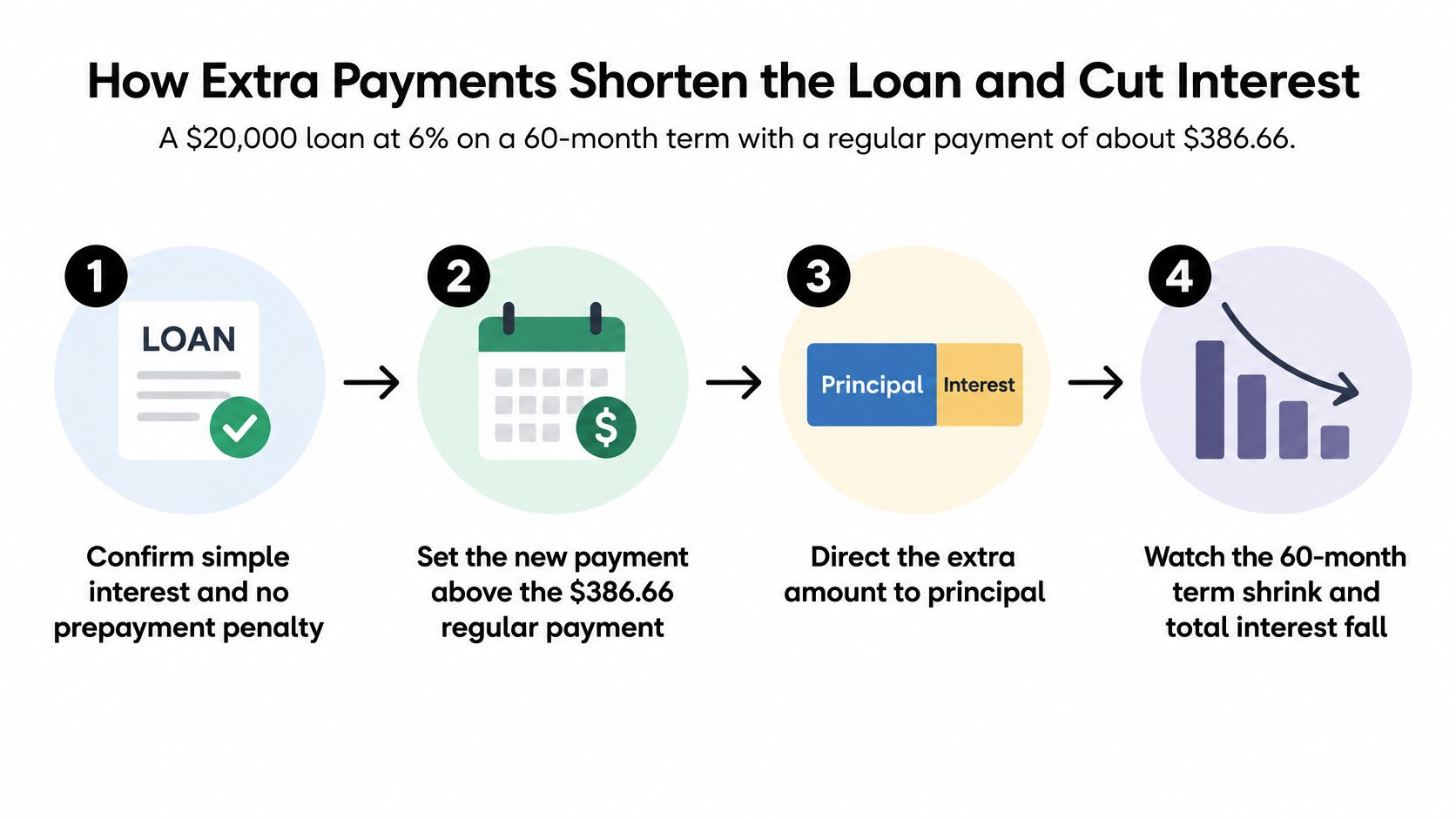
An extra $100 a month gives the same $20,000 loan at 6% a different finish line. On a 60-month term, increasing the regular payment of about $386.66 to $486.66 reduces the balance faster, leaving less money for future interest to be calculated on.
The key is how the servicer applies the extra money.
Make the extra payment count
- Confirm the mechanics. Ask whether your contract uses simple interest and has a prepayment penalty. With simple interest, charges depend on the outstanding principal, so reducing that balance can reduce future interest, as Capital One's auto finance guidance explains. A penalty could offset the benefit.
- Set a new payment target. Adding $100 to $386.66 makes $486.66 a month, or $1,200 a year above the schedule. Keep the regular payment going even as the balance falls. The example below assumes you maintain that higher payment until payoff.
- Direct the money to principal. Use the servicer's portal or written instructions to request that the extra amount reduce principal. Ask separately whether it advances your next due date. A contract without a prepayment penalty does not explain how extra payments are allocated.
- Verify on the next statement. Check that the extra amount was credited to principal alongside the scheduled principal payment. If the allocation is unclear, ask the servicer to explain it before sending more.
The before and after
| Scenario | Payoff time | Saved versus regular |
|---|---|---|
| Regular payment only | 60 months | - |
| Regular payment plus $100 extra monthly | About 46 months | About $810 and 14 months |
For this worked example, total interest falls from about $3,200 to about $2,390. That is approximately $810 saved, with the loan ending roughly 14 months sooner. The final payment is smaller than the ongoing monthly target.
The balance acts like the base of an interest calculation: shrink the base, and the charge shrinks too. More of later payments can then go toward principal, helping bring the finish line closer.
Posting dates also affect savings. Earlier principal reductions leave less balance accruing interest; processing delays can reduce that advantage. The comparison assumes consistent payments rather than changes in posting dates.
This video illustrates how extra payments affect the balance and repayment period.
Ask before you send: “Will this extra payment reduce principal today, and will my regular payment still be due?” Confirm both so an advanced due date does not interrupt your extra-payment routine.
The same principle applies to larger payments. This guide to paying off an auto loan early explains how to direct lump sums, tax refunds and bonuses toward principal rather than prepaid installments.
Why Your Payoff Quote Differs From the Amortization Table
Two documents describe one loan and disagree by a few dollars: the schedule printed at signing and the payoff quote you request today. The difference is day count.
Interest accrues on the outstanding balance for each day the money is borrowed. Divide the annual rate by 365 and multiply by the balance. On $20,000 at 6%, that's $20,000 × 0.06 ÷ 365, or about $3.29 a day. Some contracts use a 360-day divisor, putting the figure near $3.33. Four situations turn that daily figure into a real gap.
- A late payment. Post a payment seven days late on that balance and roughly $23 of interest accrues in the gap, leaving less of your money to reduce principal.
- A mid-cycle extra payment. Pay an extra $500 on the 12th instead of the 28th and the next interest charge is smaller, because interest is figured on a balance that dropped earlier.
- A payoff quote. The number you receive equals remaining principal plus per-diem interest from the last payment to the payoff date. That's why the quote carries a good-through date and expires if you wait.
- Calendar friction. Weekends, holidays, grace periods and processing delays all shift day counts. A printed schedule can't, which is why it assumes perfectly on-time payments.
A loan payoff guide explains how to time the request so the quote you're given is the amount you owe on the day the wire lands.
Three questions for the servicer: What is my per-diem interest? How is extra money allocated between principal and the next due date? Can you send a written payoff quote with its good-through date?
Market Rates for New and Used Cars and Dealer Markups
Use market averages as a guardrail, not as your offer. They show the usual direction rates move by vehicle type, and they help you notice when a quoted APR sits far outside the normal range. Think of them as the temperature reading before you decide whether to investigate a fever.
| Vehicle and period | Average rate | Average term | Average amount financed |
|---|---|---|---|
| New car, Q1 2008 | 6.64% | 62.01 months | $25,041 |
| Used car, Q1 2008 | 12.08% | 58.98 months | $17,063 |
| New car, Q3 2018 | 6.43% | 65.59 months | $29,921 |
| Used car, Q3 2018 | 13.80% | 61.86 months | $18,211 |
The Federal Reserve's historical finance company data shows two durable patterns. Used vehicles have consistently carried higher rates than new ones, and longer maturities coexist with larger financed balances. Between the two snapshots, the average new-car amount financed rose by nearly $5,000 while the average term lengthened past 65 months.
Both patterns feed the same engine. A higher rate charges more on every dollar of balance in every payment period, and a longer term keeps that balance exposed for more periods. On a $20,000 loan at 6%, the familiar example from earlier, a higher APR makes each day's interest larger. A longer term does not raise the daily rate, but it gives that daily charge more days to work.
Where dealer financing adds cost
Dealer-arranged financing can include a markup. In general practice, a dealer may offer a rate above the lender's original "buy rate" as compensation for arranging the loan, which makes the rate itself negotiable. The buy rate is the rate the lender makes available before the dealer adds any margin.
The comparison that exposes it is simple. Arrive with a bank or credit union quote in hand, then ask whether the dealer's APR includes a markup above the lender's buy rate. A rate that matches the bank is fine. A rate a point or two higher deserves a question. Ask the question before discussing monthly payments, because payment talk can hide the cost inside a longer term.
Price matters too, especially when the rate is higher. Buyers comparing affordable cars for sale in Kenya run the same arithmetic as anyone shopping used: a lower purchase price shrinks the balance the rate works against, which is often the larger lever. On the $20,000 example, cutting the financed balance lowers interest from the first day, while negotiating only the payment can leave the total cost untouched.
Why Long Terms and Rolled-Over Balances Get Expensive
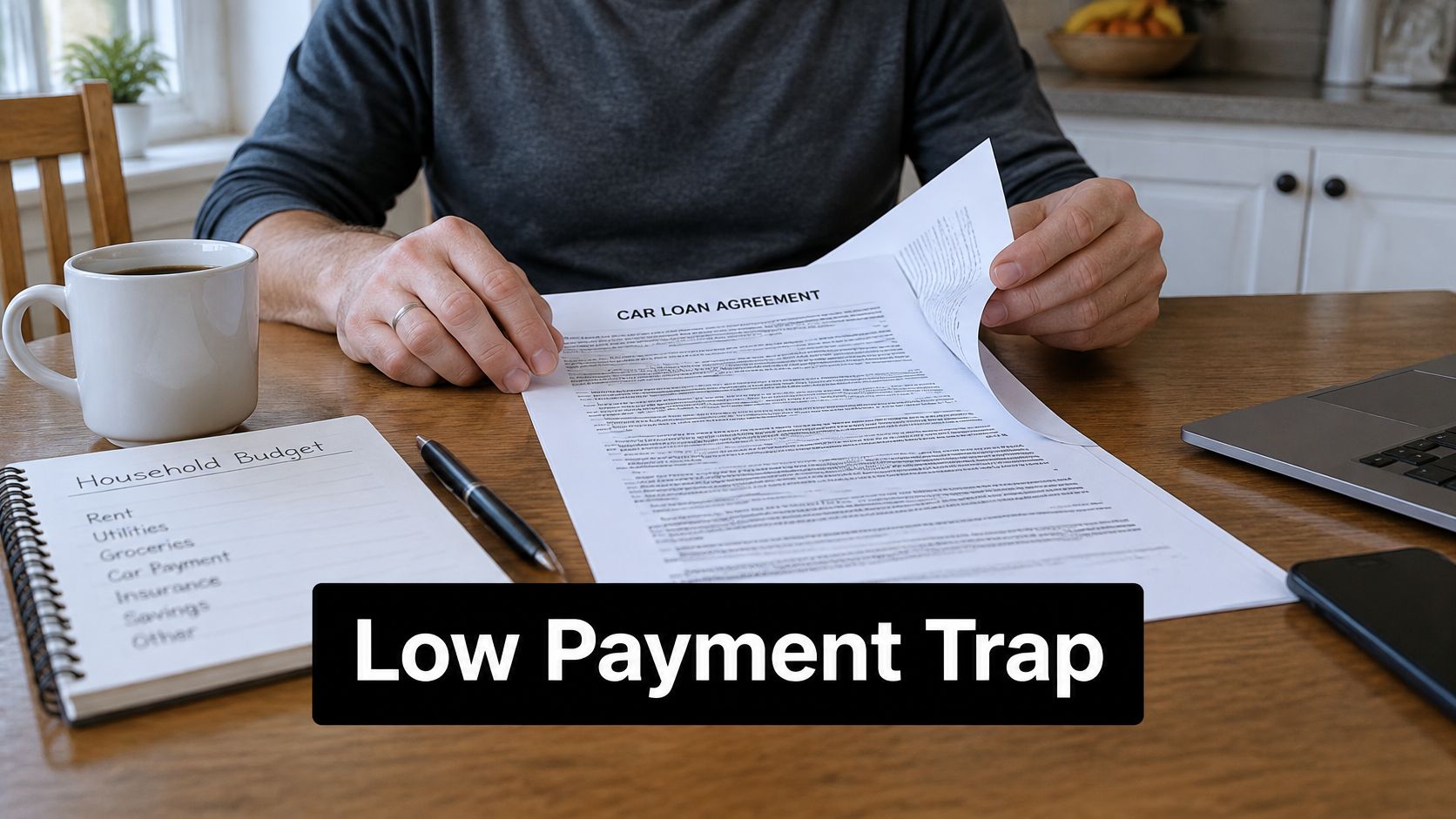
A smaller payment can be the most expensive line in a household budget. The cost stays hidden on the monthly statement, then shows up later when the car is worth less than the loan. A long term works like stretching a leaky hose across a longer yard. The drip per moment may look small, but it keeps running for many more moments.
Recent market averages put new-vehicle loan terms near 68.6 months at about 6.7%, with used-vehicle rates near 11.9%, according to Mercer Capital's review of 2025 auto finance data. Much of the term growth sits in loans of 73 months or more, and nearly 70% of used-vehicle terms run 72 months or longer. Those terms reduce the monthly bill, but they keep interest charging against a declining asset.
That matters because depreciation does not slow down just because the loan does. Negative equity, meaning the loan balance is higher than the car's value, becomes more likely when principal reduction is slow. The risk rises again when an old balance is carried into a new loan.
The rolled-over trade-in, in dollars
Say a borrower owes $25,000 on a car a dealer values at $20,000. The dealer pays off the old loan and adds the $5,000 difference to the new one. That $5,000 buys no extra miles of transportation, yet it borrows at the new loan's rate for the full new term.
At 6% over 60 months, that extra $5,000 adds roughly $97 to the monthly payment and about $800 in interest over the life of the loan. On the original $20,000 loan, the first month's interest is about $100, because 6% annual interest is about 0.5% for one month. Each payment covers that month's interest first, then reduces principal. A longer term leaves more principal in place for longer, so the same 0.5% keeps applying to a bigger balance.
Watch for these signals that a payment is hiding a fragile structure:
- Balance above value. If the payoff amount exceeds the car's current market value, depreciation widens the gap.
- Term past 72 months. More months of interest and slower principal reduction raise the odds of negative equity when you trade.
- A rolled-in balance. Old debt financed into a new loan shows that payment relief is being bought with future cost.
- Financed add-ons. Service contracts, GAP coverage and accessories added to the principal earn interest for the entire term.
Compare payoff balance, total interest and expected vehicle value before comparing payments. A payment that fits the budget while the balance outruns the car is a rental with a debt attached.
Read the Disclosure and Check the Offer Before You Sign
Two loans can carry the same interest rate and produce different costs. The APR is broader than the stated rate because it folds in certain loan fees and expresses the full annual cost of credit. Both appear as annual percentages, but only the APR is built for comparison.
The CFPB's explainer on interest rate versus APR puts a number on it. Take a $25,000 auto loan at 6% from two lenders. If one charges $500 in qualifying origination or documentation fees and the other charges none, the first loan carries a higher APR even though the nominal rates match exactly.
Four checks on the Truth in Lending disclosure catch most of what an offer hides.
- Read five numbers together. APR, finance charge, amount financed, payment schedule and total of payments. Any offer missing one of them is incomplete.
- Do the subtraction. Total of payments minus amount financed gives the finance charge the lender is disclosing. That figure should match your own interest calculation.
- Hunt the difference. If the finance charge exceeds the interest you computed from rate and term, look for fees or optional products, such as service contracts or GAP coverage, financed into the loan.
- Test the term. On the same $20,000 balance at 6%, the 60-month version carries roughly $1,300 more interest than the 36-month version. Reject the longer term unless the monthly relief clearly outweighs that cost.
Ask in writing: whether extra payments reduce principal and whether a prepayment penalty applies. An answer given at the desk isn't a contract term; a written reply is.
A payoff tool such as Toya AI shows, for each connected debt, how an extra payment changes the debt-free date and how much interest the user saves, and it estimates outcomes from a few figures before any account is connected. Those projections are informational suggestions, not financial advice, and the signed loan agreement controls the exact result.
Seeing the split between interest and principal changes how a car loan feels: the balance is no longer a fixed monthly obligation but a number you can push down and measure. Toya AI builds a payoff plan across credit cards, student loans, auto loans and personal loans, then shows which balance to attack next and how much interest each extra dollar saves. Visit Toya AI to preview the plan for free, then connect your accounts when you're ready for exact dates and figures.
Ready to start your debt-free journey?
Toya AI builds a personalized payoff plan so you can see your debt-free date and save on interest.
Get Started Free