
10 Financial Wellness Tips for Paying Off Debt
Several balances are competing for the same limited cash flow. A credit card payment is due early in the month, student-loan payments follow, an auto loan has a different withdrawal date, and a personal loan sits on another lender's website. The problem isn't always the total amount owed. It's the lack of one clear view and one reliable decision about what to pay next.
Financial wellness for people carrying debt isn't about perfect finances or eliminating every expense. It means seeing the full picture, protecting payment history, directing extra money intelligently, and repeating the process when circumstances change. The Federal Reserve's 2024 household economic well-being report found that 63% of U.S. adults could cover a hypothetical $400 emergency with cash, savings, or a credit card they'd pay off at the next statement. Yet 13% couldn't cover it by any method, and 15% would carry the credit-card balance over time. A plan needs both debt reduction and protection against the next surprise expense.
The sequence below starts with visibility and safeguards, moves into interest and cash-flow decisions, and ends with behavior systems that can survive income changes. Each example shows how a practical action can affect interest, repayment timing, or motivation without relying on unrealistic perfection.
Table of Contents
- 1. Create a Centralized Debt Dashboard to Track All Obligations
- 2. Use Interest Rate Analysis to Prioritize High-Cost Debt
- 3. Automate Minimum Payments to Prevent Late Fees and Credit Damage
- 4. Build a Micro-Budget to Find Money for Accelerated Debt Payoff
- 5. Leverage the Debt Payoff Calculator for Scenario Planning and Motivation
- 6. Implement the Debt Snowball or Avalanche Method for Structured Payoff
- 7. Negotiate Lower Interest Rates to Reduce Monthly Costs Immediately
- 8. Capture and Redirect Windfalls and Variable Income to Accelerate Payoff
- 9. Establish Automatic Adaptive Plans That Update as Life Changes
- 10. Track Progress and Celebrate Milestones to Maintain Momentum
- 10-Point Debt Strategy Comparison
- Make Your Debt Plan Stronger Than Your Motivation
1. Create a Centralized Debt Dashboard to Track All Obligations
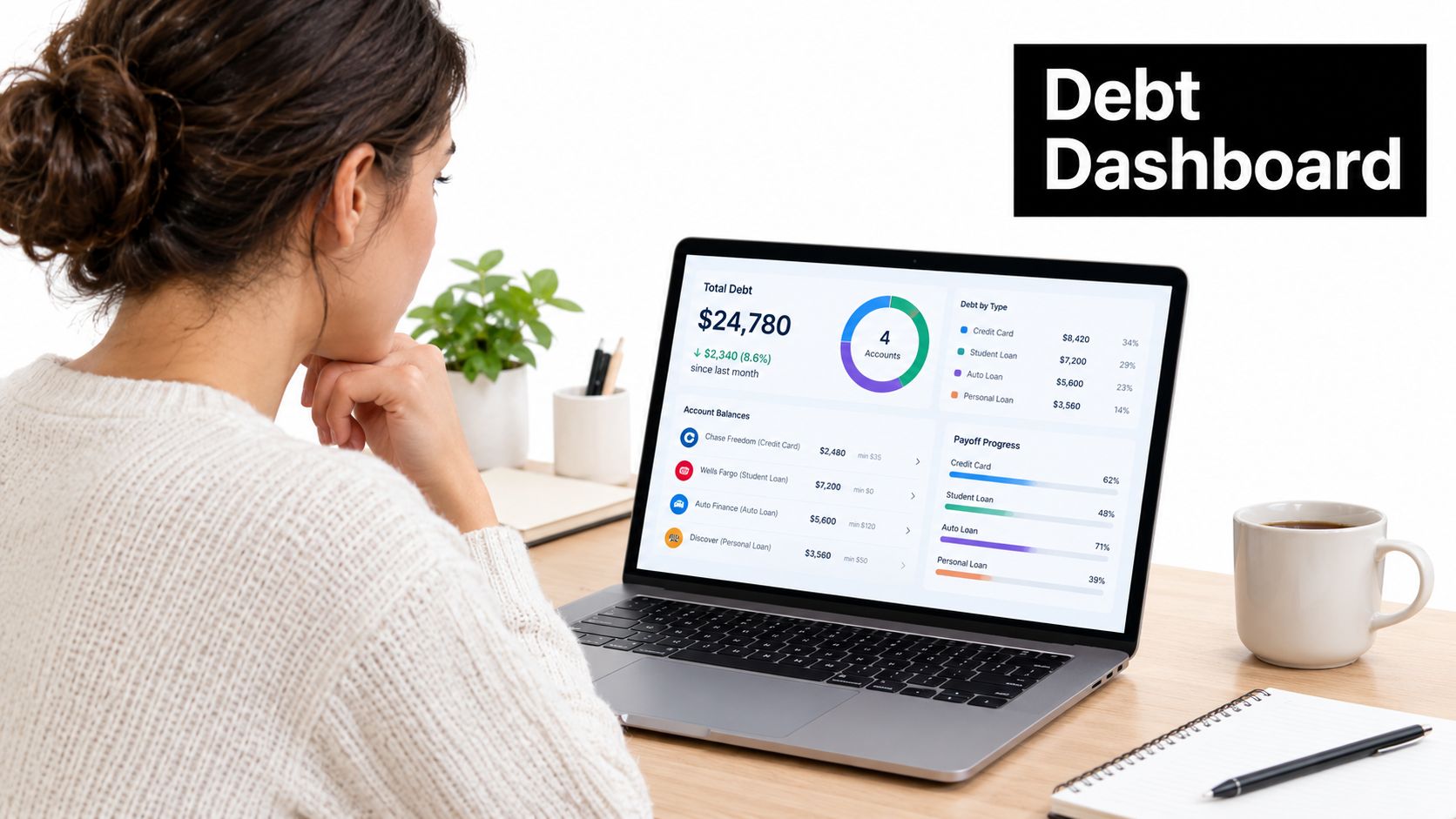
Debt becomes harder to manage when balances, APRs, minimum payments, and due dates are scattered across several websites. A centralized dashboard puts credit cards, student loans, auto loans, personal loans, and mortgages into one view. That single screen makes it easier to identify the most expensive balance, spot an approaching due date, and measure whether the total is falling.
A useful dashboard should show more than the amount owed. It should include the annual percentage rate, minimum payment, next due date, current balance, and payment history for each account. Someone learning how to track finances can start with a spreadsheet, then move to a read-only aggregation tool when manual updates become too difficult.
Consider Sarah, who has a $5,000 credit-card balance at 22%, a $12,000 car loan at 6%, and $35,000 in student loans at 5%. Her credit card generates roughly $91 in monthly interest at the starting balance, while the other debts cost less in interest despite their larger balances. Seeing that contrast in one dashboard gives her a clear reason to direct extra money toward the card.
Build the dashboard without creating another burden
Gather account details in batches. Add credit cards first, then installment loans, instead of trying to organize everything during one stressful evening.
- Set a review day: Check the dashboard on the first Sunday of each month.
- Use due-date alerts: Treat reminders as protection against missed payments, not as a substitute for reviewing balances.
- Save progress snapshots: Export or screenshot the dashboard quarterly so the declining totals remain visible.
- Control access carefully: Use read-only connections where available and review which permissions each service requests.
A tool such as account aggregation services can reduce the need to log in to every lender separately. The dashboard doesn't pay the debt by itself, but it turns scattered obligations into a decision-ready system.
2. Use Interest Rate Analysis to Prioritize High-Cost Debt
The balance with the largest dollar amount isn't automatically the most urgent. APR determines how quickly interest consumes each payment, so the first optimization step is comparing rates across every account.
Write down each balance and annual percentage rate, then calculate an approximate daily interest cost by dividing annual interest by 365. The figure won't replace the lender's statement, but it makes the trade-off easier to understand. If an account has a high APR, directing extra money there generally reduces future interest more effectively than spreading the same amount across lower-rate balances.
Jennifer has $8,000 across three cards. Card A holds $3,000 at 24%, Card B holds $2,500 at 18%, and Card C holds $2,500 at 12%. Card A produces roughly $60 in monthly interest at the starting balance. Her practical rule is simple: pay the minimum on B and C, then send every available extra dollar to A until it's gone.
Practical rule: Protect every minimum payment first. Send the extra payment to the account with the highest APR unless a different choice is necessary to keep the plan affordable.
A recent graduate with $25,000 in student loans at 5% and a $3,200 credit-card balance at 21% faces the same decision. The card represents a small share of total debt, but it produces roughly $56 in monthly interest at the starting balance. Paying it down before accelerating the student loans can lower ongoing interest costs and create a visible early win.
Review rates quarterly and verify any change against current statements. A lower rate, promotional expiration, balance transfer, or servicing change can alter the order. The dashboard from the first step should make those changes visible instead of leaving the borrower to discover them after interest has already accumulated.
3. Automate Minimum Payments to Prevent Late Fees and Credit Damage
Manual payment management fails when due dates vary, income arrives irregularly, or an account gets overlooked. Automatic minimum payments create a floor under the plan. Extra payments can change from month to month, but the required payment should still reach each lender on time.
David manages six accounts with different due dates. Before automation, he missed a student-loan payment, paid a $25 late fee, and saw a temporary credit-score decline. After setting up automatic minimums, he could focus on directing extra cash rather than remembering six separate deadlines.
The automation method matters. A bank-side bill-pay system can give the account holder more centralized control, while lender-side autopay may offer convenience or a rate benefit. Either way, the checking account needs enough money to cover withdrawals without creating an overdraft.
Create a payment-control routine
- Schedule early: Set withdrawals two or three days before the due date to allow for processing time.
- Start small: Automate one or two accounts first, confirm that the amounts and dates work, then add the remaining debts.
- Add low-balance alerts: A warning before an account runs short can prevent an overdraft.
- Verify monthly: Review payment history and confirm that each payment posted correctly.
- Keep a calendar marker: A reminder to check the withdrawal makes automation auditable.
A self-employed consultant with uneven income can use automatic minimums as protection during low-revenue months, then make larger discretionary payments when cash flow improves. Guidance on credit-card payment due dates can help borrowers align payment timing with their personal cash cycle.
Automation doesn't mean ignoring statements. Lenders can change payment amounts, servicing details, or account information. The system should handle routine payments while the borrower continues checking that the routine still matches reality.
4. Build a Micro-Budget to Find Money for Accelerated Debt Payoff
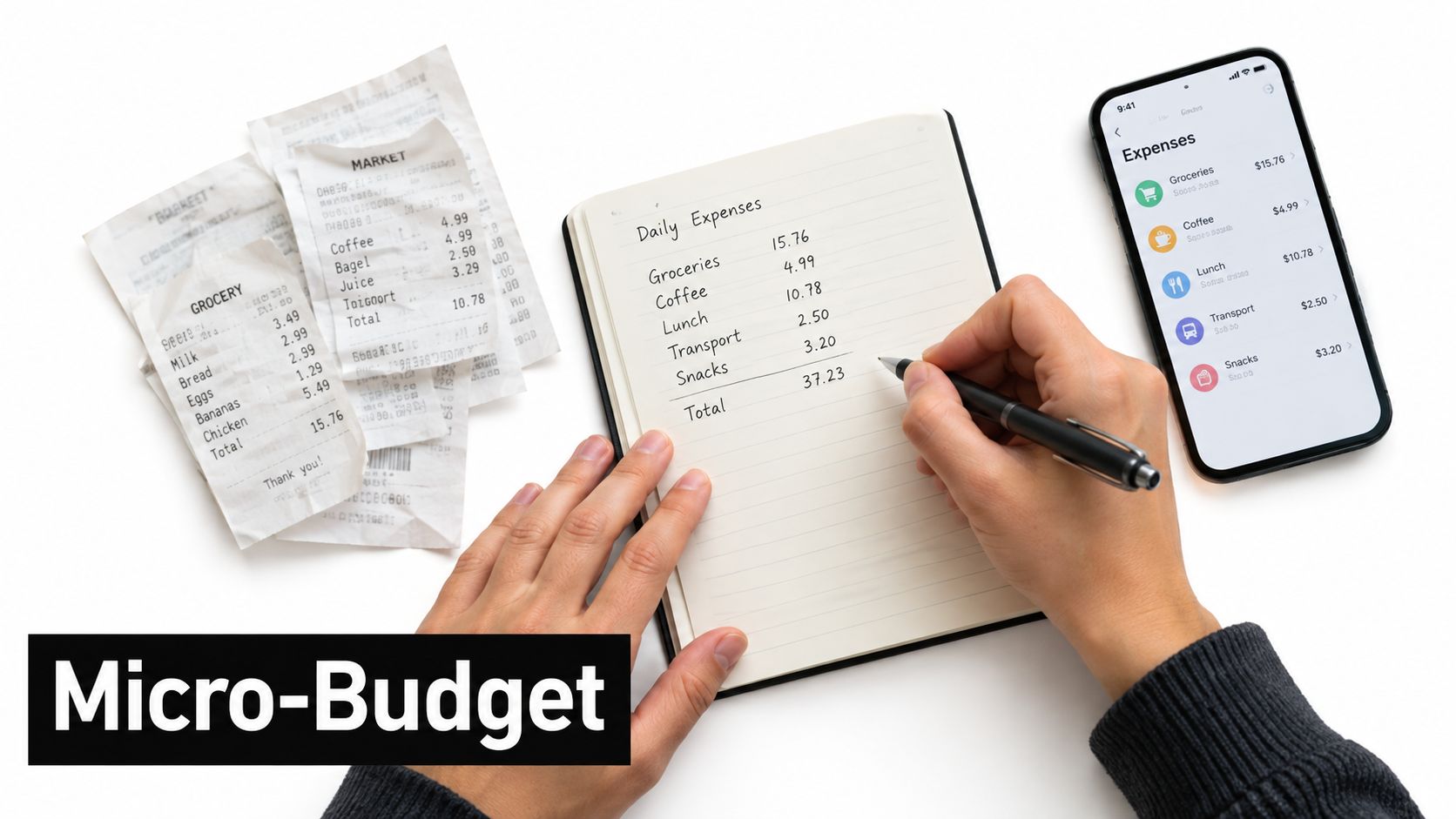
A monthly budget often hides the small purchases that absorb money before a debt payment can use it. A micro-budget tracks spending daily or weekly, so the borrower can see recurring leaks while they're still easy to change.
Lisa tracked four weeks of spending and found $8 daily coffees, three unused subscriptions costing $45 per month, and $200 in delivery meals. She chose to brew coffee at home, cancel the subscriptions, and prepare more meals. Those changes freed $485 per month for debt payoff without cutting housing, utilities, or required payments.
The point isn't to remove every enjoyable purchase. It's to distinguish spending that supports daily life from spending that happens by default. A young professional might find $120 in barely used apps and digital services, plus $60 in convenience-store snacks. Redirecting those two categories creates $180 for the payoff plan while preserving larger priorities.
Track the categories that reveal decisions
Use a spreadsheet, YNAB, EveryDollar, or a notes app. Log transactions each day, then review the pattern at the end of the week.
- Protect necessities: Separate housing, utilities, food, insurance, and required debt payments from optional spending.
- Find painless cuts: Start with unused subscriptions and premium versions of free services.
- Set a target: Choose a specific amount, such as $50 per week in additional debt payments.
- Move the money immediately: Send the freed cash to the target debt instead of leaving it in checking.
- Record small wins: Mark a week in which $100 moved toward debt so progress becomes visible.
An emergency reserve still matters. The Federal Reserve's household survey found that 55% of adults reported having a rainy-day fund covering three months of expenses, compared with 54% in 2023 and 59% in 2021. A micro-budget should therefore preserve a cash buffer rather than directing every available dollar to debt and leaving the household exposed to the next repair, medical bill, or income interruption.
5. Leverage the Debt Payoff Calculator for Scenario Planning and Motivation
A payoff calculator turns a vague intention into a comparison between payment choices. Enter the balance, APR, minimum payment, and proposed extra payment, then compare the resulting payoff dates and estimated interest.
Tom has a $10,000 credit-card balance at 19% APR. At roughly $200 per month, a calculator estimates a 66-month payoff and $3,200 in interest. Increasing the payment to $300 changes the scenario to 42 months and $2,100 less interest. The calculation gives him a concrete reason to find an additional $100 through his micro-budget.
Use conservative assumptions. Keep the current rate in the projection rather than assuming a reduction, and update the balance after each statement. A calculator can show a mathematical outcome, but it can't decide whether a payment leaves enough cash for essentials or emergencies.
Compare three realistic payment paths
Test a baseline with no extra payment, the amount the household can reliably commit, and an aggressive amount that remains affordable. A couple comparing a car loan with an $8,000 credit-card balance might discover that paying the card first saves substantially more interest, but the result should still be checked against minimum-payment requirements and emergency cash needs.
The free debt payoff calculator can help users preview outcomes before they commit. Save the result, revisit it quarterly, and update the inputs as balances fall. A payoff date works best as a planning signal, not a promise that creates shame when a medical bill or reduced work schedule changes the timeline.
A good projection answers one useful question: “What changes if this payment happens every month?”
Post the graph somewhere visible, such as a refrigerator or shared household workspace. The visual reminder can support consistency during the months when the balance falls slowly.
6. Implement the Debt Snowball or Avalanche Method for Structured Payoff
Two payoff orders can turn a pile of accounts into a sequence. The avalanche method targets the highest APR first, while the snowball method targets the smallest balance first. Both approaches require minimum payments on every account and extra money directed to one target.
Maria has a $2,000 credit card at 21%, an $8,000 car loan at 6%, and $15,000 in student loans at 4%. The snowball begins with the credit card because it's the smallest balance. Once that payment is freed, she rolls it into the car loan, then the student loans. The early account closure gives her a visible success and a simpler payment schedule.
Marcus uses the same debts but chooses the avalanche approach. He also starts with the credit card because it has the highest APR, then directs extra money to the next-highest rate. His method emphasizes lower total interest and permanently removing the most expensive borrowing first.
Choose the method that can survive ordinary months
Snowball can suit someone who needs quick wins or feels overwhelmed by many small accounts. Avalanche can suit someone who wants mathematical efficiency and can stay committed while a larger balance remains open. Neither method works if the payment is so aggressive that the household repeatedly falls back onto a credit card.
- List the order in writing: Remove ambiguity about which account receives the next extra payment.
- Roll payments forward: When a target closes, add its former payment to the next target.
- Mark every elimination: Use a no-cost celebration, such as a home-cooked meal or a progress post.
- Track interest avoided: Keep the financial reason visible during slower months.
For student borrowers, Federal Student Aid explains that extra payments can reduce principal sooner and lower future interest, but the borrower should confirm that the servicer applies the extra amount as intended and continue making at least the required payment. The Federal Student Aid repayment guidance supports a practical rule: maintain all minimums, then direct sustainable extra cash to the chosen target.
7. Negotiate Lower Interest Rates to Reduce Monthly Costs Immediately
A lower APR can improve the plan without requiring a higher payment. Call the card issuer, explain the recent payment record, and ask whether a lower rate or retention offer is available. Check the new terms carefully, especially if the reduction is temporary.
Kevin has a $6,000 balance at 22%, producing roughly $110 in monthly interest at the starting balance. After six months of on-time payments, he asks the issuer to review the APR and receives an offer of 19%. The three-point reduction lowers interest over time while he keeps the same payment amount, allowing more of each payment to reach principal.
The call should be specific and calm. A borrower can say, “The account has a recent record of on-time payments. Are any lower APR options available?” The customer-retention or loyalty department may handle the request, but the borrower should avoid threatening to close the account unless a genuine alternative is ready.
Prepare before making the call
- Review the statement: Record the current APR, balance, and any promotional end date.
- Check alternatives: Research legitimate competing offers without opening unnecessary accounts.
- Request written terms: Save confirmation in an email or statement.
- Document the outcome: Record the date, representative, new rate, and expiration details.
- Repeat the review: Revisit the rate after the borrower has built another record of timely payments.
A lower rate doesn't justify increasing spending. Keep the original payment amount if possible, because the rate reduction then speeds principal reduction rather than just lowering the monthly bill. Also check balance-transfer fees, deferred interest terms, and whether a promotional rate could end before the balance is paid.
8. Capture and Redirect Windfalls and Variable Income to Accelerate Payoff
Irregular income can make meaningful progress without changing the regular household budget. Tax refunds, bonuses, gifts, rebates, inheritance, and side-income payments should receive a decision before they arrive. Otherwise, the money can disappear into routine spending.
Priya receives a $2,500 tax refund and has an $8,000 credit-card balance at 22%. Instead of treating the refund as ordinary spending money, she directs it toward the card. The payment reduces principal immediately and shortens the period during which interest accrues.
A freelancer can use a separate account for variable income. Each payment arrives there, and a predetermined rule sends a defined share to debt after taxes and essential reserves are handled. The rule may direct all available windfall money to debt or divide it between debt and savings. The key is deciding before temptation takes over.
Make the transfer automatic and timely
- List every source: Include refunds, bonuses, gifts, rebates, freelance payments, and occasional commissions.
- Separate the money: Use a dedicated windfall savings account instead of mixing it with checking.
- Set the rule: Write down the percentage or dollar amount that goes to debt.
- Transfer quickly: Send the chosen amount within a week of receiving it.
- Measure the effect: Record how the payment changes the target balance and projected payoff date.
Households should agree on the rule before a bonus or refund arrives. A planned small amount for enjoyment can protect the strategy from backlash, while the main payment still advances the target debt. Windfalls should accelerate a sustainable system, not replace regular minimum payments or eliminate the emergency buffer.
9. Establish Automatic Adaptive Plans That Update as Life Changes
A fixed plan can become unsafe after a job change, medical expense, rate adjustment, or new household obligation. An adaptive plan changes the recommended extra payment when cash flow changes while preserving the protection layer of required payments and emergency reserves.
Marcus sets a three-year plan based on a $60,000 salary. Six months later, a promotion raises his salary to $75,000. The system recognizes greater payment capacity, increases the suggested extra payment, and moves the projected debt-free date to two and a half years. He reviews the recommendation before accepting it and directs the increase toward principal.
A different household faces a sudden medical expense that reduces monthly cash flow. Its plan lowers extra payments temporarily, preventing an overdraft while minimums continue. When income returns to normal, the system suggests a measured increase rather than demanding an unrealistic catch-up payment.
Set guardrails before automation
- Protect a cash threshold: Don't allow an automatic increase to consume the household's emergency reserve.
- Require explanations: The system should show whether a recommendation changed because of income, balance, APR, or due date.
- Approve large changes: Use alerts for major payment adjustments instead of allowing them to happen without notice.
- Review conflicts: A household can modify a recommendation if it conflicts with rent, medical care, taxes, or another priority.
The OECD/INFE survey collected comparable data across 39 countries and economies and found an average financial literacy score of 60 out of 100, while average financial well-being was 42 out of 100. The OECD/INFE financial literacy survey reinforces a practical point: knowledge alone doesn't create stability. A useful system must translate information into timely, affordable actions.
10. Track Progress and Celebrate Milestones to Maintain Momentum
Debt payoff is a long sequence of ordinary payments. Tracking turns those payments into evidence that the plan is working, while modest celebrations reinforce the behavior without creating a new balance.
Jenna pays off her smallest credit card, records the result in her dashboard, and celebrates with a no-cost movie night. The celebration matters because it marks a completed action, while the former card payment immediately rolls into the next target.
A couple can post a shared progress graph on the refrigerator. Each time the line crosses a chosen milestone, they cook a favorite meal at home. The ritual keeps the debt visible without turning every household conversation into a discussion about sacrifice.
Measure behavior as well as balances
- Choose concrete milestones: Mark the first account closed, the first $1,000 paid, or the point at which half the total debt is gone.
- Track payment adherence: Record whether the planned payment happened, not only whether the balance declined.
- Use low-cost rewards: Choose a home meal, a dashboard badge, or a shared activity.
- Review monthly: Compare balances, interest costs, emergency cash, and the next target.
- Keep the reward contained: Fund celebrations from a small planned amount so they don't reverse the payment.
Employer programs need the same discipline. A 2024 survey of 255 U.S. respondents found 90% employee participation in retirement plans and 82% in health insurance, while only 38% of organizations had or were considering a financial-wellness program when retirement plans were excluded. The 2024 State of Employee Financial Wellness Report supports separating availability from repeated use. A debt tool should measure activation, the first completed action, recurring use, balance change, and plan adherence, not just registrations.
10-Point Debt Strategy Comparison
| Strategy | Implementation Complexity | Resources Required | Expected Outcomes | Ideal Use Cases | Key Advantages |
|---|---|---|---|---|---|
| Create a Centralized Debt Dashboard to Track All Obligations | Medium, initial connections/setup | Account credentials, aggregator API (Plaid/etc.), dashboard tool | Unified view of balances, due dates, APRs; fewer missed payments | Multiple debts across lenders; need consolidated visibility | Real-time visibility, reduced decision fatigue, payoff visualization |
| Use Interest Rate Analysis to Prioritize High-Cost Debt | Low–Medium, APR calculations and sorting | Debt balances & APRs, calculator or tool | Prioritized payoff order; lower total interest paid | High-interest credit card debt or mixed-rate debts | Mathematically optimal prioritization (avalanche), clear savings estimates |
| Automate Minimum Payments to Prevent Late Fees and Credit Damage | Low, set recurring payments | Bank bill-pay or creditor autopay, stable checking account | Elimination of late fees and protected credit history | Risk of missed payments, busy schedules, travel | Prevents fees/score damage, reduces mental load |
| Build a Micro-Budget to Find Money for Accelerated Debt Payoff | Medium, daily/weekly tracking discipline | Time to track, app or spreadsheet, receipts | Identify redirectable spending; extra monthly payment capacity | Want to free cash without income change | Reveals small savings, supports intentional spending |
| Leverage the Debt Payoff Calculator for Scenario Planning and Motivation | Low, enter data and run scenarios | Debt balances, rates, payoff calculator tool | Clear timelines and interest savings under different plans | Planning, motivation, comparing payment strategies | Instant scenario testing, motivates concrete action |
| Implement the Debt Snowball or Avalanche Method for Structured Payoff | Low–Medium, choose and follow method | Debt list, payment discipline, tracking tool | Structured roadmap and accelerated elimination | Multiple debts needing sequence and discipline | Removes decision paralysis; momentum (snowball) or efficiency (avalanche) |
| Negotiate Lower Interest Rates to Reduce Monthly Costs Immediately | Low, phone calls and documentation | Credit history, competitor offers, time to call issuers | Reduced APRs, lower monthly interest, faster payoff | Improving credit scores, high-rate credit cards | Immediate interest reduction with minimal cost/effort |
| Capture and Redirect Windfalls and Variable Income to Accelerate Payoff | Low, rules and account setup | Separate savings account, discipline to transfer windfalls | Large one-time principal reductions; compressed timeline | Irregular income, expected bonuses, tax refunds | Accelerates payoff without cutting regular budget |
| Establish Automatic Adaptive Plans That Update as Life Changes | High, integrations and automation rules | Real-time data feeds, adaptive platform, account permissions | Continuously optimized payments and up-to-date payoff date | Variable income/rates, prefer hands-off management | Automatically adapts to changes; reduces manual recalculation |
| Track Progress and Celebrate Milestones to Maintain Momentum | Low, tracking and ritual setup | Progress dashboard or tracker, review routine | Sustained motivation; lower likelihood of abandoning plan | Long payoff timelines needing behavioral reinforcement | Boosts motivation, accountability, habit formation |
Make Your Debt Plan Stronger Than Your Motivation
A durable debt plan follows a sequence. First, centralize every account so balances, APRs, minimums, and due dates are visible. Next, automate minimum payments to protect payment history and prevent avoidable fees. Then build a realistic micro-budget that finds money without stripping away every useful or enjoyable part of life.
After protection comes optimization. Compare interest rates, choose a payoff order, and direct extra cash toward one target while maintaining all minimums. Use a calculator to test the payment amount before committing. If a lender offers a lower APR, preserve the original payment so the reduction reaches principal faster. When a windfall or variable-income payment arrives, apply the written rule instead of allowing the money to disappear into unplanned spending.
Student-loan borrowers should examine the repayment plan as carefully as the balance. Federal Student Aid describes the standard federal repayment plan as a fixed-payment schedule that generally pays eligible nonconsolidation loans within 10 years, with payments of at least $50 per month. Consolidation loans can have terms from 10 to 30 years, and longer schedules may reduce the required monthly payment while usually increasing the time interest accrues. The Federal Student Aid repayment-plan guidance recommends comparing monthly payment, payoff date, and total paid instead of choosing based on monthly affordability alone.
Borrowers should also compare accrued interest with the required payment. Federal Student Aid explains that interest is calculated from unpaid principal, and an income-driven payment can sometimes be lower than the interest accruing that month. If a loan generates $180 in monthly interest and the required payment is $120, the remaining $60 can remain unpaid under the plan's rules. That borrower should review the statement, ask the servicer how unpaid interest is handled, and assess whether an eligible plan or sustainable voluntary payment improves the trajectory. The Federal Student Aid explanation of loan interest provides the relevant framework.
Small automatic savings can also help. Federal Student Aid states that eligible student-loan auto pay can reduce the interest rate by 0.25% each month. On a $30,000 starting balance, that rate reduction represents roughly $75 less annual interest before principal repayment changes the calculation. Borrowers should verify eligibility, keep enough money in the linked account, and monitor the first withdrawals. The Federal Student Aid auto-pay guidance supports treating the discount as an added efficiency, not as permission to weaken the cash buffer.
The plan must adapt when reality changes. The Federal Reserve found that 85% of adults who always had money left over at month-end had three months of emergency savings, compared with 13% of those who never had money left over. That relationship supports a clear decision rule: preserve enough cash to absorb normal volatility, then increase extra payments when month-end cash flow consistently allows it. A mathematically optimal payment that causes overdrafts or new card balances isn't an effective plan.
A first-week setup can be straightforward:
- Day one: Gather every statement and create the centralized debt dashboard.
- Day two: Record each APR, minimum payment, balance, and due date.
- Day three: Turn on minimum-payment automation and low-balance alerts.
- Day four: Track every expense and identify the first painless cut.
- Day five: Compare snowball and avalanche outcomes with a payoff calculator.
- Day six: Call the highest-rate lender and request a rate review.
- Day seven: Set the monthly review date and write the windfall rule.
Toya AI can support this process by connecting accounts, comparing debt costs, previewing payoff scenarios, and adjusting next-best-action guidance as balances and cash flow change. It should be used as a planning tool alongside statement checks, lender instructions, and a cash buffer, not as a replacement for reviewing important financial decisions.
Toya AI centralizes balances, APRs, utilization, and due dates, then shows how a recommended payment can affect interest and the projected debt-free date. Visit Toya AI to connect accounts, test payoff scenarios, and build an adaptive debt-management routine.
Ready to start your debt-free journey?
Toya AI builds a personalized payoff plan so you can see your debt-free date and save on interest.
Get Started Free