
Defaulting Credit Card Debt: A Practical Roadmap
Defaulting credit card debt is a process that moves through 30, 60, 90, and 180+ days past due, rather than a single moment, and the sensible response changes at each stage.
The situation often starts with an ordinary cash shortage: rent clears, groceries cost more than expected, and the card payment no longer fits. A borrower opens the banking app, sees the overdue notice, and wonders whether making a small payment will help or merely leave too little for essentials.
The first priority is cash-flow triage, not credit-score perfection. A workable response identifies the account's current stage, protects necessities, and compares repayment options before agreeing to terms that the household can't sustain.
Table of Contents
- What Defaulting on a Credit Card Actually Means
- Two Stories That End Very Differently
- The Day-by-Day Reality of Default Progression
- Credit Score, Tax Surprises, and the Lawsuit Clock
- Choosing Between Minimums, Hardship, Settlement, and Bankruptcy
- Prioritizing Bills When You Cannot Pay Everything
- Your 30-Day Plan to Get Ahead of Default
What Defaulting on a Credit Card Actually Means
In everyday conversation, defaulting means falling behind. In a card agreement, contractual default can mean failing to meet a required payment or another condition, including exceeding the credit limit. It doesn't necessarily begin only when an issuer writes off the account.
The Federal Reserve's discussion of household borrowing and card delinquency distinguishes contractual problems from the delinquency stages used in credit-market analysis. That distinction matters because an issuer's remedies, a credit bureau's reporting, and an accountant's charge-off classification aren't the same event.
Identify the status, not just the label
A borrower needs the oldest unpaid due date, the amount required to bring the account current, and the account's present status. A statement showing “past due” doesn't establish whether the issuer has restricted spending, referred the account for collection, or already charged it off.
- Payment status: Ask how many days past due the account is, rather than relying on a general “delinquent” label.
- Cure amount: Request the amount needed to become current. A partial payment may reduce the balance without curing the delinquency.
- Account ownership: Confirm whether the issuer still owns the debt and which department handles payment arrangements.
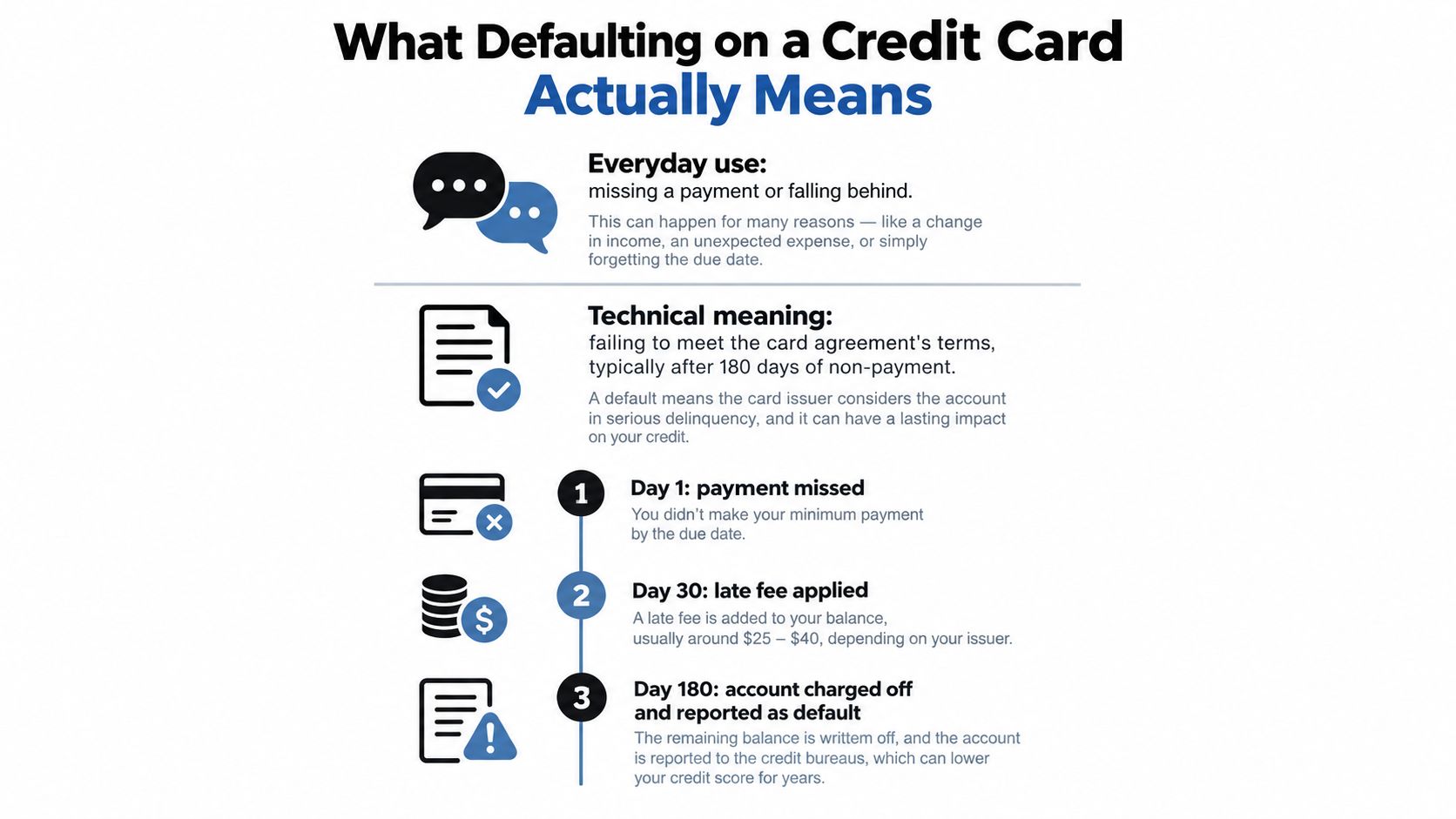
The visual below summarizes the progression, but the card agreement controls contractual default. Late fees also aren't universally delayed until the credit-reporting stage.
Understand what market statistics measure
The Federal Reserve defines its credit-card delinquency series around loans at least 30 days past due and reported a 3.04% balance-weighted rate in Q2 2025 for credit-card loans at commercial banks, according to its credit-card delinquency data. That isn't the percentage of borrowers whose accounts have already been charged off.
For an individual household, the useful question isn't whether the national rate sounds high. It's whether the next available payment can cure an overdue account without sacrificing food, housing, or necessary medical care.
Two Stories That End Very Differently
Maria and James are hypothetical borrowers, not documented client cases. Both begin with the same balance, interest rate, and minimum payment, then lose enough income to miss a payment.
Maria calls her issuer within four days. James stops opening statements for four months. Their contrasting choices illustrate possible outcomes, not guaranteed issuer responses.
Maria addresses a temporary shortfall
Maria expects her income to recover and can cover essentials. Before calling, she calculates what remains after necessary expenses, rather than offering the payment amount she wishes she could afford.
She asks for the hardship department, explains the interruption, and requests an affordable arrangement. She also asks whether the issuer will waive a late fee, how interest will be handled, and whether the account will remain usable.
A workable outcome might leave Maria paying interest and an unwaived fee while keeping the account from progressing further. A brief late payment doesn't automatically produce a credit-score drop, and a phone call alone doesn't guarantee protection. The payment arrangement and reporting treatment matter.
Early contact is useful because it creates an opportunity to negotiate. It isn't a substitute for an affordable agreement.
James avoids the paperwork
James has a deeper problem: his income no longer covers both necessities and card payments. Avoiding statements spares him an uncomfortable task, but it also prevents him from learning which assistance options remain available.
Under the progression described below, the issuer may apply higher pricing as the delinquency ages. James then has less room to negotiate a manageable payment while interest continues to consume money that could otherwise reduce principal.
Eventually, the account may reach charge-off and collection handling. James still has choices, but he must first establish who controls the account and whether repayment, settlement, or legal relief fits his circumstances.
- Maria's useful choice: She tests a realistic payment against her household budget before agreeing.
- James's missed opportunity: He doesn't investigate assistance while the account is moving through earlier stages.
- The shared lesson: Neither borrower should promise payments that require skipping essentials.
The distinction isn't responsibility versus irresponsibility. A temporary shortfall and a permanently unworkable debt load require different solutions. Early communication helps reveal which problem the borrower has.
The Day-by-Day Reality of Default Progression
Days past due determine the next operational question. Before collection transfer, that question may be how to restore current status. After transfer, it may be who owns the debt and what authority the person requesting payment has.
A payment at least 30 days late may be reported to major credit bureaus; around 60 days, an issuer may impose a penalty APR that can apply to the existing balance; and around 180 days, nonpayment commonly leads to charge-off and possible collection transfer or sale, according to PNC's explanation of unpaid credit-card bills. These are typical stages, not promises of identical treatment by every issuer.
What Changes at Each Stage of Credit Card Default
The following comparison uses those typical reporting and pricing milestones. Fees, account restrictions, and contractual remedies depend on the agreement and issuer policy.
| Days Past Due | Typical Fee Trigger | APR / Pricing Change | Bureau Reporting | Account or Collections Action |
|---|---|---|---|---|
| Before 30 | A missed due date may trigger a contractual late fee | Check the agreement and notices | Reporting treatment requires confirmation | Contact the issuer and request a cure amount |
| 30 | Existing fees may remain payable | Review current pricing | A late payment may be reported | Ask about reinstatement and hardship assistance |
| 60 | Continuing delinquency may add costs under the agreement | Penalty APR may apply, including to an existing balance | Delinquency may continue aging | Reconfirm restrictions and available arrangements |
| 90 | No universal new fee applies solely because of this milestone | Elevated pricing may continue | Serious delinquency becomes the central concern | Determine whether internal recovery staff handle the account |
| 180+ | Collection costs require review of applicable terms and law | Obtain a current balance breakdown | Charge-off may become part of the record | Account commonly enters charge-off and collection workflows |
Choose the action tied to the next threshold
If an account is approaching a reporting or pricing milestone, the borrower should request the specific payment required to prevent further aging. Sending an arbitrary amount isn't a reliable substitute.
For example, a household with one overdue card and another current card should investigate curing the overdue account before sending extra principal to the current one. That recommendation applies only after essentials are covered and the issuer confirms what the payment accomplishes.
A higher APR means more of a constrained payment goes toward finance charges rather than principal. That's why preventing an avoidable pricing increase can take precedence over a standard highest-interest-first payoff strategy.
A borrower whose statement already shows charge-off needs a different checklist. The guide to a charge-off on a credit report provides context for interpreting that label, while the current account holder must confirm the balance and available resolution terms.
No stage is automatically beyond negotiation. Later stages change the negotiating party, paperwork, and risks. They don't establish that settlement is available, or that collection will stop.
Credit Score, Tax Surprises, and the Lawsuit Clock
A charge-off typically arrives after roughly 180 days of delinquency, about six consecutive missed monthly payments. The issuer may continue collecting, hire an agency, or sell the debt, as explained in FinBarrow's charge-off and statute-of-limitations overview.
Charge-off is an accounting classification, not debt forgiveness. A hired agency and a debt buyer also have different roles: one may collect for the owner, while the other may own the account.
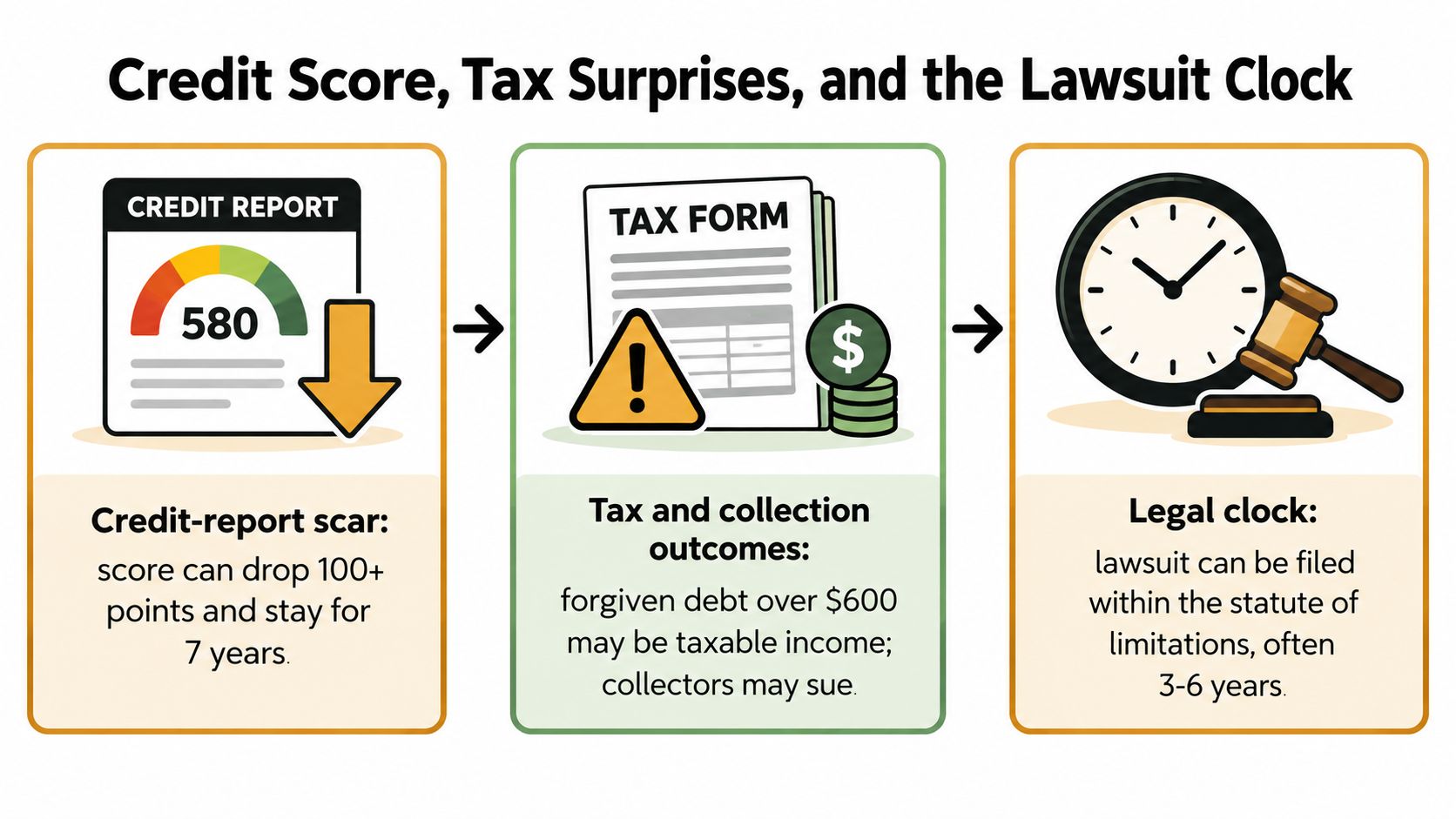
The illustration highlights the categories of downstream risk. Its numerical examples shouldn't be treated as a personal score prediction or a universal legal deadline.
Separate credit reporting from collection rights
A charged-off account can remain a serious negative credit-report item for up to seven years, according to consumer-credit guidance on missed card payments. That reporting period isn't the same as the legal deadline for filing a collection lawsuit.
There's no responsible universal prediction for how far a borrower's score will fall. The sensible response is to review the actual reports, preserve payment records, and challenge inaccurate information rather than rely on a promised score recovery.
- Verify the demand: Review the collector's written validation notice and compare it with saved statements.
- Document a settlement: Obtain the amount, payment deadlines, treatment of the remaining balance, and proposed reporting in writing.
- Investigate the legal clock: Ask a consumer attorney which state law applies and whether a payment or acknowledgment could affect an old debt's enforceability.
Document rule: A reassuring phone conversation isn't an adequate settlement record.
Treat taxes and court papers as separate tasks
Canceled debt can create a tax question, including whether a Form 1099-C or a tax exception applies. A borrower should ask a qualified tax professional about the proposed cancellation before treating a settlement discount as the full savings.
A lawsuit requires prompt legal review, not another round of informal budgeting. Court papers need attention even while settlement discussions continue; an assumption that the debt is old or unaffordable isn't a response to a filing.
For additional context, the following video can accompany a review of the account's documents and professional advice.
Choosing Between Minimums, Hardship, Settlement, and Bankruptcy
The right option is the one the household can sustain after essentials, with its full costs understood. A payment that preserves current status but repeatedly causes a food or rent shortage isn't a workable plan.
The Philadelphia Fed reported that the share of active card accounts making only minimum payments reached a 12-year high in Q4 2024 before declining in Q1 2025, in its large-bank credit-card performance update. Minimum payments can maintain current status, but they don't establish that the debt is becoming affordable.
Compare the complete outcome
| Option | Total cost and resolution | Credit and lawsuit considerations | Essentials test |
|---|---|---|---|
| Continue minimums | Ongoing interest can make repayment prolonged | Maintaining current status avoids further delinquency progression | Works only when minimums fit without recurring shortages |
| Issuer hardship plan | Compare the offered rate, payment, duration, and remaining balance | Obtain reporting and account-restriction terms | Useful when the revised payment is genuinely affordable |
| Nonprofit counseling | Request all fees and a written repayment projection | Ask which creditors participate and how accounts are treated | A structured plan still needs room for necessary expenses |
| Settlement | Compare the settlement amount, fees, and possible tax cost | Existing delinquency and collection exposure require review | Don't fund a deal with rent money or an unaffordable loan |
| Bankruptcy consultation | Evaluate legal costs, eligibility, assets, and potential debt relief | A lawyer should explain credit consequences and lawsuit handling | Relevant when repayment cannot coexist with basic necessities |
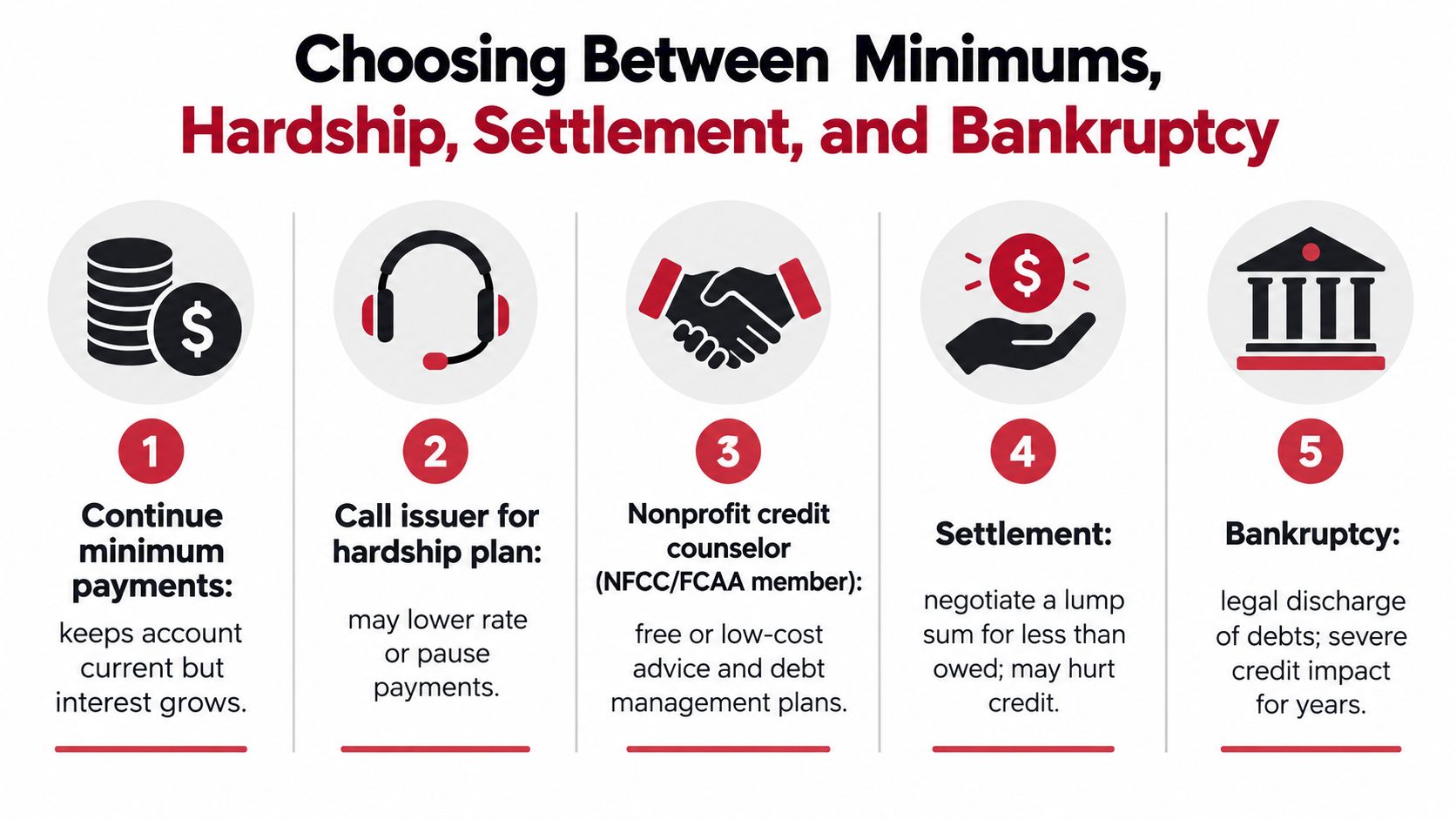
The illustration offers a compact comparison; the written terms of a specific proposal should decide the choice.
Match the solution to the cash-flow problem
For a temporary income disruption, issuer hardship assistance deserves the first inquiry. A borrower should ask whether reduced pricing or payments are available and whether the offer changes account access.
When income is stable but multiple card payments are disorganized or expensive, a nonprofit counselor can help compare a structured repayment proposal. An NFCC or FCAA member agency is an option to investigate, and this overview of credit counseling services can help prepare questions.
Settlement deserves scrutiny when full repayment isn't realistic but an affordable settlement fund exists. A borrower considering tax-related obligations can also consult Tax Attorney Stephen A Weisberg on tax as a resource for framing questions about tax-debt settlements, not as a substitute for advice about the particular card cancellation.
For a household with no sustainable repayment surplus, a bankruptcy consultation should happen before years of unaffordable promises. A lawyer can compare Chapter 7 and Chapter 13, eligibility, asset treatment, and remaining obligations. Bankruptcy isn't a budgeting failure, and settlement isn't automatically cheaper once every cost is counted.
Prioritizing Bills When You Cannot Pay Everything
A borrower choosing between groceries and an unsecured card payment needs a defensive budget, not a lecture about credit scores. Basic necessities come before extra card principal, and sometimes before card minimums.
The St. Louis Fed found that credit-card delinquency rose 63% in the lowest-income 10% of ZIP codes versus 44% in the highest-income 10% from Q2 2021 to Q1 2025, in its analysis of the continuing rise in delinquent card debt. Those are community-level comparisons, not a diagnosis of an individual borrower's decisions.
Rank the consequence of nonpayment
The strongest general hierarchy protects housing, food, medicine, essential services, and transportation needed for work or care. Secured loans, taxes, and legal obligations need separate attention because the consequences can differ sharply from those of unsecured cards.
The checklist below provides a starting point, not a rigid order for every household.
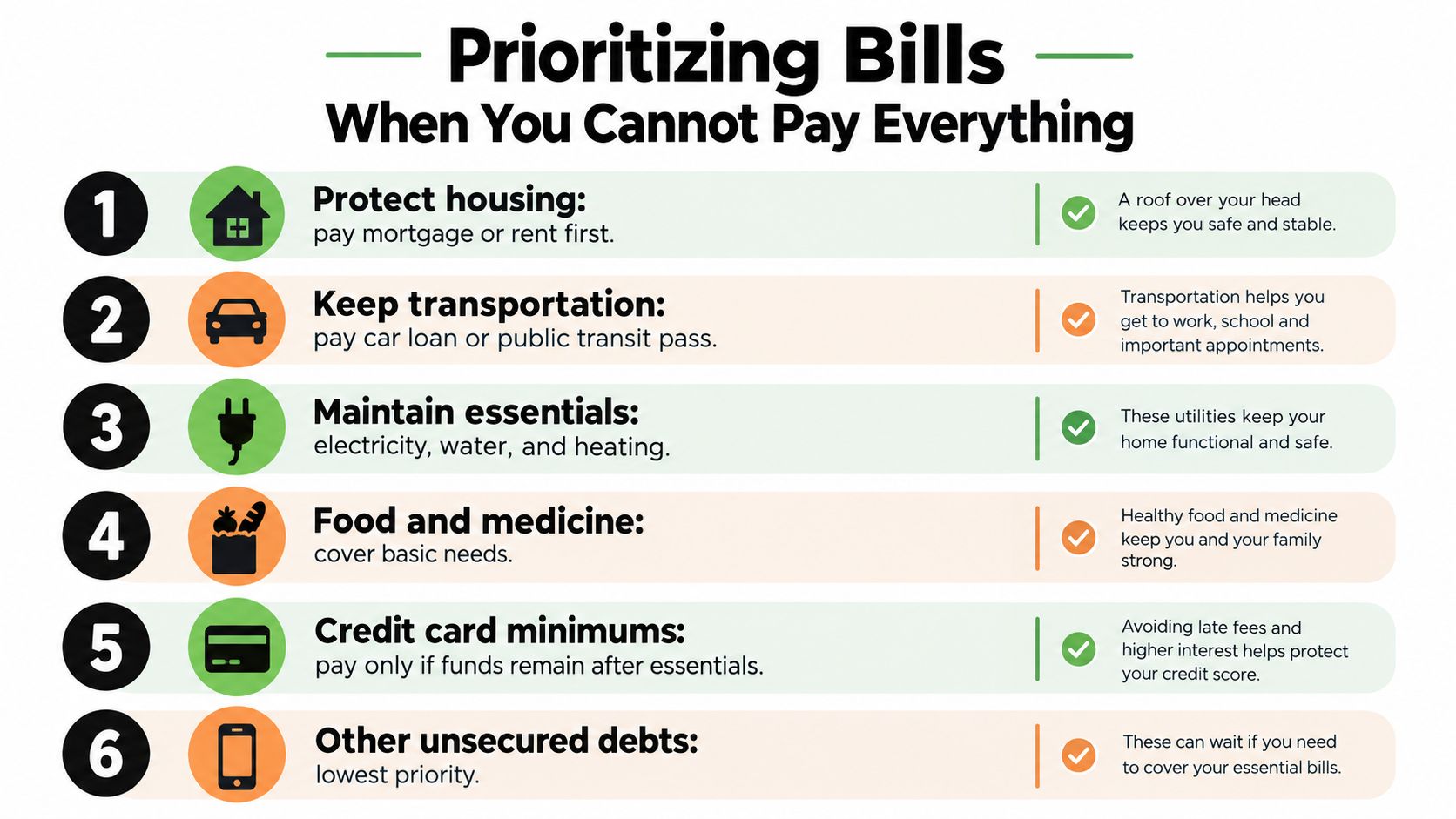
- Protect immediate necessities: Budget for food and required medication alongside housing and essential utilities.
- Preserve necessary transportation: Distinguish a vehicle needed for employment from a cost the household can reduce.
- Review urgent obligations: Seek advice about tax notices, secured-loan arrears, and any threatened loss of essential services.
- Allocate remaining card money deliberately: Obtain cure amounts and hardship terms before dividing a limited surplus.
For example, a borrower facing a utility shutoff shouldn't send extra principal to a current card while ignoring that notice. Local protections and eligibility vary, so emergency assistance programs deserve investigation before the household assumes no help exists.
Prepare the issuer call
A written call sheet should contain the reason for the shortfall, the affordable payment, and the requested accommodation. The borrower should ask for the hardship or payment-assistance department and record the representative's name and the conversation date.
Useful questions include whether the offer stops delinquency aging, changes the APR, restricts the card, requires automatic withdrawals, or leaves a catch-up payment later. No unaffordable debit authorization should be accepted merely to end an uncomfortable call.
An affordable promise is more useful than an impressive promise that fails before the next paycheck.
Paying one card doesn't cure another card's delinquency. A borrower should review each agreement rather than assume identical reporting or cross-default treatment across issuers.
A counselor can help coordinate negotiations. A consumer attorney becomes the priority when litigation appears, and a bankruptcy lawyer deserves consideration when no proposed repayment plan leaves essentials covered.
Your 30-Day Plan to Get Ahead of Default
A 30-day plan should produce a documented decision, not merely a cleaner spreadsheet. Every account needs a status, an affordable proposed action, and a follow-up date.
By year-end 2024, the CFPB reported delinquency rates of 3.0% for general-purpose cards and 3.8% for private-label cards, alongside its discussion of higher card delinquency and lender risk-taking. Different card categories and borrower circumstances make account-specific action more useful than generic reassurance.
Start with inventory and communication
The opening week should focus on records: statements, collection notices, credit reports available through AnnualCreditReport.com, and a household cash-flow list. Each debt entry should include its balance, APR, required payment, oldest unpaid due date, and current owner.
During the next week, the borrower should contact issuers and compare written proposals. Calls shouldn't be postponed until a complete emergency fund exists; meanwhile, a modest cash buffer can be built when income permits.
- Record the next consequence: Identify the upcoming due date, reporting threshold, collection deadline, or court deadline.
- Save the evidence: Keep notices, proposed agreements, payment confirmations, and call notes together.
- Escalate immediately when necessary: Legal papers or threatened loss of an essential asset shouldn't wait for the calendar's final week.
Select a path and monitor it
The following week should produce a choice: resume affordable repayment, accept a sustainable hardship arrangement, investigate counseling, negotiate a documented settlement, or obtain legal advice. Comparing total cost is useful only after rejecting options that the household can't fund.
The final week should establish calendar alerts and a recurring cash-flow review. Automatic minimum payments can help when funds are reliably available, but they shouldn't be enabled blindly on an account whose withdrawal could crowd out necessities.
For example, a worker with variable pay might use reminders and confirm the available bank balance before authorizing each payment. A household with predictable income may find carefully funded autopay simpler.
The essential habit is reviewing upcoming obligations before money leaves the account. The immediate goal is stable cash flow and a repeatable plan, not a promise of instant credit repair.
Toya AI offers a dashboard that centralizes balances, APRs, utilization, and due dates, with adaptive payoff planning that compares payment choices and projected interest costs. For households addressing default risk, it can complement issuer arrangements and professional advice by making the repayment picture easier to track. Readers can visit Toya AI to start organizing their debts and build a plan around the cash available.
Ready to start your debt-free journey?
Toya AI builds a personalized payoff plan so you can see your debt-free date and save on interest.
Get Started Free