
Debt Payoff Calculator with Extra Payments: How It Works
The credit-card payment has cleared, but the balance still looks stubbornly familiar. There may be enough room in the household budget for an extra payment, yet sending that money without knowing its effect can feel like guessing.
A debt payoff calculator with extra payments turns that guess into a comparison. A useful calculation answers two separate questions: how much extra gets paid, and where the lender applies it. It should also distinguish a dependable monthly surplus from a tax refund or bonus that arrives on a particular date.
Table of Contents
- Payoff Results With Extra Payments at a Glance
- How Extra Payments Cut Interest Over Time
- Model Your Own Payoff Scenario
- Plan Irregular Cash Flow as Lump Sums
- Fixed Payments Versus Percentage Minimums
- Avalanche or Snowball for Your Extra Money
- Confirm Where Each Extra Dollar Actually Lands
Payoff Results With Extra Payments at a Glance
Baseline vs extra payment on a $5,000 card at 18% APR
The Calk-USA credit-card payoff example reports the following comparison for a $5,000 balance at 18% APR, with no new purchases: increasing the monthly payment from $100 to $150 cuts repayment by 47 months and saves $2,327.58 in interest.
| Scenario | Monthly payment | Payoff time | Total interest |
|---|---|---|---|
| Baseline | $100 | 94 months | $4,311.18 |
| Extra payment | $150 | 47 months | $1,983.60 |
| Difference | +$50 | 47 months sooner | $2,327.58 less interest |
The extra payment doesn't merely remove an equivalent amount from the end of the schedule. It reduces the balance sooner, changing the interest charged during the remaining repayment period.
These figures describe a fixed-payment comparison, not a promise about every cardholder's minimum payment. The estimate assumes a fixed APR, no new charges, and no fees. Actual results can differ with payment timing, interest calculations, or account changes.
What a useful calculator needs to show
The basic inputs are straightforward:
- Balance: The amount currently owed, taken from the latest account information.
- APR: The annual percentage rate that applies to that balance.
- Monthly payment: The total amount scheduled for payment, with the extra portion identified separately.
The useful outputs are the payoff date, total interest, and interest saved relative to a baseline. A calculator also needs a starting date to translate repayment time into a calendar date.
A single projection isn't enough. A debt-free date might look encouraging, but without a required-payment baseline beside it, the borrower can't tell how much the proposed extra payment improves the outcome.
Reading rule: When the payoff date moves meaningfully earlier, the extra amount is doing measurable work. When it barely moves, the rate or the size of the balance may deserve more attention.
The baseline should match the account's actual payment arrangement. Calling a fixed payment a minimum when the issuer uses a changing formula can make an otherwise tidy comparison misleading.
How Extra Payments Cut Interest Over Time
For an interest-bearing loan, the payment generally covers accrued interest before the remainder reduces principal, the amount borrowed that remains unpaid. An extra payment helps only to the extent that it reaches principal under the account's rules.
The following visual illustrates the relationship between additional payments, repayment time, and total interest.
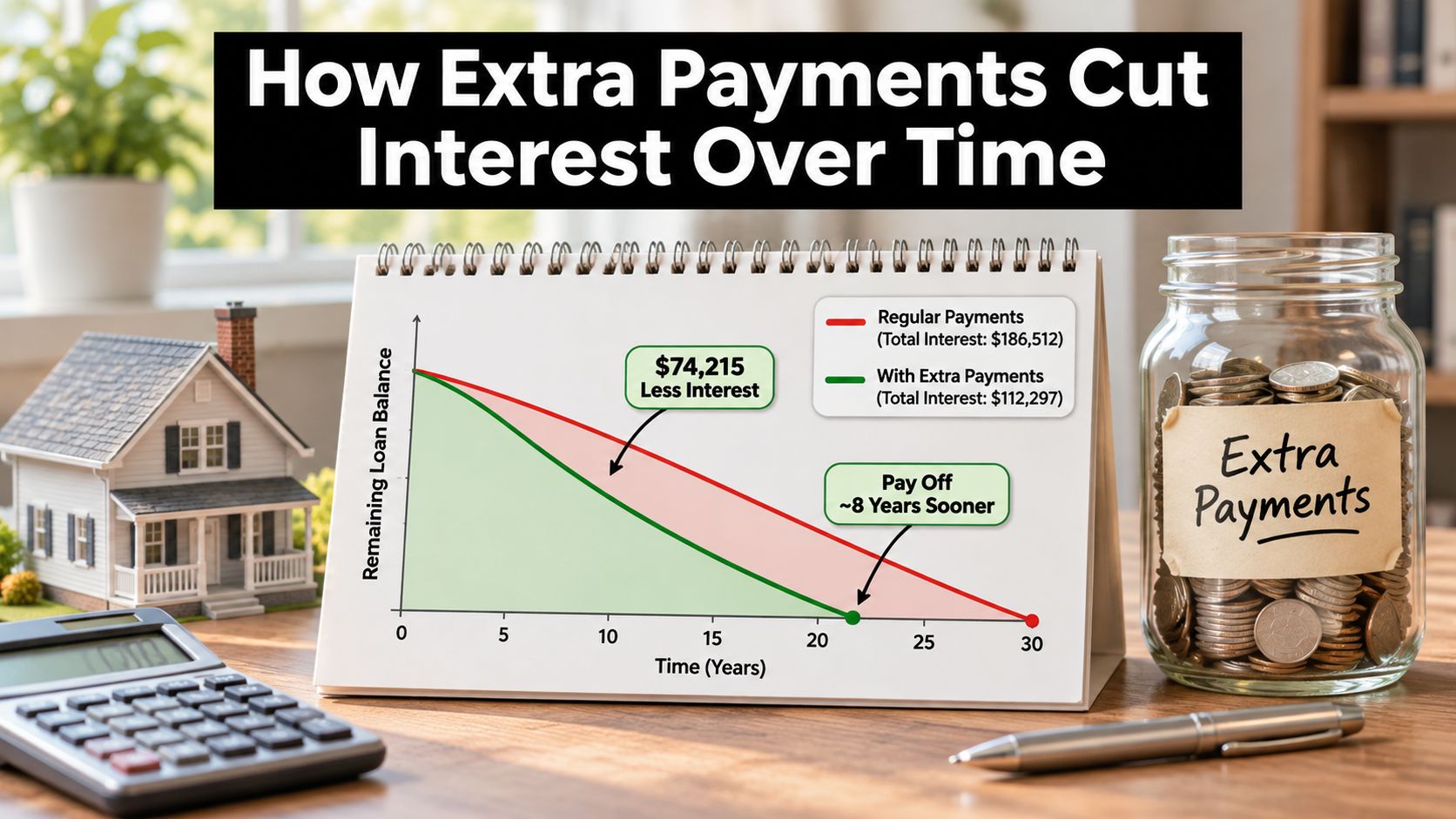
A leaking bucket offers a useful analogy: interest represents money lost through the leak, while reducing principal lowers the water level so less escapes. Financially, the sequence is precise: a smaller principal balance produces less subsequent interest, leaving more of the next unchanged payment available for principal.
Why the payment date matters
Using the daily-interest method described by Federal Student Aid, $20,000 × 6% ÷ 365.25 produces approximately $3.29 in daily interest before payments or capitalization. Federal Student Aid also explains that borrowers may pay early or pay more than the amount due, which can reduce total interest and loan cost.
For a daily-interest loan, an earlier principal reduction changes the balance used in later interest calculations. A calculator that treats every extra payment as arriving at the end of the month may therefore miss part of the timing effect.
A payment schedule should make those mechanics visible:
- Payment date: When the lender receives and credits the money.
- Principal allocation: How much remains after applicable interest and other amounts.
- Interest savings: The difference from the otherwise identical baseline.
The accompanying video offers another way to follow the payoff process.
This mechanism matters especially for revolving credit, where a borrower can keep carrying a balance while making payments close to the minimum. The important distinction is between making a payment and making sustained progress against principal.
Model Your Own Payoff Scenario
A reliable model starts with statements and a realistic budget, not an ambitious target. A borrower should be able to explain every input and identify which assumptions might change.
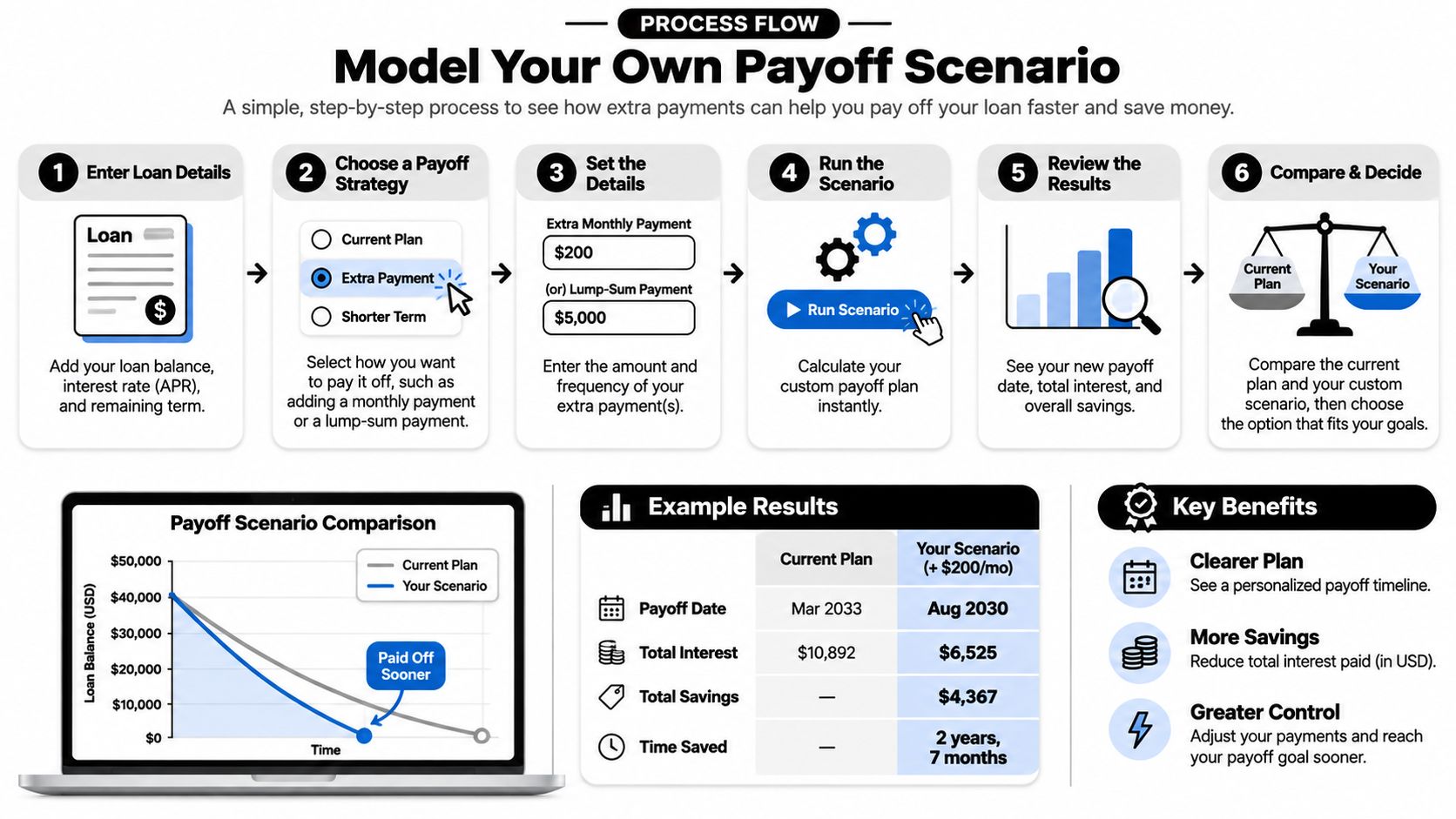
The process below separates gathering account details from choosing an affordable payment.
Build a plan that can survive ordinary expenses
List each account separately. Record the balance, APR, minimum payment, and due date from current statements. For a card with a percentage-based minimum, record the formula rather than only the amount due this month.
Choose a sustainable extra amount. The starting figure should come from money left after essential bills and planned expenses. If overtime is uncertain, it belongs in an optional-payment scenario rather than the permanent monthly commitment.
Run the required-payment baseline. Save its payoff date and total interest. This establishes the comparison without assuming any extra money will become available.
Add the recurring extra payment. Record the revised results and inspect the schedule, not just the headline savings. A plan that requires payments during months when cash is already tight needs adjustment.
Compare allocation methods. Run avalanche and snowball using the same accounts and total budget, while preserving every required payment. Changing the budget between runs prevents a fair comparison.
Protect a cash buffer. Review upcoming bills and emergency savings before committing the surplus. Paying extra only to borrow again for an ordinary expense can undermine the plan.
Separate estimates from account execution
Toya AI calculates a debt-free date based on current payments; its value preview calculator gives a quick estimate from three numbers, while connecting accounts in the app gives exact results from account data. It builds a payoff plan from existing accounts and doesn't consolidate or move debt. Even with accurate account information, future outcomes still depend on payments, rates, and borrowing remaining consistent with the projection.
The slip most likely to break a projection is an extra payment that the household can't maintain. New card purchases create another problem: the model assumes debt reduction while the borrower is adding fresh borrowing.
A practical starting action is to model the largest card using its balance, APR, and current payment. Before sending extra money, the borrower should confirm allocation instructions with the lender and save the baseline for later comparison.
Plan Irregular Cash Flow as Lump Sums
Not every household has a dependable monthly surplus. Tax refunds, overtime, side-gig earnings, and bonuses arrive unevenly, so a model should place them on the calendar rather than spread them into an imaginary steady income.
The Accredited Debt Relief State of Debt survey reports that 21% of indebted respondents took on extra work, overtime, or a side gig, while 39% paid more than the minimum during the previous year. Those patterns support testing optional payments separately from recurring commitments.
Compare a monthly plan with a dated payment
Consider a hypothetical $5,000 card at 18% APR, a $100 starting required payment, a $1,200 tax refund applied in April, and $75 extra monthly after that. These are scenario inputs, not a calculated payoff result.
| Model | Payment treatment | Purpose |
|---|---|---|
| Baseline | Actual required-payment rule only | Establish the comparison |
| Monthly extra | Required payment plus the recurring extra | Test the sustainable commitment |
| Combined | Same monthly plan plus the dated refund | Isolate the lump sum's effect |
The borrower should enter the refund as a separate event with its expected posting date, then compare payoff month and total interest across the models. Under otherwise identical conditions, an earlier principal reduction leaves less balance exposed to later interest than the same payment made near the end.
A cash-flow forecast helps establish whether the money is available after upcoming expenses. It also prevents assigning the refund to both the lump sum and the monthly extra.
Expected money isn't available money. A refund-based payment should remain conditional until the funds arrive.
For variable-income households, a hybrid plan can be more workable than a large fixed commitment: a modest recurring extra payment, supplemented by dated payments in stronger months. The lender's treatment of those payments still needs confirmation before projected savings become part of the household plan.
Fixed Payments Versus Percentage Minimums
A credit-card minimum doesn't necessarily stay the same. When the issuer calculates it partly from the remaining balance, the required dollar amount can shrink as repayment progresses.
That distinction matters, but so does checking a calculator's arithmetic. The CalcLibrary debt-payoff example publishes the following figures for a $5,000 card at 18% APR; its stated $150 fixed-payment result of 24 months and $989.13 interest is inconsistent with that payment amount and shouldn't be treated as a validated projection.
Fixed payment vs percentage minimum on a $5,000 card at 18% APR
| Scenario | Payment rule | Payoff time | Total interest |
|---|---|---|---|
| Fixed payment | $150 a month | 24 months | $989.13 |
| Percentage minimum with extra | 3% of opening balance, $25 floor, plus $100 extra | 37 months | $1,294.67 |
These are the publisher's reported results, not a reliable like-for-like comparison. A schedule cannot repay the stated starting principal within the reported fixed-payment period using the stated monthly amount, even before accounting for interest.
Check the rule, then check the schedule
The useful distinction remains fixed dollars versus a changing minimum. Under the percentage-style rule shown, the percentage applies to the balance before that month's interest, subject to the floor. As that opening balance falls, the percentage portion can decline.
For a cardholder, the practical checks are:
- Match the statement formula: Include the issuer's floor and any other components instead of substituting a convenient fixed amount.
- Separate minimum and extra: Determine whether the calculator adds the extra to a changing minimum or holds the total payment constant.
- Inspect total payments: The schedule must repay principal as well as interest. A favorable headline can't override that basic check.
- Account for changes: New purchases, fees, promotional-rate expiration, and issuer-specific rules can invalidate an estimate.
Calculation check: A repayment schedule should reconcile the starting balance, payments, interest, and ending balance. If it doesn't, the output isn't ready to guide a payment decision.
A useful calculator should offer both payment modes. The borrower can then choose a fixed-dollar commitment that remains affordable and satisfies the required minimum, rather than unintentionally reducing the total payment whenever the minimum falls.
Avalanche or Snowball for Your Extra Money
Avalanche and snowball rules for the same three debts
For the example discussed in RightCapital's debt-management guidance, the balances are $1,000 at 29%, $4,000 at 18%, and $10,000 at 7%, with a $300 monthly surplus above minimum payments.
| Method | Extra goes to first | Freed payment rolls to | Main trade-off |
|---|---|---|---|
| Avalanche | $1,000 debt at 29% | $4,000 debt at 18%, then $10,000 at 7% | Lowest total interest |
| Snowball | $1,000 debt, smallest balance | $4,000 debt, then $10,000 | Faster early account closures |
This particular example has an important feature: both methods choose the same order. The smallest balance also has the highest APR, so switching the method alone shouldn't create a different result when all other assumptions stay identical.
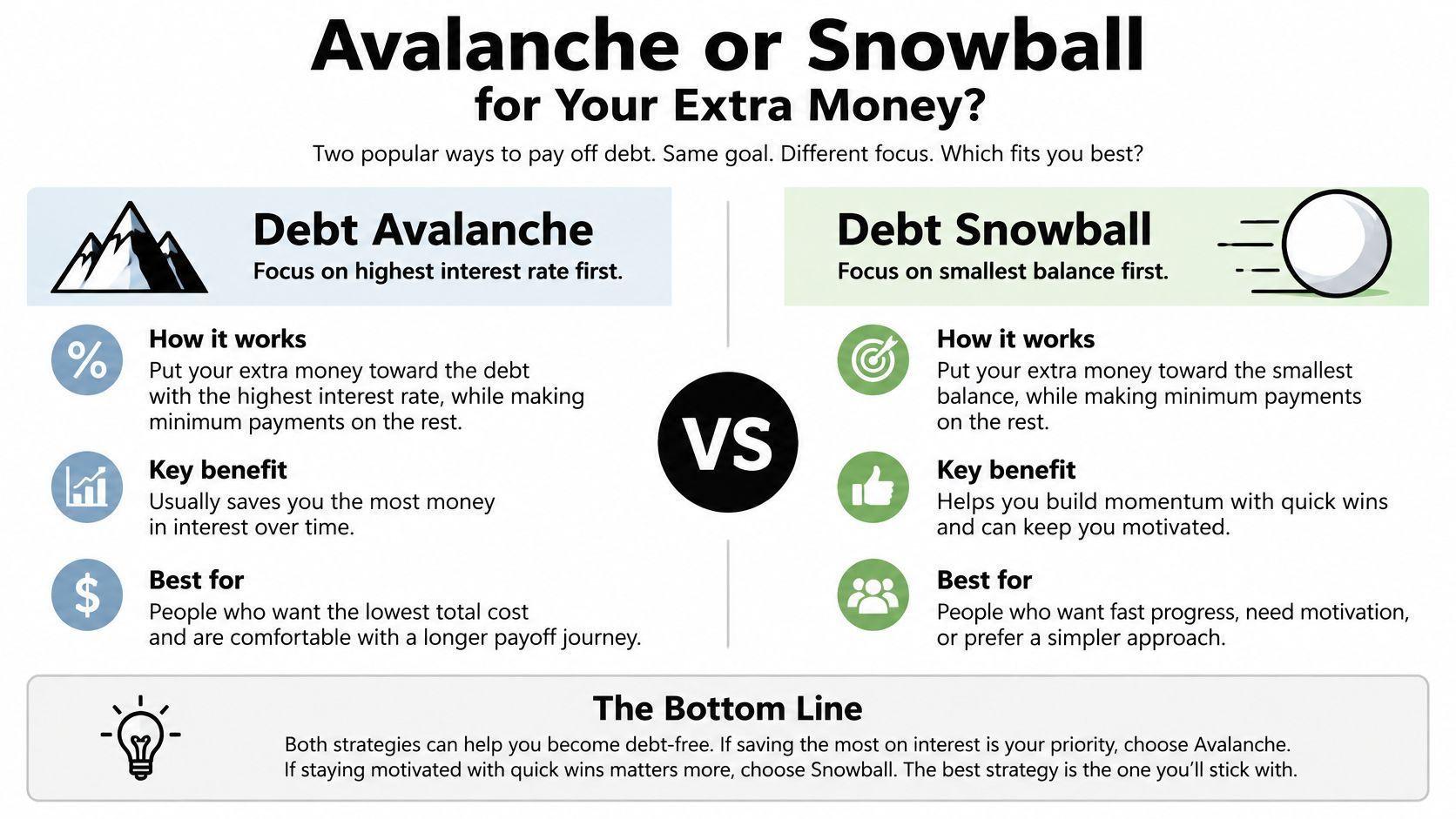
The visual distinguishes the rules even when their chosen targets happen to coincide.
When the choice actually changes the plan
Under avalanche, the borrower pays all minimums and directs the surplus to the highest-APR debt. Once that account is cleared, its former payment joins the surplus directed toward the next-highest-rate account.
Under snowball, the borrower targets the smallest balance instead. The attraction is an earlier account closure when that smallest account wouldn't have been the avalanche target.
The methods diverge when a smaller balance carries a lower rate than a larger balance. Avalanche prioritizes the more expensive borrowing; snowball prioritizes closing the smaller account. Under stable rates and otherwise comparable assumptions, avalanche minimizes interest mathematically, while snowball may be easier for a borrower who needs visible milestones to stay consistent.
A useful snowball-versus-avalanche comparison therefore looks beyond the method's name. It considers the cost difference, the expected timing of account closures, and whether the household can maintain the chosen order.
Keep the total budget consistent
The calculator should preserve minimum payments on every account under either approach. It should also roll the entire freed payment forward, rather than treating a closed account as permission to reduce the debt budget.
If the projected interest difference is small, the method a borrower can maintain may be the practical choice. If the difference is substantial, the additional cost of prioritizing early closures deserves deliberate consideration.
Confirm Where Each Extra Dollar Actually Lands
The mathematically optimal plan isn't automatically the plan the lender executes. Every extra payment has two parts: the amount sent and the balance that receives it.
For federal student loans, MOHELA's payment-allocation guidance explains that payments generally address past-due and current amounts, with accrued interest satisfied before principal; overpayments may be directed toward the highest-rate loan unless the borrower provides payment directions. Those rules illustrate why a calculator's assumed allocation needs to match the servicer's actual process.
Three situations that need closer attention
- Multiple student loans: A borrower may intend to target a particular loan while the servicer distributes the payment differently. Available payment directions should identify the intended loan.
- Cards with promotional balances: The currently displayed rate may not describe the cost after a promotion expires. Allocation across balances and the promotion's end date both matter.
- Accounts in arrears: Money described in a household budget as extra may first address overdue obligations rather than produce the intended principal reduction.
Understanding what a principal payment does helps distinguish a lower balance from an account that merely displays a later next-due date. Those aren't interchangeable outcomes.
Verify the payment after it posts
Before payment, the borrower should confirm the allocation rule and submit directions when the lender offers that option. Accounts in arrears need a plan to become current before optional overpayments elsewhere take priority.
After posting, the next statement should show how much went toward interest, fees, and principal, and which loan or balance received it. A moved due date alone doesn't prove that the intended principal reduction occurred, though principal reduction and an advanced due date can occur together.
The final check is operational, not theoretical: the actual account activity should match the modeled payment event. Fees and promotional expiration dates also need review, because either can change the payoff date.
Toya AI builds a personalized payoff plan from existing accounts and shows which debt should receive extra money and how that choice affects interest savings. Visit Toya AI to preview a debt-free date and compare a sustainable extra-payment plan before committing the next available dollar.
Ready to start your debt-free journey?
Toya AI builds a personalized payoff plan so you can see your debt-free date and save on interest.
Get Started Free