
Credit Card Payoff Calculator with Amortization Explained
A payment can leave a checking account every month while the credit card balance barely changes. That experience often feels like a budgeting failure, but the explanation is usually mathematical: interest takes its share before the remaining payment reduces the balance. A credit card payoff calculator with amortization makes that split visible, then turns a vague debt problem into a schedule that can be tested and adjusted.
The useful question isn't only, “What payment can be made?” It's also, “How much of that payment reduces principal, when do extra payments create the most savings, and what happens if the APR changes?” A static payoff estimate answers only part of that problem. An amortization schedule gives the rest.
Table of Contents
- Why Your Credit Card Balance Barely Moves
- Gathering Your Key Calculator Inputs
- Behind the Numbers How Amortization Works
- How to Read Your Amortization Schedule
- Making Strategic Decisions with Your Calculator
- From Calculation to Action Your Path Forward
Why Your Credit Card Balance Barely Moves
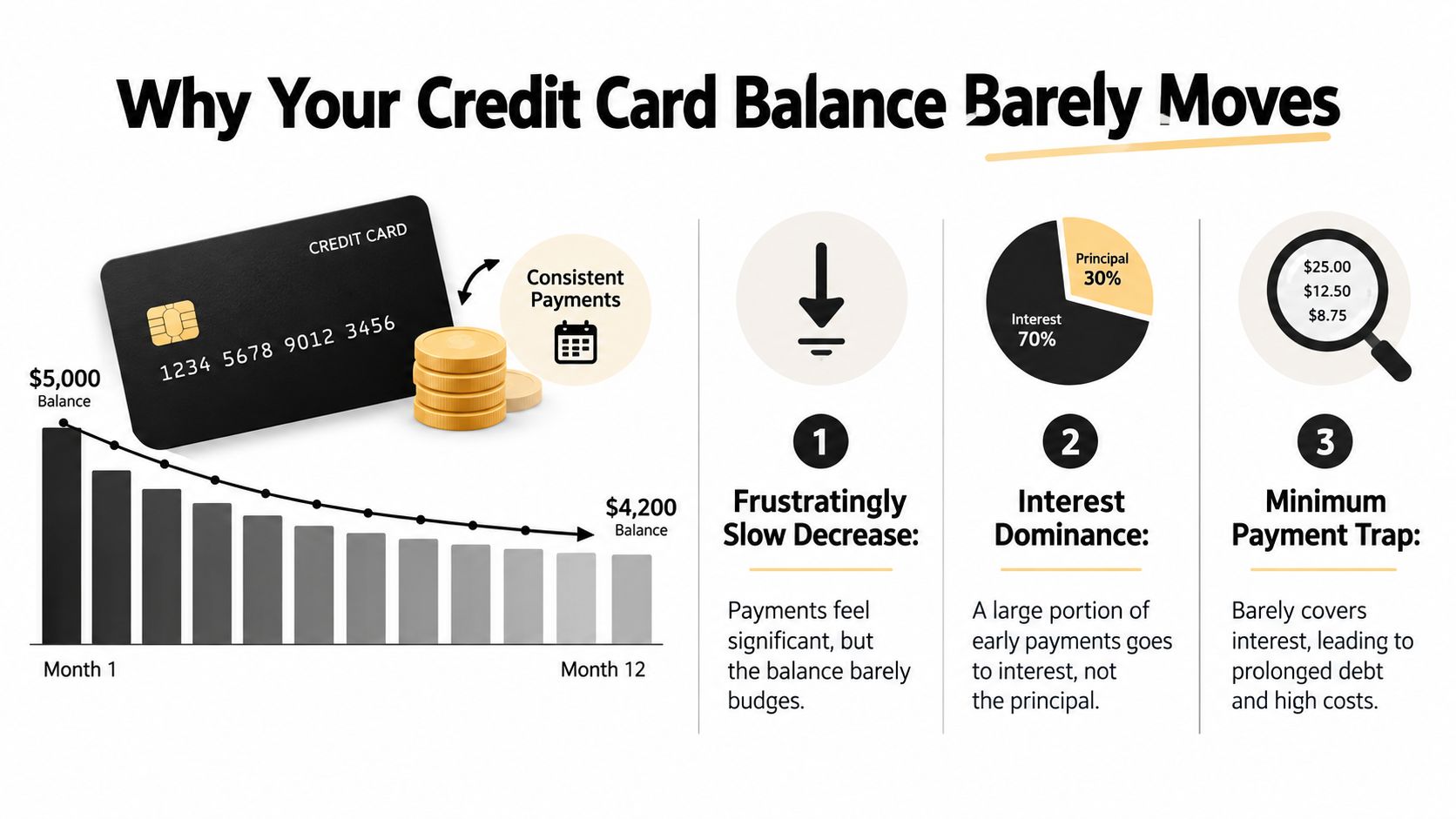
A cardholder may pay consistently and still see little progress because the payment covers interest before it attacks the borrowed balance. Credit card interest is calculated against the balance that remains, and revolving debt doesn't come with the same fixed end date as a typical installment loan. If the payment stays close to the interest charge, the principal falls slowly.
The borrowing environment makes that effect more severe. The Federal Reserve's G.19 Consumer Credit data put the average APR across all credit card accounts at 20.94% in May 2026, while balances actively accruing interest averaged 22.15%. At these near-historic highs, even a modest change in payment can materially alter the payoff timeline and total interest.
The payment has two jobs
Each payment performs two distinct tasks:
- Interest cost: This pays for carrying the balance during the billing period.
- Principal reduction: This lowers the amount on which future interest is calculated.
Suppose a payment is $200 and the issuer applies $90 to interest. Only the remaining $110 reduces principal. The exact allocation depends on the balance, APR, billing cycle, payment timing, and issuer rules. A clear explanation of how credit card interest works can help cardholders understand those mechanics before building a schedule.
Amortization is the map of that process. It lists the balance at the beginning of each period, the payment, the interest portion, the principal portion, and the new ending balance. The early rows often reveal why progress feels disappointing. Later rows show whether the plan is gaining momentum.
Practical rule: A payment plan isn't meaningful until it shows both the payoff date and the total interest paid.
Minimum payments can preserve the problem
Minimum payments may keep an account current, but they aren't necessarily designed to eliminate debt quickly. A calculator that models only a minimum payment can show a technically valid path while hiding how long the balance may persist.
The better approach is to compare the minimum with a fixed payment that fits the household's cash flow. That comparison turns frustration into a decision. It shows the cost of maintaining the current pattern and the benefit of choosing a deliberate repayment amount.
Gathering Your Key Calculator Inputs
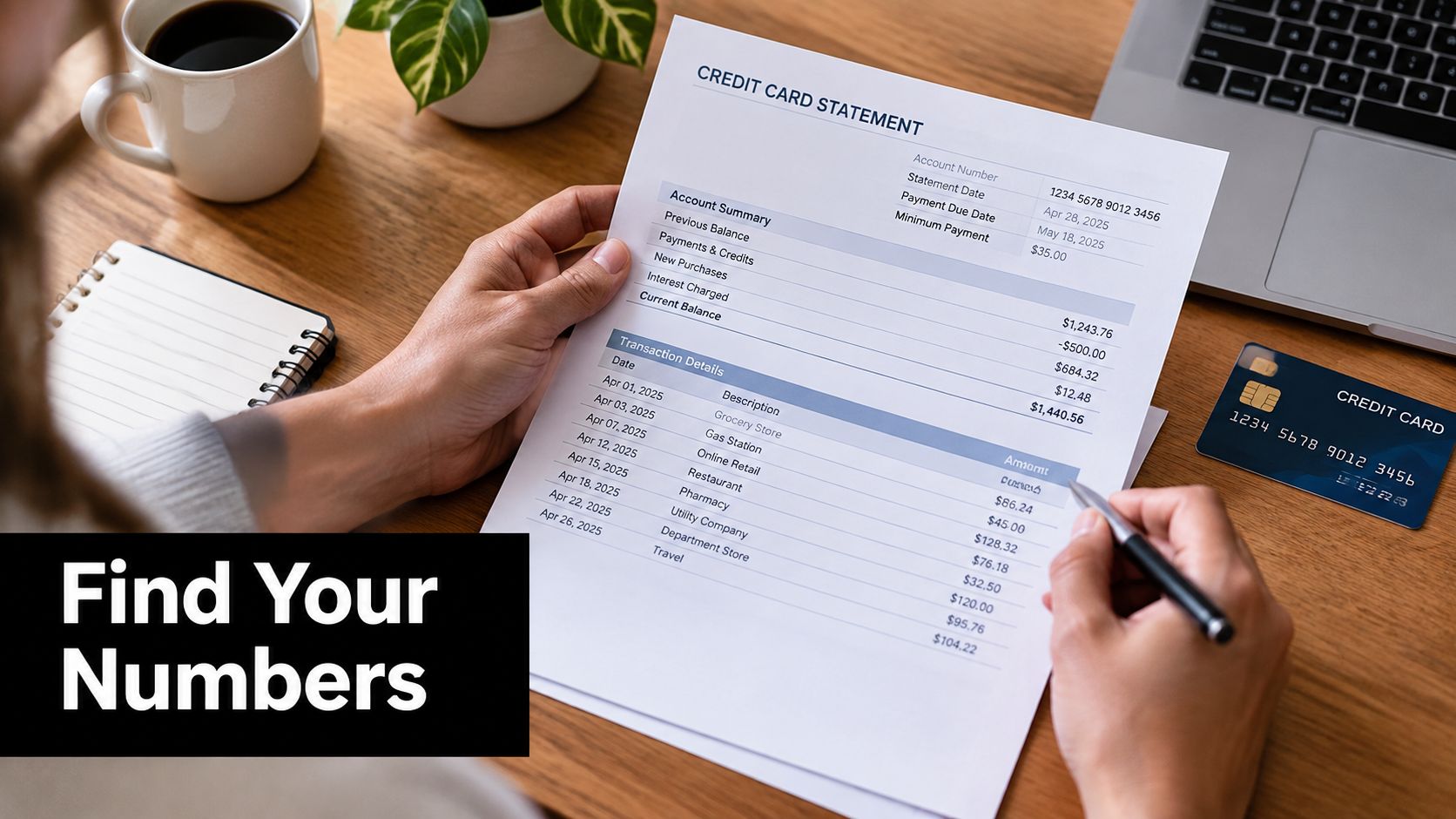
A payoff schedule is only as reliable as its inputs. Before opening a spreadsheet or calculator, gather the exact figures from the latest statement and account portal. Estimates can create a false sense of precision, especially when several cards have different rates or promotional terms.
Start with the current balance
Use the balance that matches the point the calculator is modeling. A statement balance works well for a statement-cycle plan, while a current balance may be more appropriate when the account has recent purchases, credits, or payments. Don't combine balances from different dates without recording the date for each figure.
Check for pending transactions, annual fees, returned payments, and recently posted interest. If the cardholder continues using the account, the schedule will be optimistic unless new spending is entered separately or the card is excluded from future purchases.
Record the APR accurately
The APR usually appears in the account terms or on the statement. Check whether the account has separate rates for purchases, balance transfers, and cash advances. A promotional rate should be entered with its expiration condition, not treated as permanent.
Variable APRs need a scenario rather than a single promise. A useful schedule can show the current rate as a baseline, then a higher-rate scenario to test resilience. The guide to understanding credit card APR helps distinguish the quoted annual rate from the practical cost of carrying a balance.
Choose the payment assumption
The calculator needs a payment amount, but the right input depends on the question.
- Minimum payment: Useful for exposing how long the existing pattern may last, but it can change as the balance changes.
- Fixed payment: Better for a controlled payoff plan because the schedule tests a consistent commitment.
- Irregular payment: More realistic when income varies, though the user must enter expected payment dates and amounts.
- Extra payment: Model this separately so the schedule reveals its effect instead of blending it into an unexplained total.
For a practical example, a cardholder might run one schedule using the current minimum, another using a fixed amount that fits monthly cash flow, and a third with occasional extra principal payments. The differences matter more than the first result. They show which plan remains workable when expenses rise.
Behind the Numbers How Amortization Works
Amortization follows a repeatable sequence. The calculator begins with the opening balance, calculates the period's interest, applies the payment, and assigns whatever remains to principal. The new balance becomes the starting point for the next period.
Consider a simple illustration with a $1,000 balance, a 24% APR, and a $50 monthly payment. This example is for understanding the mechanics, not a prediction of a particular issuer's daily-interest calculation.
Month one
A 24% annual rate can be represented as a 2% monthly rate for a simple monthly model.
- Opening balance: $1,000
- Monthly interest: $1,000 × 2% = $20
- Payment: $50
- Principal reduction: $50 minus $20 = $30
- Closing balance: $1,000 minus $30 = $970
The payment doesn't reduce the balance by the full $50 because $20 covers the borrowing cost for the modeled month.
Month two
The second month's interest is calculated against the lower balance.
- Opening balance: $970
- Monthly interest: $970 × 2% = $19.40
- Payment: $50
- Principal reduction: $50 minus $19.40 = $30.60
- Closing balance: $970 minus $30.60 = $939.40
The interest charge falls because the balance fell. That leaves slightly more of the same payment available for principal. Over time, this shift becomes the central story in the schedule.
Actual credit card calculations may use daily periodic rates, average daily balances, transaction timing, fees, and changing APRs. Users comparing credit card schedules with installment-loan estimates should therefore treat the output as a planning model and verify the issuer's terms. Those comparing broader borrowing costs can also find suitable loan terms before deciding whether a different product belongs in the analysis.
The most important row isn't the final one. It's the row that shows whether the plan keeps reducing principal under realistic conditions.
A good calculator should show the interest charge separately from the principal reduction. If it displays only a final payoff date, it hides the mechanism that makes strategic decisions possible.
How to Read Your Amortization Schedule
An amortization schedule is a sequence of financial decisions written as rows. The table below uses a $2,000 balance as a sample and shows the columns a user should expect. The entries are illustrative, and the schedule should be rebuilt with the cardholder's actual APR, payment, and issuer calculation method.
| Month | Beginning Balance | Payment | Interest | Principal | Ending Balance |
|---|---|---|---|---|---|
| 1 | $2,000.00 | $120.00 | $40.00 | $80.00 | $1,920.00 |
| 2 | $1,920.00 | $120.00 | $38.40 | $81.60 | $1,838.40 |
| 3 | $1,838.40 | $120.00 | $36.77 | $83.23 | $1,755.17 |
| 4 | $1,755.17 | $120.00 | $35.10 | $84.90 | $1,670.27 |
| 5 | $1,670.27 | $120.00 | $33.41 | $86.59 | $1,583.68 |
| 6 | $1,583.68 | $120.00 | $31.67 | $88.33 | $1,495.35 |
| 7 | $1,495.35 | $120.00 | $29.91 | $90.09 | $1,405.26 |
| 8 | $1,405.26 | $120.00 | $28.11 | $91.89 | $1,313.37 |
| 9 | $1,313.37 | $120.00 | $26.27 | $93.73 | $1,219.64 |
| 10 | $1,219.64 | $120.00 | $24.39 | $95.61 | $1,124.03 |
| 11 | $1,124.03 | $120.00 | $22.48 | $97.52 | $1,026.51 |
| 12 | $1,026.51 | $120.00 | $20.53 | $99.47 | $927.04 |
What each column reveals
Month identifies the payment period. It helps users compare the schedule with statements, due dates, and planned income.
Beginning Balance is the amount owed before the modeled payment and interest. If this figure doesn't match the actual account at the start of the plan, every later row will be distorted.
Payment shows the planned amount applied during the period. A fixed payment creates a clean comparison, while a minimum-payment model may change from row to row.
Interest shows the borrowing cost assigned to that period. In the sample, it declines as the balance falls. That doesn't mean the APR changed. It means the rate is being applied to a smaller balance.
Principal is the part that permanently reduces the debt. Comparing this column with Interest is one of the fastest ways to judge whether a plan is making meaningful progress.
Ending Balance becomes the next period's Beginning Balance. Rounding can create small differences, so the last payment may need adjustment.
Read the trend, not just the endpoint
The sample shows interest declining while principal reduction grows. That shift provides a practical progress signal. If the interest column stays high because payments remain low, the schedule is warning that the plan has little flexibility.
Long-term context matters because debt often remains in place far longer than users expect. A 2026 survey found that 61% of U.S. credit cardholders with debt had carried it for at least a year, while 21% had carried it for at least five years. The survey release supports using a long-range schedule rather than viewing only the next statement.
Making Strategic Decisions with Your Calculator
The calculator becomes useful when it compares choices, not when it produces one impressive payoff date. A strong process begins with a baseline, then changes one assumption at a time. The user can test a higher fixed payment, an extra payment, a different payment order, or a rate-change scenario.
Suppose a cardholder adds $50 per month to the planned payment. The exact savings depend on the balance, APR, payment timing, fees, and whether new purchases continue. The schedule should be compared row by row to identify the reduced interest in each period and the earlier month in which the balance reaches zero.
An extra payment can be modeled separately as well. The important question isn't merely whether it shortens the plan. The schedule should show when the payment creates the largest reduction in future interest, because reducing principal earlier gives subsequent interest calculations a smaller base.
Compare snowball and avalanche with actual inputs
The avalanche method directs extra money toward the card with the highest APR. The snowball method targets the smallest balance first, which can create a faster visible win. Neither approach should be selected from a generic slogan when the household has multiple cards, uneven cash flow, or delinquency risk.
Current debt conditions raise the stakes. The share of Americans with $10,000 or more in credit card debt reached 29% in 2026, while 41% faced APRs above 21%, according to Debt.com's 2026 credit card survey. A calculator can compare the interest cost of each order, while the budget determines whether the plan can survive a difficult month.
- Choose avalanche when: The highest-rate balance is receiving reliable extra payments and interest savings are the primary objective.
- Choose snowball when: A quick account closure supports follow-through and prevents the plan from collapsing.
- Protect cash flow first: A mathematically efficient plan fails if it leaves no room for essential expenses or predictable irregular bills.
A basic cash flow forecast can help determine whether an extra payment is available rather than borrowed from next month's necessities. For users who want additional guidance on directing payments above the minimum, extra principal payments offer a useful planning lens.
Toya AI is one option for automating this comparison. It can centralize account balances, APRs, utilization, and due dates, then model how different payments affect the debt-free date, monthly interest, and total cost. The value comes from keeping the plan adaptive when balances, rates, or cash flow change.
From Calculation to Action Your Path Forward
A payoff schedule turns debt from a monthly mystery into a sequence of decisions. The beginning balance shows the starting point, the interest column explains the drag, and the principal column shows whether the payment is creating lasting progress. Strategic scenarios then reveal which changes are affordable and which only look attractive on paper.
Two practical paths are available. A spreadsheet can track each card with columns for balance, APR, payment, interest, principal, and ending balance. A dedicated tool can automate account updates, compare scenarios, and reduce the manual work of revising a plan when a payment or rate changes.
The plan should be reviewed whenever a card's APR changes, a new balance is added, income shifts, or an unexpected expense affects the payment amount. Basic cash flow management tips can also help households protect the payment commitment while accounting for regular obligations.
The central habit is simple: don't judge progress only by the payment leaving the bank account. Check how much reached principal, how the next interest charge changed, and whether the projected payoff date still fits real life. That review creates control without requiring perfect forecasting.
Toya AI can organize debt details, model amortization scenarios, and recommend the next payment based on balances, APRs, timelines, and cash flow. Visit Toya AI to preview a payoff plan, connect accounts for more precise projections, and turn the next payment into a deliberate step toward becoming debt-free.
Ready to start your debt-free journey?
Toya AI builds a personalized payoff plan so you can see your debt-free date and save on interest.
Get Started Free