
How to Build a Credit Card Payment Plan
The card bills arrive on different days, payday doesn't line up neatly, and the household has enough cash to make progress, but not enough to pay everything off. Sending a little extra to every account feels responsible. Then a car repair lands, and the same cards have to cover it.
A credit card payment plan should solve that cash-flow problem, not just produce an impressive payoff date. The practical approach is to coordinate required payments, choose a deliberate payoff priority, and preserve enough cash that the next surprise doesn't erase the progress.
Table of Contents
- Why a Credit Card Payment Plan Matters
- Build the Foundation Before Paying Extra
- Choose an Avalanche or Snowball Order
- Understand Interest and Payment Floors
- Automate Your Plan With Toya AI
- Protect the Plan From Common Setbacks
- Review and Reset Your Payment Plan
Why a Credit Card Payment Plan Matters
Consider a household carrying a grocery balance, an older emergency expense, and a furniture purchase across different cards. Each statement looks manageable in isolation. Together, the due dates compete with rent, utilities, and the next grocery trip.
Without a coordinated plan, the household might send extra cash to the most noticeable bill while overlooking a more expensive balance. Or it might make an ambitious payment immediately after payday, leaving too little for expenses later in the month.
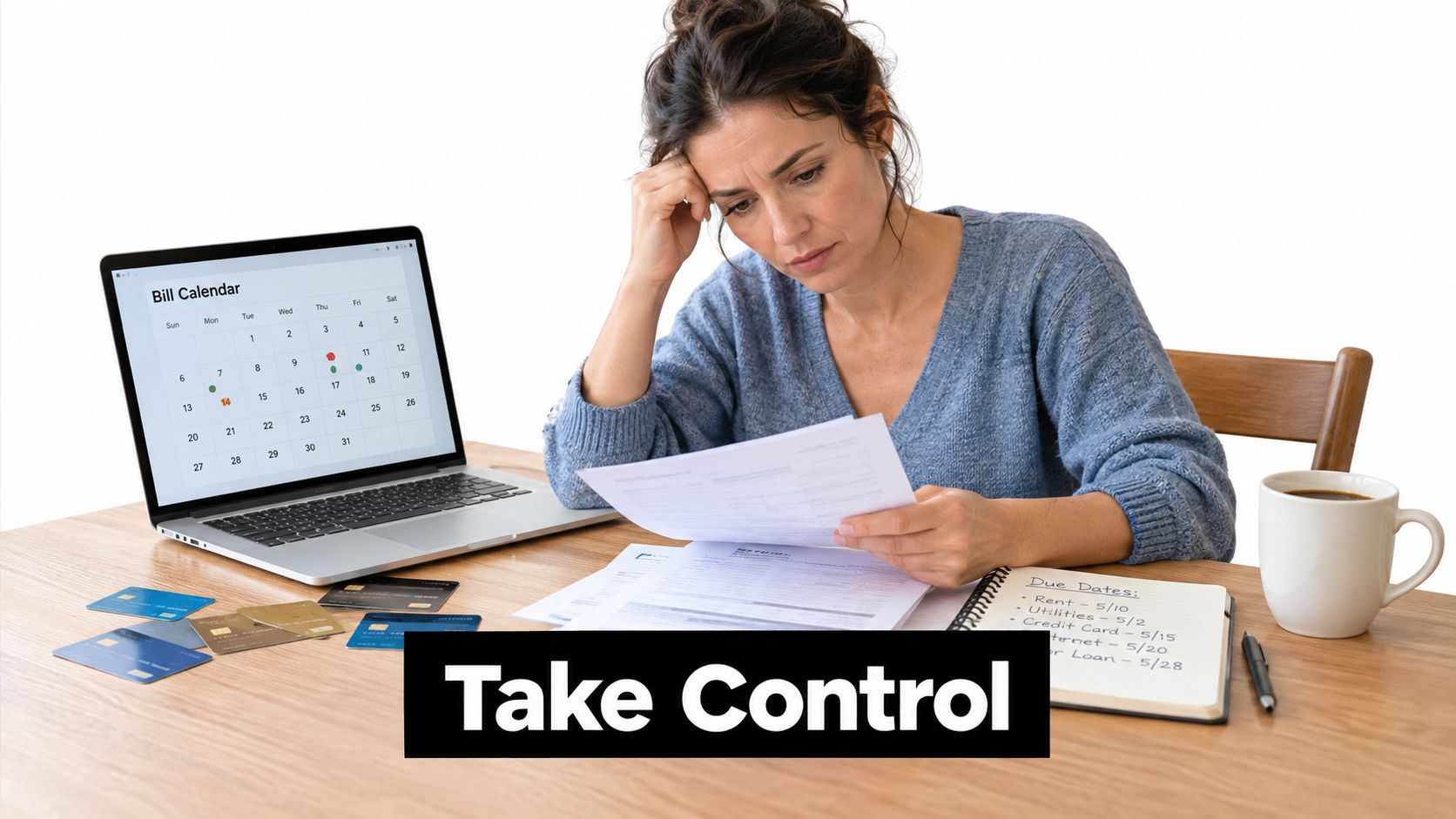
Put every obligation in the same view
A useful plan brings together balances, APRs, statement minimums, due dates, and available household cash. Those details answer different questions: what's owed, what it costs, what must be paid, when it must arrive, and what the household can afford.
The scale of the problem is substantial. U.S. credit card balances reached approximately $1.18 trillion at the end of March 2025, according to the Federal Reserve Bank of New York's household debt release.
For an individual household, though, the national total matters less than the next decision. An extra payment should have a clear destination and a clear funding source, rather than depend on whatever happens to remain in checking.
Practical rule: The strongest plan isn't automatically the fastest. It's the plan the household can maintain without creating another debt problem.
That distinction changes how success gets measured. Progress means reducing debt while keeping essential bills funded, accounts current, and new borrowing under control.
Build the Foundation Before Paying Extra
Start with the statements, not a payoff calculator. A projection based on incomplete balances or outdated minimums can look precise while describing a payment schedule the household cannot follow.
Gather the latest statement for every card and compare it with current account activity. Recent purchases, pending payments, and automatic charges belong in the working record.
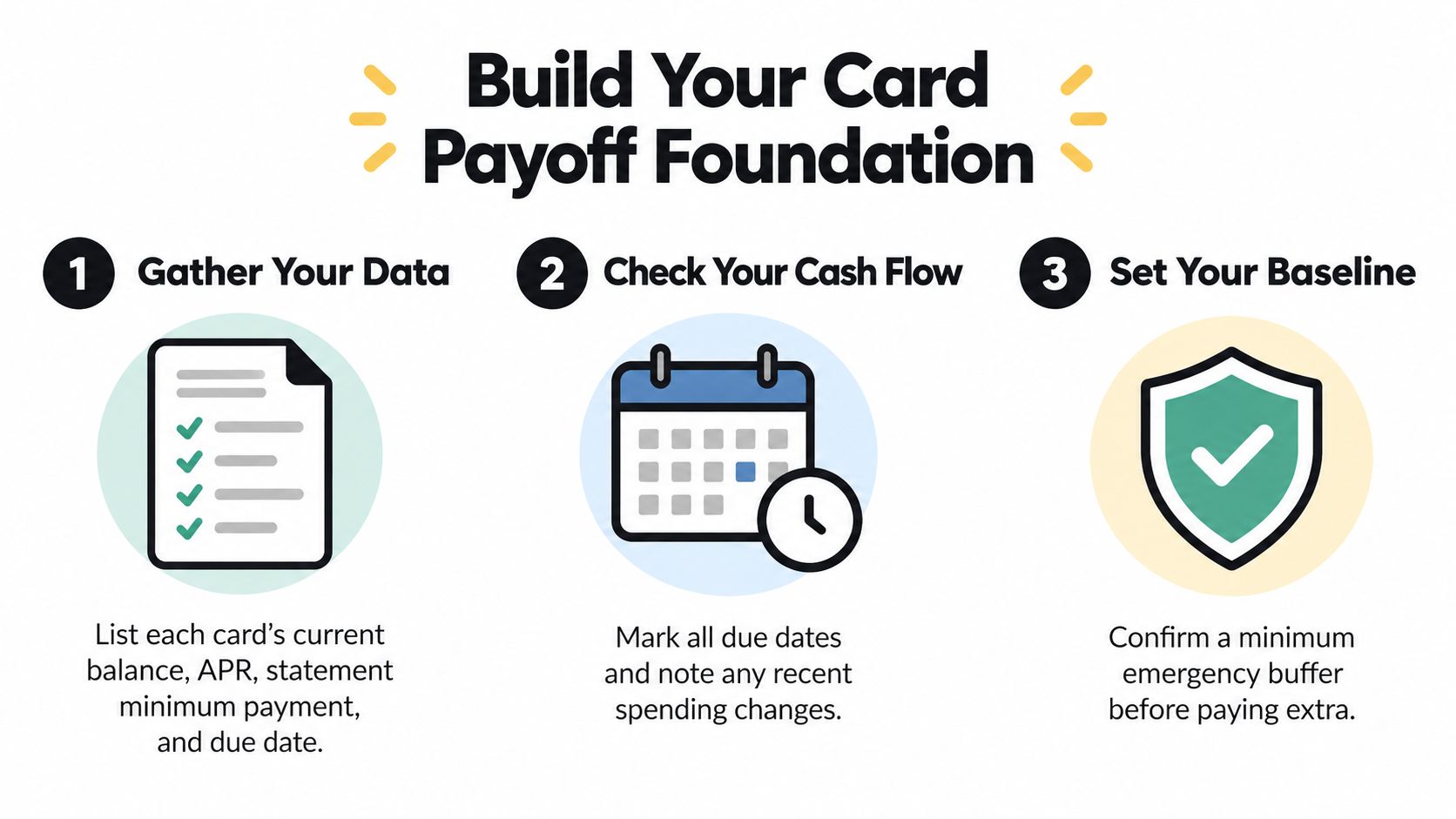
Establish the affordable baseline
- Gather account details: Record the current balance, APR, statement minimum, due date, and any existing automatic payment.
- Map essential spending: Reserve cash for housing, food, utilities, transport, insurance, and other unavoidable obligations.
- Check the calendar: Match deposits and withdrawals by date, rather than assuming a positive monthly total means cash is always available.
- Define a reserve: Set aside an accessible buffer before committing the remaining amount to accelerated repayment.
A cash-flow forecast is useful for this calendar check. The important question isn't just whether income exceeds expenses, but whether enough cash remains available when each obligation comes due.
Match the commitment to the paycheck
Consider hypothetical households with the same total card balances. A household receiving predictable salaries could commit to a regular extra payment after accounting for upcoming bills and its reserve.
A household relying on freelance work should use a more conservative baseline. It can assign additional cash after invoices are paid, rather than scheduling an aggressive withdrawal against income that hasn't arrived.
The balances may match; the safe payment commitments shouldn't necessarily match. Before approving either plan, test whether an urgent repair, medical bill, or reduced paycheck would force another card purchase.
Planned purchases also need a separate affordability decision. For a necessary household replacement, Willis Furniture & Mattress's furniture financing options can serve as a resource to review alongside the actual financing disclosures, not as a reason to expand an already strained budget.
The baseline should leave room for ordinary life. Money needed for a known expense isn't available for extra debt repayment.
Choose an Avalanche or Snowball Order
A borrower who keeps every account current still needs to decide where the extra payment goes. Spreading it evenly can feel fair, but fairness between card issuers isn't the objective. The objective is an affordable strategy that the borrower will continue using.
Avalanche prioritizes the highest-APR balance. Snowball prioritizes the smallest balance. Both require minimum payments on the remaining accounts.
Choosing a Card Payoff Order
| Method | Target After Minimums | Primary Advantage | Best Fit |
|---|---|---|---|
| Avalanche | Highest-APR balance | Reduces interest under otherwise comparable repayment conditions | Borrowers focused on cost who can maintain the strategy |
| Snowball | Smallest balance | Produces an earlier account-level payoff | Borrowers who need visible progress to sustain the habit |
When interest cost should decide
Consider a hypothetical card set containing a large, expensive revolving balance and a smaller balance with a lower APR. Avalanche sends the extra payment to the expensive balance, even though eliminating it will take longer.
That's the recommended default when the rate difference is meaningful and the borrower can stay consistent. Choosing the smaller balance first leaves the higher-cost debt outstanding while the borrower works elsewhere.
The comparison should use actual APRs, not assumptions about which card feels expensive. A store card, an older bank card, and a recently opened account shouldn't be ranked by brand or purchase history.
When a smaller payoff can help
In another hypothetical card set, a nearly cleared account sits alongside larger balances with similar rates. A borrower who repeatedly abandons long payoff efforts might choose snowball, clear the smaller account, and redirect its former payment toward the next target.
That's a deliberate trade-off, not a mathematical shortcut. The borrower accepts potentially higher interest in exchange for a simpler account list and a visible milestone.
Choose the method that supports consistent execution, but make the cost of that choice visible.
For mixed cases, compare projected interest and payoff timing before deciding. Keep the target stable unless account terms, affordability, or motivation materially change. Switching priorities whenever a different statement feels urgent makes the plan harder to evaluate.
Once a target is cleared, its payment should move to the next selected balance rather than disappear into general spending.
Understand Interest and Payment Floors
A payment can satisfy the issuer without reducing principal very much. The statement minimum is a billing requirement, not a recommended payoff strategy. Understanding that difference prevents a larger required payment from being mistaken for faster progress.
The illustration below separates interest cost from principal reduction. Actual charges depend on the account agreement and billing-cycle activity.
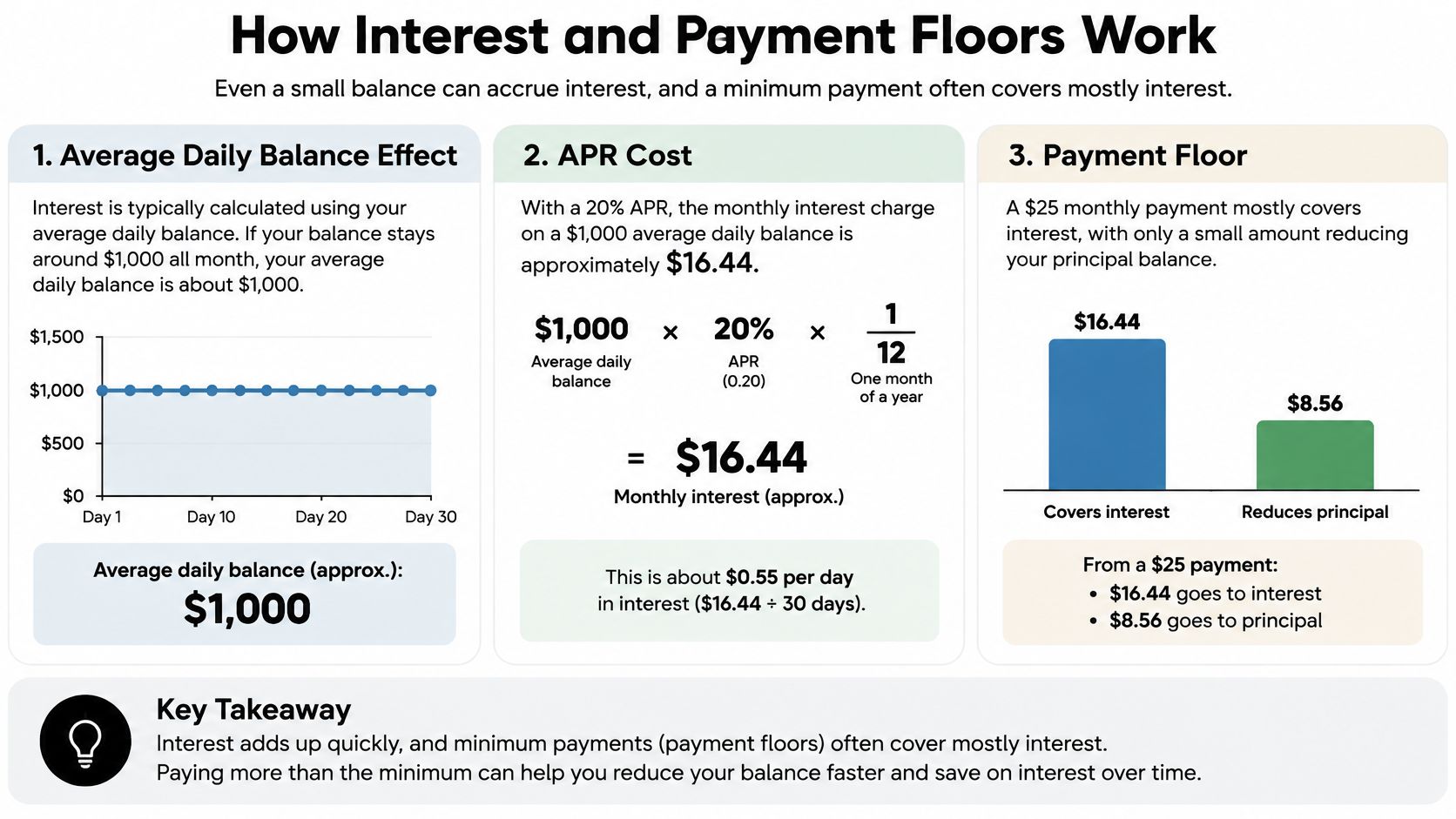
Read the cost behind the payment
Credit card interest commonly uses a daily periodic rate and average daily balance: at 24% APR, dividing by 365 gives approximately 0.0658% per day, so a $2,000 balance generates roughly $1.32 for a day before the issuer's exact calculation and compounding rules, as illustrated in Bankrate's explanation of credit card interest.
The practical implication is straightforward: payment amount and payment timing both deserve attention. A borrower carrying a balance should inspect the interest charge alongside the payment, rather than judge progress from the payment alone.
The guide to credit card APR provides additional context for comparing rates. For a retail financing account, resources such as Vinson Fine Furniture's eligibility and fees explained should be read alongside the specific account's disclosures.
Separate the required minimum from the chosen payment
In the United Kingdom, FCA minimum-payment rules require covered payments to include interest, fees, and charges plus 1% of the outstanding balance. That's a jurisdiction-specific rule, not a universal formula for every card.
The CFPB's sample minimum-payment warning illustrates the stakes: minimum-only repayment takes 10 years and costs $3,284, compared with $2,232 for a three-year payoff, saving $1,052.
- Use the statement benchmark: Compare the disclosed payoff payment with the household's affordable baseline.
- Check the agreement: Confirm how the issuer calculates minimums and applies payment floors.
- Track principal progress: Review whether the balance is falling after interest and new activity.
Those illustrative costs aren't a prediction for another account. The borrower's own statement should drive the calculation.
Automate Your Plan With Toya AI
A spreadsheet can organize a payment plan, and issuer portals can confirm balances and payment status. A connected planning app offers another option when maintaining several accounts manually becomes difficult.
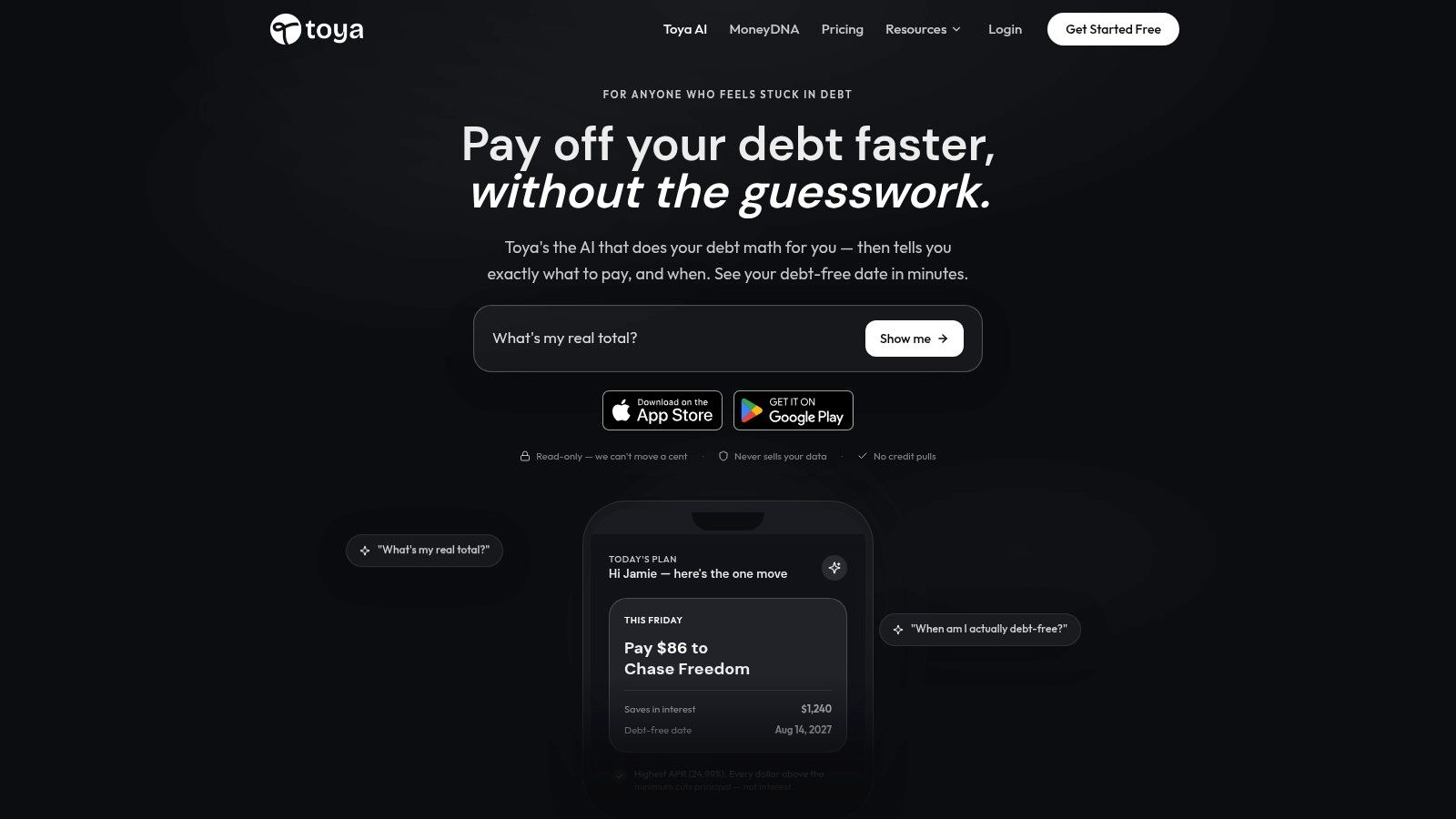
The dashboard below illustrates a centralized approach to reviewing debt.
Move from account data to payment decisions
Toya AI brings balances, APRs, utilization, and due dates into a central dashboard and recommends payment priorities based on debt and cash flow. Account connections use partners such as Plaid, Fincity, Spinwheel, and Quiltt; the service uses encrypted connections with read-only access and no credit pulls, and states that it never sells user data.
The workflow should begin with verification, not blind acceptance of a recommendation. Connected information still needs to be checked against statements, particularly when an account has recently changed.
- Preview the options: Use the calculator to explore a payment level before committing.
- Connect and verify: Review account details and projections against current lender information.
- Compare scenarios: Examine a faster payoff, a buffer-preserving payoff, and a conservative plan for uncertain income.
- Approve the affordable action: Choose the payment that remains workable after scheduled household expenses.
For example, a borrower might compare an aggressive payment with a lower payment that preserves cash for an upcoming repair. The aggressive option could show an earlier debt-free date and lower projected interest, while the balanced option leaves less need to borrow again if the repair becomes urgent.
The borrower should select the sustainable option, not automatically the earliest date. Projections describe outcomes under assumptions; they don't guarantee future income, expenses, or payoff results.
Keep recommendations separate from execution
Free access supports tracking and planning. Pro adds AI-powered optimization and next-best-action guidance, while automated payments and rewards are described as upcoming features.
Read-only account access isn't payment authorization. Until a payment capability is available and explicitly enabled, borrowers should submit payments through their lenders and verify that they posted.
The product walkthrough provides additional context for that planning workflow.
Automatic recalculation can reduce the effort of maintaining projections. The household still decides how much cash must remain available and whether a recommended action fits upcoming obligations.
Protect the Plan From Common Setbacks
The fastest payoff projection is fragile if it assumes no surprises and no new purchases. A workable plan needs a recovery procedure before the first disruption, not an improvised response after cash runs short.
Ongoing card use deserves particular attention. If planned spending must remain on a card, designate a specific account and reserve matching cash for those purchases; otherwise, pause new charges while paying down the existing debt.
Diagnose the setback before changing the strategy
- New spending: Track post-plan purchases separately so they don't get mistaken for failed repayment progress.
- A higher minimum: Compare the statement with prior activity and the agreement before assuming the issuer changed its formula.
- A cash shortfall: Reduce discretionary extra payments before sacrificing essential expenses or draining the protected reserve.
- A payment-date conflict: Review the credit card payment due date and funding schedule rather than relying on memory.
A higher required minimum and a higher self-selected payoff payment are different things. The former must be addressed as an account obligation; the latter can be adjusted when the household's circumstances change.
Escalate before an unaffordable payment is missed
If the full minimum can't be paid, the borrower should contact the issuer immediately. The CFPB's guidance for payment difficulties recommends explaining why payment is difficult, how much is affordable, when normal payments could resume, and the requested payment amount and duration.
For example, a worker experiencing reduced hours could request a temporary affordable arrangement tied to an expected return to regular work. The borrower should ask how interest, fees, credit reporting, and account access would change, then obtain any agreement in writing.
Recovery principle: A reduced payment agreed with the issuer is different from an unapproved short payment.
If the household can't support a workable issuer arrangement, a credit-counseling organization may help assess a debt-management plan. Under such a plan, the organization distributes the consumer's deposits to creditors; the FTC explains that successful plans require timely payments and can take 48 months or more.
A debt-management plan doesn't erase the debt. Creditor acceptance and an affordable deposit schedule should be confirmed before proceeding.
Review and Reset Your Payment Plan
A credit card payment plan should be reviewed against what actually happened, not defended because the original spreadsheet looked convincing. A changed payoff date isn't automatically a failure. It may reflect a necessary adjustment that prevented additional borrowing.
The monthly review should start with statements and payment confirmations. After that, the household can decide whether the difference between projected and actual progress comes from timing, changed costs, new spending, or an unaffordable commitment.
Reconcile before recalculating
- Confirm payment posting: Check that the intended payment reached the correct account.
- Update account details: Review balances, APRs, minimums, and due dates.
- Identify new activity: Separate interest, fees, purchases, and adjustments.
- Refresh projections: Recalculate the expected debt-free date and total repayment cost using current information.
A payment submitted near the statement boundary may appear in a different reporting period than expected. That calls for reconciliation, not an immediate change of strategy.
Repeatedly needing the card for groceries after making extra payments signals a different problem. The committed payment may exceed what the household can sustain, or essential spending may have been understated.
Keep a written reset checklist
An income change, unexpected expense, rate change, or major purchase should trigger a fresh affordability check. The household should preserve a short written record of the revised payment and the reason for changing it.
- Minimums scheduled: Every account has an identified funding source.
- Priority selected: The extra payment has a deliberate destination.
- Buffer defined: Protected cash has a clear purpose.
- New charges monitored: Spending remains visible rather than hidden inside the balance.
- Recovery rule recorded: A difficult month triggers a specific response, including issuer contact when necessary.
The review should end with an executable payment decision, not another round of hypothetical optimization. A flexible system allows the household to respond to real conditions while continuing toward repayment.
Consistency doesn't require identical payments forever. It requires deliberate choices, verified results, and timely adjustments.
Toya AI offers connected debt tracking, payoff projections, and adaptive recommendations for maintaining a credit card payment plan. Readers can visit Toya AI to compare payment scenarios and choose a starting plan that protects both repayment progress and household cash flow.
Ready to start your debt-free journey?
Toya AI builds a personalized payoff plan so you can see your debt-free date and save on interest.
Get Started Free