
Credit Card Payment Monthly: How Much to Pay and When
A statement arrives showing a $3,000 balance, a $75 minimum and a due date three weeks away. Paying $75 feels manageable, paying $3,000 doesn't, and a round number in between feels like a guess. That guess is where most credit card payment monthly plans go wrong, because the right amount isn't the largest amount possible in a good month.
A better approach starts with a payment a household can still make in a bad month. From there, the effect of payment size, payment timing and APR, the yearly interest rate, becomes clear enough to choose a number and keep paying it.
Table of Contents
- Minimum, Statement Balance and Full Payment Compared
- How Payment Size Changes Interest and Payoff Time
- Choosing a Fixed Monthly Amount You Can Sustain
- Timing Your Payment Around Closing and Due Dates
- Set Up Autopay and Confirm Every Due Date
- Common Payment Problems and How to Fix Them
Minimum, Statement Balance and Full Payment Compared
You're looking at three different numbers on the same statement, and they don't do the same job. To keep the comparison concrete, one example runs through this article. Say the card carries a $3,000 balance at 18% APR, and $45 of interest was charged this cycle. Nothing is past due.
What the minimum payment actually means
The minimum payment is the smallest amount that keeps the account current for that cycle. It isn't always a simple percentage. One CFPB-filed card agreement defines it as the greatest of 1% of the new balance plus finance charges, interest, fees, and past-due amounts, $15 plus any past-due amount, or the amount needed to bring an account back below its credit limit.
Run the example through that formula. One percent of $3,000 is $30. Add the $45 of interest and the result is $75, which is greater than the $15 floor. So the minimum is $75 unless being over the limit requires more. Every agreement words this differently, so readers should check the calculation printed in their own agreement rather than assume a percentage always satisfies the bill.
Of that $75, the $45 of interest is covered first in practical effect, leaving about $30 against principal. Principal is the amount borrowed, separate from interest. That's why a balance can feel stuck after a payment posts.
Statement balance versus full payment
The statement balance is the full amount billed when the cycle closed, including interest already charged. A full payment means clearing the entire current balance, which can be higher than the statement balance if new purchases have posted since the statement was generated.
The difference matters because of the grace period. Where a card offers one, paying the full statement balance by the due date generally keeps new purchases interest-free. Carrying part of the balance can remove that benefit for later purchases, depending on the issuer's terms.
Practical rule: The minimum prevents the account from becoming past due. The statement balance is the amount tied to preserving a purchase grace period.
Four monthly payment options on a $3,000 balance at 18% APR
| Payment option | Example amount | What it covers | Interest outcome |
|---|---|---|---|
| Minimum payment | $75 | Covers the $45 interest first, then $30 of principal | Balance shrinks slowly, so payoff stretches for years |
| Fixed amount you choose | $150 | Pays interest and reduces principal every month | Interest falls as principal drops, shortening payoff time |
| Statement balance | Full statement total, including carried interest | Clears everything billed in the cycle | Purchases stay interest-free if the grace period applies |
| Full payment | Entire balance, including new purchases | Ends the revolving balance completely | No carried balance, so no interest accrues on the balance |
A fixed amount, such as the $150 in the table, sits between those extremes. It doesn't clear the bill, but it sends $105 to principal after covering that first $45 of interest, before interest changes the next month. Readers who want to see how long a minimum-only path can run can test the pattern with a minimum payment trap calculator.
A quick test on any statement
Find the minimum printed on the statement. Then find the minimum calculation in the card agreement and check whether fees, past-due amounts or an over-limit amount change it. Next, compare that floor with the statement balance and the current balance in the app, since those two totals may differ by recent purchases.
That three-number check answers the first credit card payment monthly question. The minimum is a safety floor, not a payoff plan.
How Payment Size Changes Interest and Payoff Time
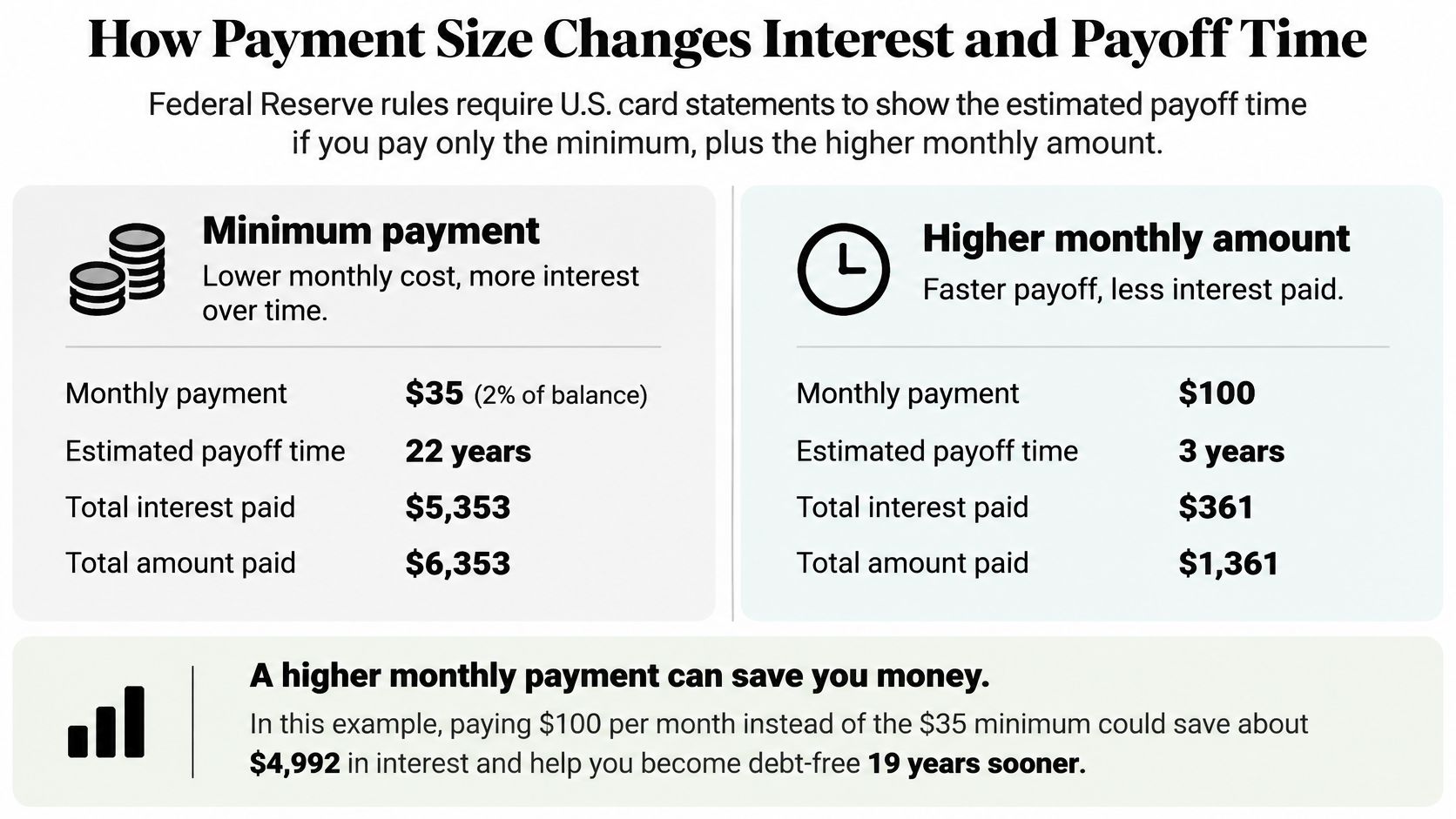
Your own statement already contains the most useful warning. The Federal Reserve summary of credit card rules requires U.S. card statements to disclose both the estimated payoff duration when making only minimum payments and the higher monthly amount needed to eliminate the balance within three years.
That disclosure exists because the minimum shrinks as the balance falls. Smaller payments stretch the schedule, and interest keeps taking part of each payment while the balance remains.
The same payment at two different rates
The Federal Reserve summary includes a CFPB example showing that paying $100 per month on a $3,000 balance requires about 41 months and $1,015 of interest at 18% APR, versus about 38 months and $783 of interest at 15% APR. The payment doesn't change. Only the rate changes.
That $232 difference comes from a three-percentage-point APR gap. It explains why a lower rate can be as valuable as a modest payment increase. Anyone comparing a loan offer against keeping the card should evaluate debt consolidation loan savings using payoff time and total cost together, not the monthly payment alone.
Stepping the payment up on the same balance
Now hold the rate at 18% APR and change only the payment. The $150, $250 and $300 figures below are calculated from the same $3,000 starting balance, assuming no new purchases, fees or rate changes.
Payoff time and interest at four monthly payments
| Monthly payment | Time to payoff | Approximate total interest |
|---|---|---|
| $100 a month | about 41 months | about $1,015 |
| $150 a month | about 24 months | about $580 |
| $250 a month | about 13 months | about $330 |
| $300 a month | about 11 months | about $275 |
Moving from $100 to $150 adds $50 a month, but it removes roughly 17 months from the schedule in this example. Each larger payment reduces principal sooner, so the next month's interest is calculated on less debt. That compounding benefit is why total interest falls faster than many readers expect.
The pattern also shows a limit. Moving from $250 to $300 still helps, but it saves far less time than the first step from $100 to $150. A sustainable $150 payment can therefore be a stronger choice than an unrealistic $300 payment that collapses after two months.
Payoff time and total interest belong side by side. A lower monthly payment can look cheaper while costing much more overall.
Readers who want the mechanics behind daily charges and shrinking principal can review how credit card interest works before changing a payment amount.
Recalculate whenever the balance, APR or payment changes. A rate reduction, a large purchase or a returned item can move the debt-free date even when the credit card payment monthly amount stays the same.
Choosing a Fixed Monthly Amount You Can Sustain
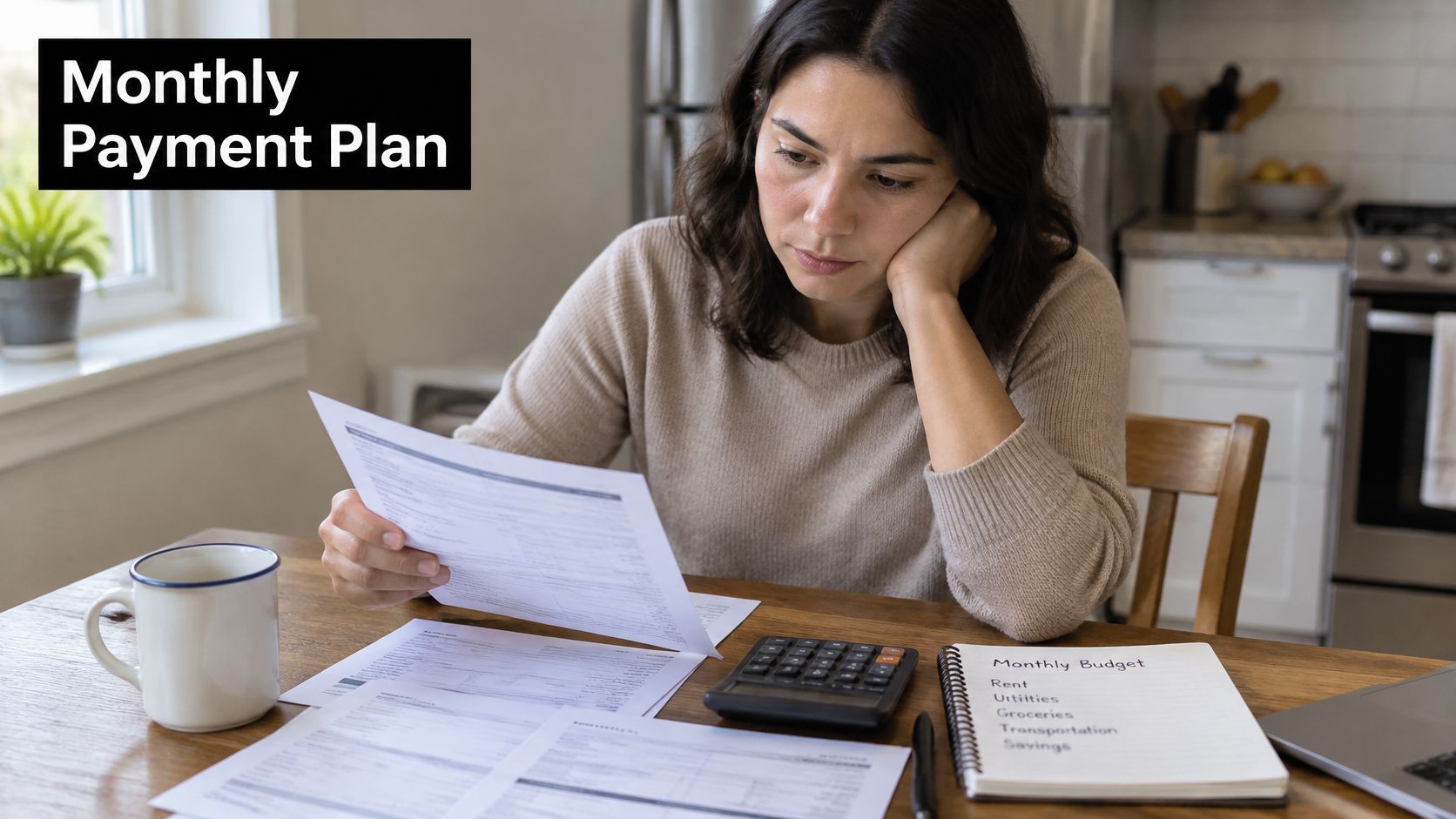
A sustainable amount begins with cash flow, not optimism. Start with take-home pay, subtract rent, utilities, groceries, insurance, transport and other fixed essentials, then subtract a buffer before assigning money to debt.
Run the cash-flow test
Say take-home pay is $3,200, fixed costs and essentials are $2,300, and the household keeps a $300 buffer. That leaves $600 for cards and loans. If two cards have minimums of $75 and $120, pay both minimums first. The remaining $405 goes to the card charging 24% APR, the highest rate in this example.
The $300 buffer is larger than the combined $195 in minimums. That's the safer setting, because a short month shouldn't force a choice between rent and keeping every account current.
- Cover every minimum first. One missed minimum can trigger a fee even when another card received extra money.
- Send surplus to the highest APR. That reduces the balance creating interest at the fastest rate.
- Keep the buffer separate. Money assigned to an emergency isn't extra debt money until the month ends safely.
Choose for the bad month
Paying as much as possible sounds responsible, but it can backfire when income varies. A freelancer who pays $600 after a strong invoice, then misses a $75 minimum the following month, may lose ground through fees and higher interest. A steady $250 payment that never misses can produce a cleaner result.
The short video below walks through building that kind of repeatable monthly choice.
Use a step-up rule when income improves. Raise the fixed payment by $50 after a raise or a finished subscription, instead of waiting for a large lump sum. Small scheduled increases are easier to keep than repeated promises to pay extra someday.
Set a target debt-free date and check it after 90 days. If the balance is falling more slowly than planned, raise the fixed amount, stop new charges on the payoff card, or move a larger share to the highest-APR account. Recalculate after a job change, raise, new card or unexpected balance increase.
Timing Your Payment Around Closing and Due Dates
Take one billing cycle and walk through it in order. Say a statement closes on June 1 and the payment is due on June 24. Those dates aren't interchangeable, and confusing them creates problems even for people who pay every month.
What each payment date controls
| Date | What it controls | What to do |
|---|---|---|
| Statement closing date | Which charges appear on the next statement and the balance reported to bureaus | Pay down before this date if reported utilization matters |
| Due date | The deadline for an on-time payment and the trigger for late fees | Pay the full statement balance, or at least the minimum, by this date |
| Posting date | When the issuer records your payment, which can lag by a business day or more | Pay two business days before the due date, especially near weekends |
The closing date ends the billing cycle. A purchase after June 1 belongs to the next statement, while the June 1 statement balance is the amount tied to the June 24 due date. A payment before June 1 can reduce the balance reported for that cycle. A payment on June 23 can still be on time, but it won't change the balance that closed on June 1.
Why earlier can cost less
Interest timing adds another layer. The CFPB explanation of credit card interest calculations says issuers commonly use the average daily balance, summing each day's balance, dividing by the number of days in the cycle, and multiplying by the periodic rate derived from the APR.
At 24% APR, the approximate daily rate is 0.0658% when divided by 365. Reducing the balance by $1,000 for 20 days avoids roughly $13.15 in simple daily interest. The total paid that month can stay the same, yet paying earlier in the cycle costs less.
Match the date to the goal
The CFPB guide to credit card key terms defines the grace period as the period between the billing-cycle end and the payment due date, and explains that a card company is not required to offer one. Where one exists, paying the full statement balance by June 24 generally preserves interest-free purchases.
Use three timing rules. Pay at least the minimum, and ideally the statement balance, by the due date. Pay before the closing date when reported utilization is the concern. Schedule payment two business days early when the due date falls near a weekend or holiday. A detailed credit card payment due date guide can help readers place each card on one calendar.
Set Up Autopay and Confirm Every Due Date
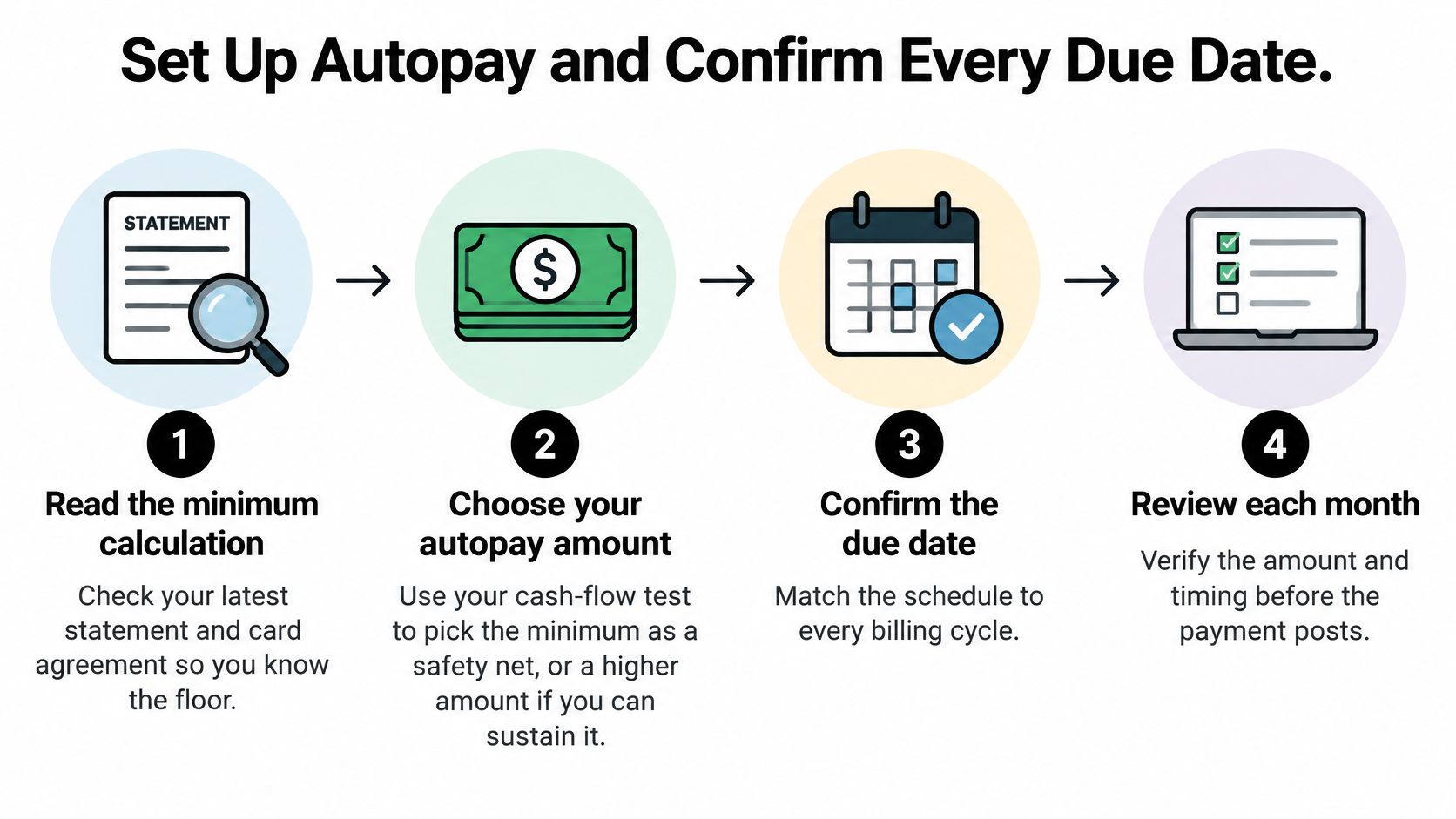
Autopay works best as a backstop with a chosen amount, not as a button pressed once and forgotten. The setup below turns the earlier decisions into a repeatable credit card payment monthly routine.
Five setup steps
Read the minimum calculation. Check the latest statement and the card agreement so the floor is known before choosing an autopay option. A fixed dollar amount that covered last month's minimum may fall short after interest, fees or new purchases raise the next minimum.
Choose the autopay amount. Use the cash-flow test. Autopay for the statement balance suits someone who doesn't carry debt and wants to preserve the grace period. Autopay for the minimum suits someone with several balances who needs a safety net on every account. A fixed amount above the minimum suits someone paying down one main card and able to sustain that number in a weak month.
Link the funding account and set the date. Connect the checking account that normally holds enough money, then schedule payment two business days before the due date. Payday timing matters here. If pay arrives on the first and the card is due on the third, there's little room for a delayed deposit, so asking the issuer to move the due date may be safer.
Add alerts around the payment. Set a low-balance alert on the funding account, a payment-scheduled alert from the issuer and a reminder for any card not placed on autopay. Alerts don't pay the bill, but they give time to move money before a payment fails.
Confirm the first two cycles. Check the posted date, the amount taken and the balance drop. Then compare the actual result with the intended payoff date. A payment can show as scheduled in one app while the issuer hasn't posted it yet, so the posted confirmation is the one that counts.
Safety check: Autopay set to the minimum prevents a late payment, but it doesn't create a payoff plan. Add a separate extra payment toward the highest-APR balance.
Make the extra payment deliberate
Extra money needs a destination. Apply it to the card with the highest APR while every other account receives its minimum. When a windfall arrives, such as a refund or overtime pay, decide the split before spending it. For example, half can rebuild the cash buffer and half can reduce the highest-rate balance.
Recalculate the debt-free date after 90 days. If income fell, reduce the voluntary extra before missing a minimum. If income rose, increase the fixed amount by a set step rather than relying on occasional manual transfers.
Keeping several accounts in one view
Multiple issuer apps make confirmation harder. Step 1 with Toya AI is linking credit cards and loans securely via Plaid, with read-only access. Toya AI recommends which payment to make next and shows the impact on time and interest, and it calculates the user's debt-free date based on current payments.
That view doesn't replace the issuer's own autopay. Keep the card issuer's setting active as the backstop, then use the consolidated balances, APRs and due dates to decide where extra money should go.
Common Payment Problems and How to Fix Them
Most payment problems give a visible clue before they become expensive. The balance barely moves, a fee appears after autopay, or utilization stays high despite an on-time payment. Each symptom points to a different cause.
Payment symptoms, causes and fixes
| Symptom | Likely cause | Fix |
|---|---|---|
| Balance barely drops after paying | Only the minimum was paid, so interest took most of it | Set a fixed amount above the minimum and direct extra money to the highest APR |
| Late fee after autopay | Autopay was set below the current minimum or the account was underfunded | Set autopay to the statement balance or minimum plus a buffer, with a low-balance alert |
| Payment counted late by one day | Payment posted after the due date | Schedule the payment two business days before the due date |
| Higher rate after a late payment | A penalty APR applies under the card agreement | Restore on-time payments and ask the issuer for a penalty-rate review |
| High utilization despite on-time payment | Payment posted after the closing date | Pay down the balance before the closing date |
What a late payment can cost
The exact fee and rate come from the card contract. One CFPB-filed agreement on late payment terms charges $25 for the first late payment in a six-month period and $35 for later late payments, capped at the missed minimum payment. If the minimum due is $20, that cap limits the fee to $20.
Another agreement described in the same filing applies a 29.99% penalty APR after a late or returned payment until six consecutive months of on-time payments. On a $2,000 balance, interest at 18% is about $30 a month before compounding, while 29.99% produces about $50. The rate increase can therefore cost more over time than the initial fee.
Start the fix sequence by confirming whether the payment posted. Then check the funding account, autopay amount and scheduled date. If the due date repeatedly lands before payday, ask the issuer to move it. After six on-time payments, ask whether the agreement allows a penalty-rate review.
Readers who can't cover the minimum because of a job loss, illness or another setback can read Velzee's guide to credit card hardship for context before calling the issuer. The practical decision today is simple. Choose a credit card payment monthly amount that survives a bad month, confirm every due date, and check that the first payment posts.
Link accounts with read-only access, see balances, APRs and due dates together, and use Toya AI to choose the next payment while tracking how each amount changes interest and the debt-free date. Start with the sustainable monthly number chosen today, keep issuer autopay as the safety net, and review the plan after the first payment posts.
Ready to start your debt-free journey?
Toya AI builds a personalized payoff plan so you can see your debt-free date and save on interest.
Get Started Free