
Credit Card Payment Due Date: Rules and Automation
The payment is scheduled. The bank balance looks sufficient. Then an issuer marks the account late because the transfer arrived after the processing cutoff. That unpleasant surprise happens when cardholders treat a credit card payment due date as a reminder instead of a deadline controlled by the issuer's receipt time.
A reliable system starts with the legal rule, then accounts for billing cycles, grace periods, cash flow, and processing delays. The strongest approach combines a due-date adjustment with automatic minimum-payment protection and a debt-payoff plan that directs extra cash toward expensive balances.
Table of Contents
- The Legal Reality of Your Credit Card Payment Due Date
- How Billing Cycles and Grace Periods Protect Your Wallet
- The Hidden Long-Tail Costs of Missing the Deadline
- How to Find and Change Your Credit Card Due Date
- Automating Debt Payoff to Eliminate Human Error
- Your Action Plan for Flawless Payment Management
The Legal Reality of Your Credit Card Payment Due Date
A cardholder initiates a bank transfer on the due date, sees the transaction leave the bank account, and assumes the obligation is satisfied. The issuer can still treat the payment as late if it hasn't received the money by the applicable cutoff. The payment's initiation date isn't the same as the issuer's receipt date.
The cutoff that matters
Under Consumer Financial Protection Bureau guidance, a payment is generally considered on time when the issuer receives it by 5 p.m. on the due date, using the statement's applicable time zone. If the due date falls on a Sunday or holiday when payments aren't processed, the next business day generally receives an extension, provided the payment arrives before the applicable cutoff. The CFPB's explanation of when a credit card payment is late makes the practical point clear: the issuer's receipt controls.
That rule changes how a household should schedule payments. A transfer submitted late in the day, a mailed check, or a third-party bill-pay instruction may face processing lag. A calendar alert that says “pay today” is weak protection if the payment still has to travel through another system.
Practical rule: A payment should be scheduled early enough for the issuer to receive it, not merely early enough for the cardholder to click “submit.”
Federal rules also require the issuer to mail or deliver the periodic statement at least 21 days before the payment due date, and the due date must recur on the same calendar day each month. The Federal Reserve's credit card rule summary also describes the 5 p.m. cutoff and the next-business-day treatment for weekends and holidays.
Why the statement window matters
The 21-day delivery requirement creates a minimum planning window between statement delivery and the legal payment deadline. It doesn't turn the final day into a safe processing day. It gives the cardholder time to review the statement, confirm the minimum payment, plan cash flow, and submit funds with enough margin.
The federal rule in 15 U.S.C. 1666b anchors this timing for statements connected to an interest-free repayment period. Readers tracking credit card late fee changes should still separate fee limits from the basic operational rule: an issuer needs to receive the required payment on time.
How Billing Cycles and Grace Periods Protect Your Wallet
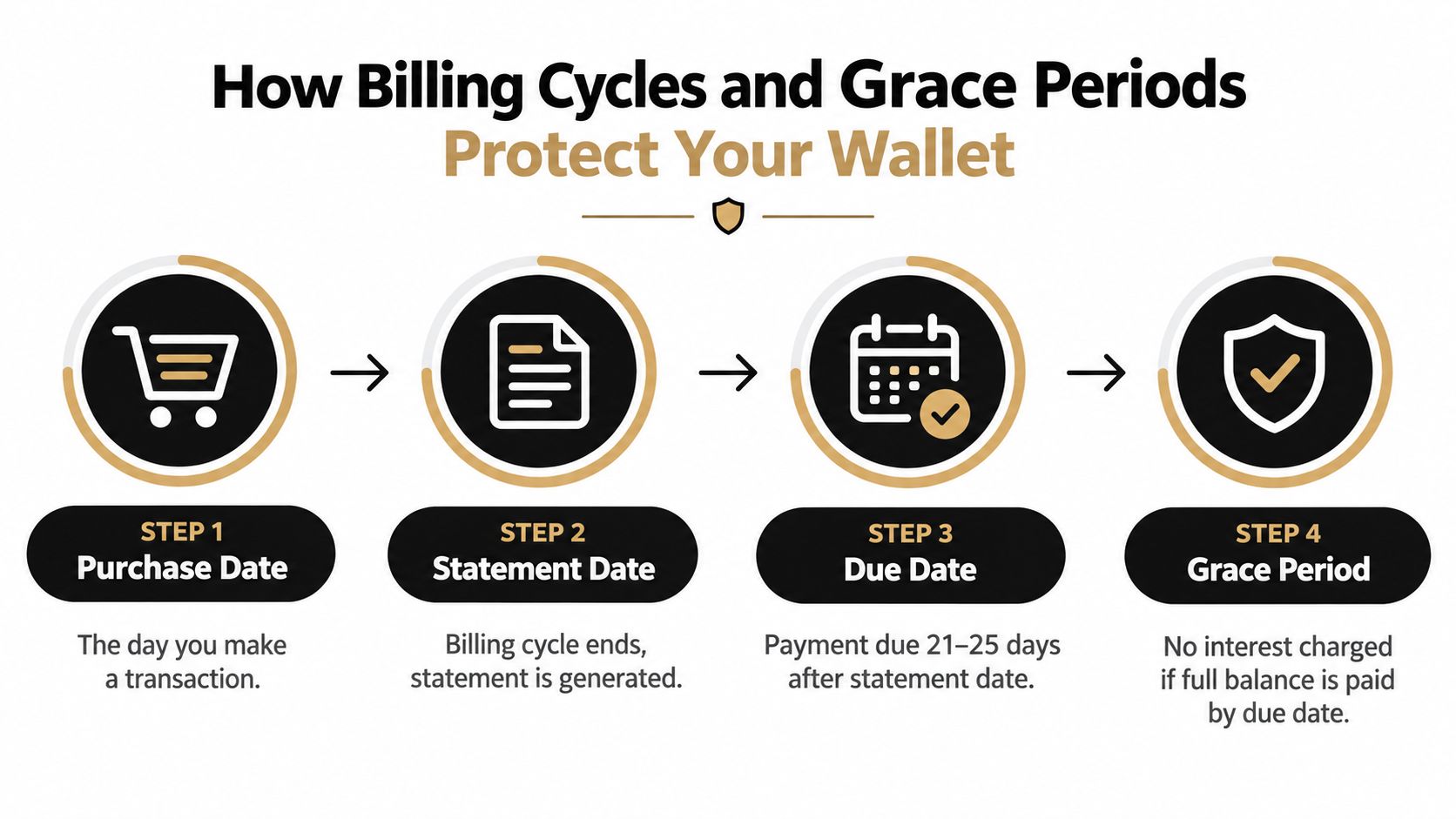
A due date makes sense only when it's connected to the billing cycle. The issuer records purchases and payments during a cycle, closes that cycle, produces a statement, and assigns a recurring payment deadline. The statement date and the payment due date perform different jobs.
A simple calendar example
Suppose a statement closes on the 1st and the payment due date is the 25th. Purchases recorded before the statement closes appear on that statement. The cardholder then has the period between the cycle's end and the due date to pay the statement balance.
The CFPB's grace-period explanation defines that interval as the time between the end of a billing cycle and the payment due date. If the full statement balance is paid by the 25th, new purchases may avoid interest under the card agreement. The grace period protects purchases conditionally, not automatically.
| Date or period | What happens | What the cardholder should do |
|---|---|---|
| Purchase date | A transaction enters the account activity | Keep enough cash reserved for the statement |
| Statement close | The billing cycle ends and the issuer generates the statement | Review the balance and minimum payment |
| Delivery window | The statement must arrive at least 21 days before the deadline | Check for errors and plan the payment |
| Due date | The issuer must receive the payment by the applicable cutoff | Pay the full statement balance when possible |
The condition many cardholders miss
Issuers aren't required to offer a grace period. When an issuer does offer one, paying the full statement balance by the due date is generally what preserves the interest-free treatment for new purchases. Paying only the minimum can keep the account current, but it doesn't provide the same protection from purchase interest.
A practical routine is simple. On statement delivery, record the statement balance, confirm the due date, and reserve the payment amount. If full payment isn't possible, the cardholder should stop treating new spending as cost-free and review the account's interest terms before making additional purchases.
The 21-day delivery rule gives time to act, but it doesn't excuse waiting until the final afternoon. The safest use of the grace period is to pay well before the cutoff and verify that the issuer shows the payment as received.
The Hidden Long-Tail Costs of Missing the Deadline
A late fee is the obvious consequence, but it isn't the entire financial problem. A missed deadline can disrupt the interest-free treatment that made a card seem manageable, turning ordinary new purchases into additional borrowing costs.
The CFPB explains that the grace period applies when the full statement balance is paid by the due date. If the balance isn't paid in full, the grace period can be lost, interest may begin accruing on unpaid balances from the end of that billing period, and future purchases may also accrue interest immediately. Cardholders who focus only on the fee can miss the larger cost created by continued revolving debt.
The cost continues after the missed date
A delinquency can also affect the account's pricing under the card agreement. The CFPB's credit card contract definitions explains the relationship between the due date, grace period, finance charges, and unpaid balances. A payment deadline therefore controls more than account status. It can influence whether purchases receive interest-free treatment and whether borrowing costs continue to build.
The penalty-fee framework also limits a late fee to 25% of the required minimum periodic payment due immediately before the fee is assessed, according to the CFPB penalty-fee rule materials. For a required minimum payment of $40, that rule's cap would be $10. The cap doesn't make a late payment harmless, because interest treatment and future account terms can matter more than the immediate charge.
Why reminders fail
Many missed payments aren't caused by a deliberate refusal to pay. They come from inattention, competing bills, changing paydays, uncertain balances, or a transfer that takes longer than expected. Research on repayment timing in the NYU Stern economics paper examines how inattention affects repayment behavior, reinforcing a practical lesson: a system that depends on memory will eventually fail.
That's why a calendar reminder alone is inadequate. It asks a person to notice the alert, have the cash available, choose the right account, submit the payment, and allow enough time for delivery. A safer setup automates the minimum payment, schedules the full statement balance when cash flow allows, and keeps a reserve for timing differences.
For readers who want a deeper explanation of how interest accumulates, the credit card interest guide provides useful background. The immediate priority remains the same: protect the due date first, then attack the balance that produces the most expensive borrowing.
How to Find and Change Your Credit Card Due Date
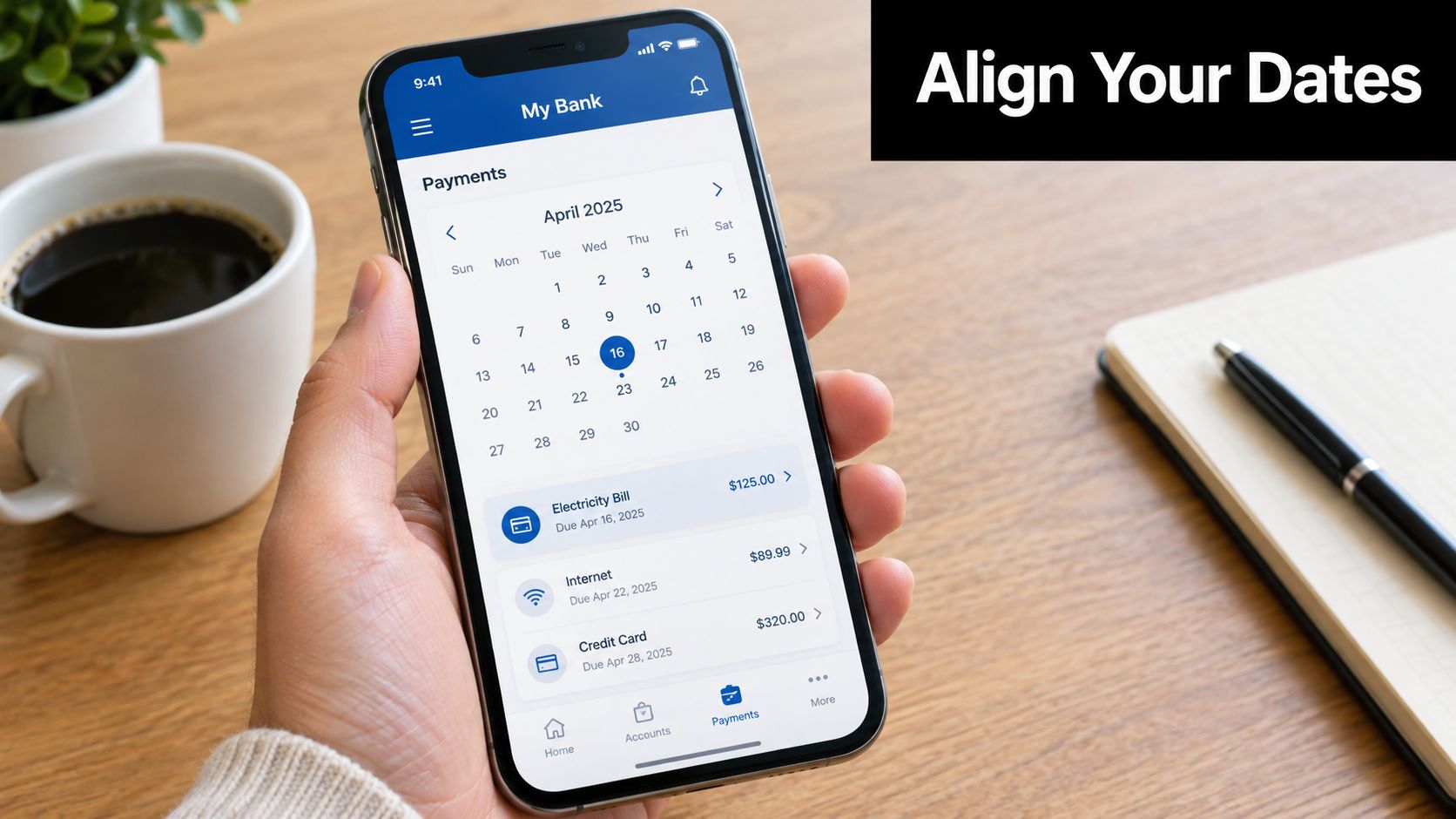
The due date appears on the monthly statement, usually near the minimum payment and statement balance. It also appears in the issuer's website or mobile app, where the account overview typically shows the next payment deadline and the amount required to keep the account current.
Find the date before changing anything
A cardholder should first compare the statement date, due date, paycheck schedule, rent, utilities, and other fixed withdrawals. The best due date isn't an arbitrary date that looks convenient. It's a date that leaves the account funded before the issuer needs to receive the payment.
The statement-date guide for credit cards helps distinguish the cycle-closing date from the payment deadline. That distinction matters because moving the due date doesn't necessarily change when spending enters a statement or when the issuer reports account information.
A useful review can follow this sequence:
- Check the statement: Confirm the current due date, minimum payment, statement balance, and issuer time zone.
- Map cash flow: Mark paydays and essential withdrawals on the same calendar.
- Choose a buffer: Select a date after expected income arrives, leaving time for transfers to settle.
- Compare all cards: Decide whether several due dates should be grouped or staggered based on the household's cash flow.
- Record the current deadline: Continue protecting the existing date until the issuer confirms a change.
Request the change directly
Many issuers allow cardholders to request a new due date through the online account or by calling the customer-service number on the back of the card. The request should specify the desired recurring date and ask when the change becomes effective.
The issuer's answer matters more than the request submission. A due-date change may take time to take effect, and the account can still show the original deadline during the transition. Automatic payment should remain active, or the cardholder should manually pay the minimum by the old date until the new schedule is visible in the account.
A changed due date is useful only after the issuer confirms that the new date governs the account.
Consolidating several deadlines can reduce the number of dates a household must remember, but grouping every payment on one day can also create a cash-flow squeeze. The right choice is the one that matches income timing and leaves room for essential expenses. If an issuer won't change a date, early payments and automated minimum payments can still reduce deadline risk.
Automating Debt Payoff to Eliminate Human Error
A household with several cards and loans doesn't have one due date problem. It has a coordination problem. Balances, APRs, minimum payments, statement dates, and available cash can change across accounts, while a basic bank autopay feature may only handle one payment at a time.
Replace scattered reminders with one operating view
Centralized debt automation brings account information into a single dashboard. A useful system should show each balance, APR, utilization, minimum payment, and due date, then make it obvious which payment needs attention next.
Toya AI is one option that connects financial accounts through read-only access via partners such as Plaid, Fincity, Spinwheel, and Quiltt. It centralizes credit cards, student loans, auto loans, personal loans, and mortgages, then uses balances, rates, timelines, and cash flow to recommend a next payment within a debt-payoff plan.
Separate protection from acceleration
The first job is payment protection. Minimum-payment autopay can prevent an account from being missed when attention slips, but the household still needs to review the account and confirm that the payment source is funded. A payment system should also account for issuer processing time, rather than scheduling everything at the last permissible moment.
The second job is debt acceleration. Once every account's minimum is protected, extra cash should be directed deliberately. An AI plan can compare interest rates, cash flow, and payoff timelines to identify the next best payment instead of leaving the household to divide extra money by instinct.
The due-date tracking software guide outlines why centralizing deadlines can be more reliable than maintaining separate alerts across multiple banking apps and spreadsheets. The practical standard is straightforward:
- Minimums stay protected: Every account has a funded payment path.
- Extra payments have a target: Additional cash goes toward a selected balance.
- Changes trigger a review: New debt, income changes, or a rate change updates the plan.
- Statements still get checked: Automation doesn't replace error detection.
A dashboard doesn't remove the need for judgment. It removes repetitive coordination, the exact work most likely to fail during a busy month.
Your Action Plan for Flawless Payment Management
A cardholder starts with three accounts, separate due dates, and a habit of paying whichever bill appears first in an inbox. One month, a transfer is submitted on the deadline but arrives too late. The account is marked late, the grace-period treatment is put at risk, and the cardholder realizes that memory was doing the work of a financial system.
The replacement process is less complicated than the old routine. The cardholder checks each statement, records the current deadlines, compares them with income dates, requests changes where useful, and enables minimum-payment autopay. After that foundation is in place, extra cash can follow a clear payoff priority rather than an improvised decision.
The immediate checklist
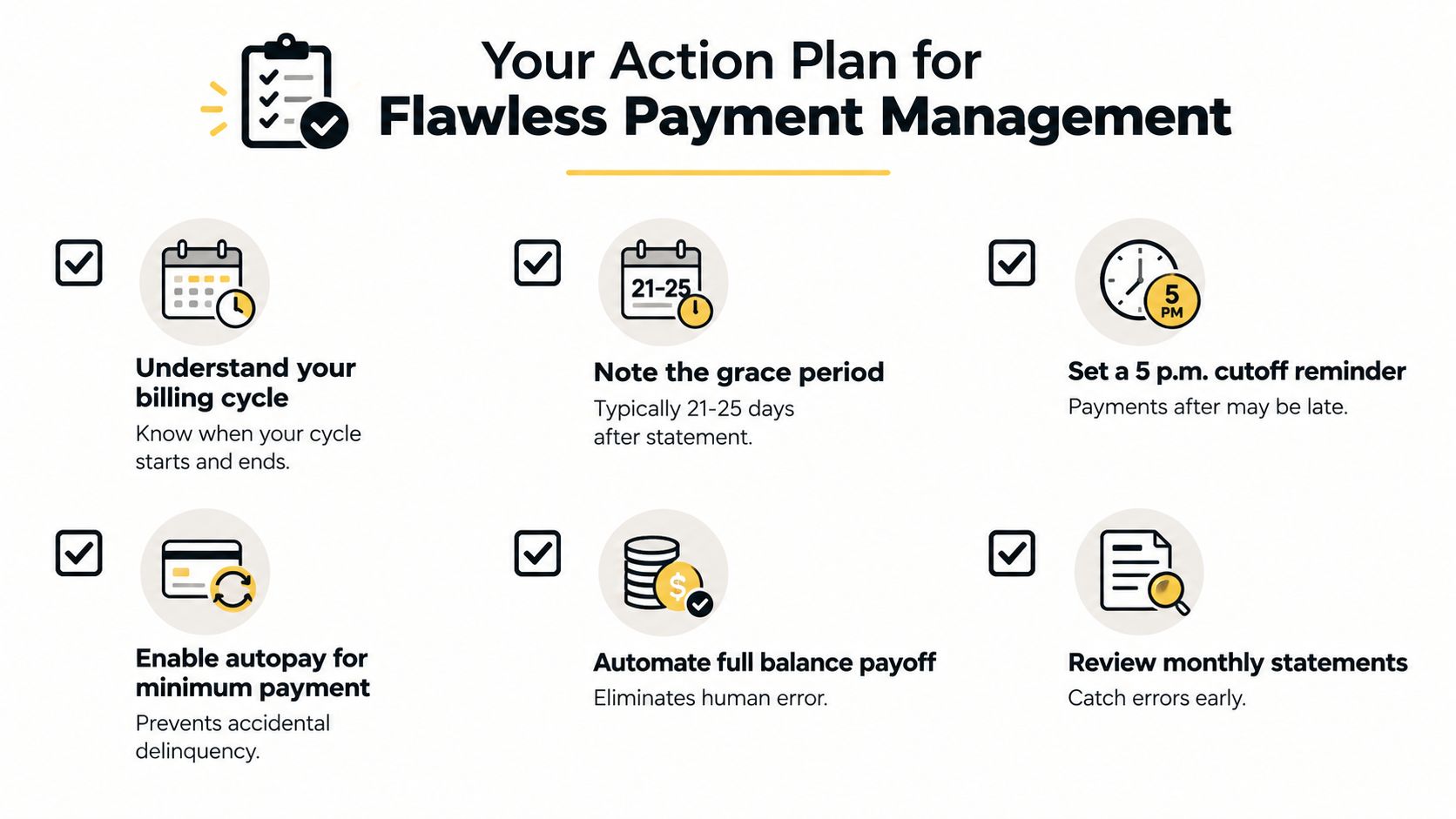
- Audit every statement: Record the due date, minimum payment, statement balance, and payment method.
- Protect the cutoff: Treat 5 p.m. on the due date as the issuer's receipt deadline, not as the moment to begin a transfer.
- Preserve the grace period: Pay the full statement balance by the due date when cash flow permits.
- Align the schedule: Ask each issuer whether the due date can move closer to a funded point in the household's income cycle.
- Automate the floor: Set minimum-payment autopay and verify the linked account can cover it.
- Direct the surplus: Apply additional money to the balance with the most costly borrowing terms, based on the household's full debt picture.
The cardholder then checks the next statement rather than assuming the system worked. A changed date must appear correctly, an autopay payment must show as received, and the balance must move as expected. That monthly review catches failed connections, unexpected charges, and issuer changes before they become larger problems.
The best credit card payment due date strategy isn't a better reminder. It's a layered system: aligned dates, early receipt, minimum-payment protection, full-balance payment when possible, and automated payoff decisions that adapt when cash flow changes.
Toya AI centralizes credit cards and other loans, displays balances, APRs, utilization, and due dates, and creates an adaptive debt-payoff plan with next-best-payment guidance. Visit Toya AI to connect accounts securely, replace scattered reminders with a clear plan, and start managing payment deadlines as part of a deliberate path out of debt.
Ready to start your debt-free journey?
Toya AI builds a personalized payoff plan so you can see your debt-free date and save on interest.
Get Started Free