
Credit Card Debt to Income Ratio: What It Really Means
A household can bring home a paycheck, pay rent, buy groceries, cover a student loan and make two credit-card minimums, then wonder why nothing is left to put toward savings or a faster payoff. The balances may not look extraordinary on their own, but the required payments arrive alongside every other bill. That pressure is real, even if one familiar ratio makes the situation look manageable.
The confusion often comes from treating three different measures as if they were interchangeable: lender debt-to-income ratio (DTI), the burden of credit-card minimum payments, and the cash left after essential expenses. Each answers a different question. Together, they help explain why two households with the same card balance can face very different repayment challenges, and which actions might ease the strain.
Table of Contents
- Why Your Credit Card Balance Feels Heavier Than the Number Suggests
- Defining the Credit Card Debt to Income Ratio and Its Core Formula
- How Credit Card DTI Differs From Utilization and Standard DTI
- Worked Examples at Two Income Levels
- Why the Ratio Matters for Approvals, Rates, and New Credit Lines
- Practical Levers That Actually Lower the Ratio
- Common Misconceptions That Keep People Stuck
- Your First 90 Days With a Smarter Payoff Plan
Why Your Credit Card Balance Feels Heavier Than the Number Suggests
A household's monthly budget can feel tight before a card balance looks alarming. Rent takes its share, groceries vary from week to week, and a student-loan payment is due on schedule. Then two card minimums claim another piece of the paycheck. Paying those minimums may keep accounts current, but it doesn't necessarily leave enough room to build savings or make meaningful progress on principal.
That's because a balance is only one part of the picture. Income, required payments, interest costs, and essential expenses all affect how much breathing room a household has. A balance that's manageable for a household with steady income and low fixed costs can be difficult for a household earning less or coping with variable hours, childcare, or higher housing costs.
The difference matters for planning, not just for borrowing. A 2024 analysis by the Federal Reserve Bank of St. Louis found that the lowest-income households had credit-card balances equal to approximately 85% of one month's income, and that lower-income households had the highest overall credit-card-debt-to-monthly-income ratio (Federal Reserve Bank of St. Louis analysis). That's a balance-to-income comparison, not a formal debt-service ratio: it compares the balance owed with monthly income, not the required monthly payment with income.
A useful starting point: A balance tells how much is owed. A payment tells how much cash is committed each month. Neither, by itself, shows what remains after essentials.
A practical way to read the situation is through three separate lenses. Lender DTI measures required debt payments against gross income. Credit-card minimum-payment burden isolates the card payments that must be made. Post-essential cash flow shows what remains after required payments and necessities. The rest of the guide uses those distinctions to help borrowers identify the number they need to track and the levers that can change it.
Defining the Credit Card Debt to Income Ratio and Its Core Formula
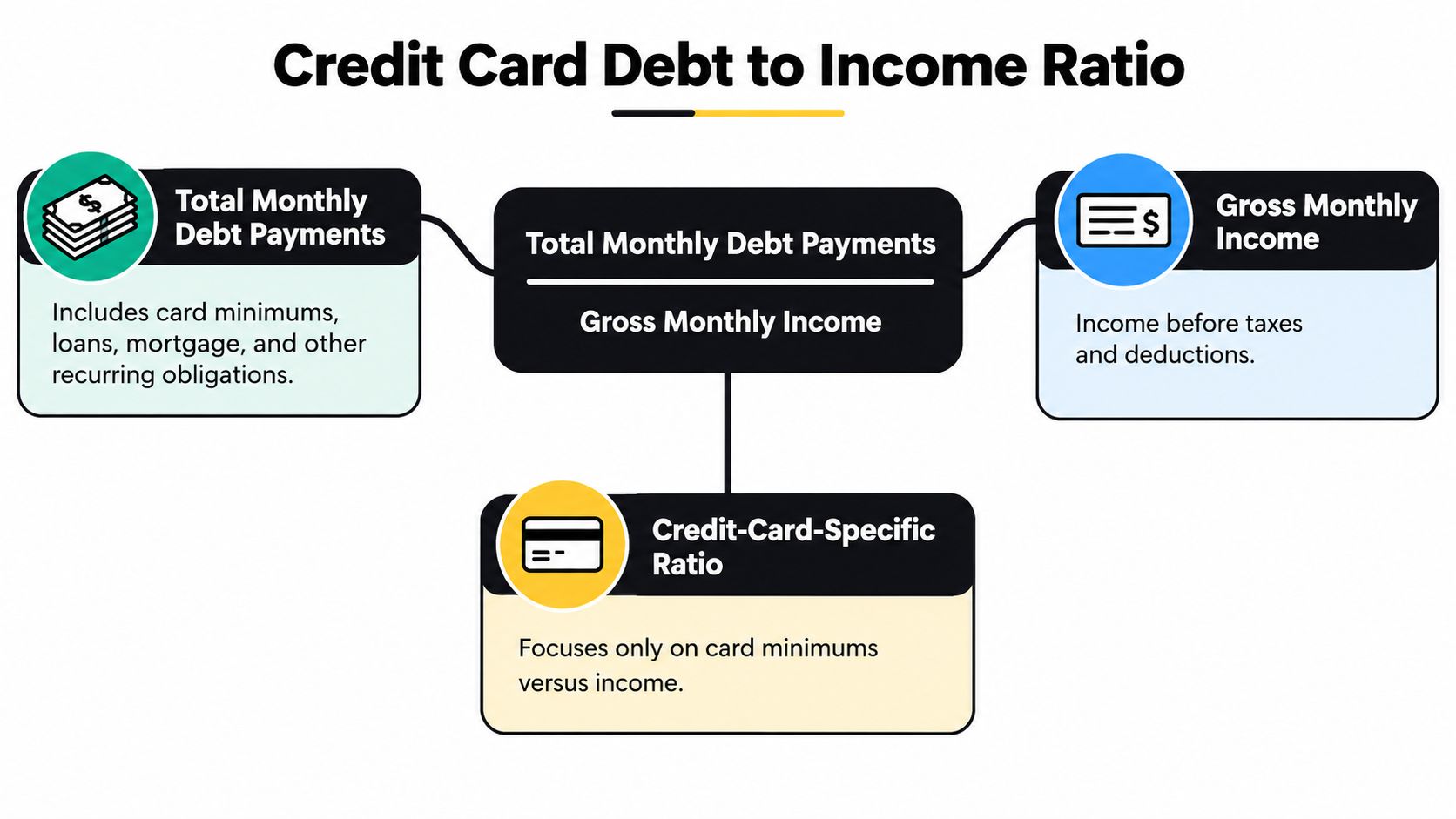
The standard debt-to-income ratio compares monthly debt payments with gross monthly income:
DTI = total monthly debt payments ÷ gross monthly income × 100
Gross income means income before taxes and deductions. Lenders use it as a consistent income baseline, although it doesn't show the cash a household takes home. Monthly debt payments generally include required recurring obligations such as credit-card minimums, auto loans, student loans, and housing payments considered under the applicable underwriting rules.
The credit-card detail that often surprises borrowers is this: lenders generally count the required monthly payment, not the full card balance, in DTI. Fannie Mae treats revolving accounts as recurring obligations. If a credit report doesn't show a required minimum and the borrower can't document a lower amount, the lender generally uses 5% of the outstanding balance. For automated Desktop Underwriter casefiles, the assumed payment is the greater of $10 or 5% of the balance (Fannie Mae guidance on monthly debt obligations).
A worked calculation
Consider someone earning $6,000 in gross monthly income, with a $10,000 card balance, a $400 car payment, and a $300 student-loan payment. If the lender must apply the 5% assumption to the card balance, the card obligation becomes $500 per month. Add the three monthly payments: $500 + $400 + $300 = $1,200. Divide $1,200 by $6,000, and the resulting DTI is 20%.
If the documented card minimum were lower than the assumed amount and the lender accepted that documentation, the calculation could change. That is why borrowers preparing for an application should check both the balance and the minimum payment reported or documented. A balance reduction may help the assumed payment, but the effect depends on the amount the underwriting model uses.
The calculation is simple; the inputs need care. A borrower's planned extra payment generally isn't the payment counted for underwriting. The relevant figure is the required or lender-assigned monthly obligation. DTI is also a lender constraint, not a full household-budget assessment: utilities, groceries, and other everyday costs may not enter the formula, even though they affect whether a payment feels affordable.
How Credit Card DTI Differs From Utilization and Standard DTI
Three measures can all describe card-related pressure, but they answer different questions. Standard DTI looks at monthly debt payments across obligations. Credit utilization compares card balances with credit limits. A credit-card balance-to-income measure compares the outstanding balance with income over a chosen period. A balance-to-income measure can offer a vulnerability check, but it isn't the same as a lender's payment-based DTI.
| Measure | Formula | Who cares | What it predicts |
|---|---|---|---|
| Standard DTI | Total monthly debt payments ÷ gross monthly income | Mortgage, auto, and other lenders | How much gross income is committed to qualifying debt payments |
| Credit utilization | Card balance ÷ credit limit | Credit-scoring models and borrowers | How much of available revolving credit is in use |
| Card balance-to-income | Outstanding card balance ÷ income over the chosen period | Borrowers assessing repayment vulnerability | How large the balance is relative to the income available to repay it |
For example, a borrower can have a high card balance but a relatively low required minimum payment, so the balance may affect interest and utilization more than the DTI calculation. Another borrower can have a modest card balance but tight cash flow after rent, food, insurance, and childcare. A favorable result on one measure doesn't guarantee comfort on the others.
For readers evaluating a home purchase, Homes By Carmen's affordability breakdown offers context on thinking about housing costs alongside borrowing capacity. That kind of affordability view is useful, but it doesn't replace a household cash-flow check.
Credit utilization is a separate credit-file concern, not a debt-payment ratio. Borrowers focused on that measure can review how to lower credit utilization. For a payoff plan, the practical point is to track each measure independently rather than assuming that lowering one automatically solves the others.
Worked Examples at Two Income Levels
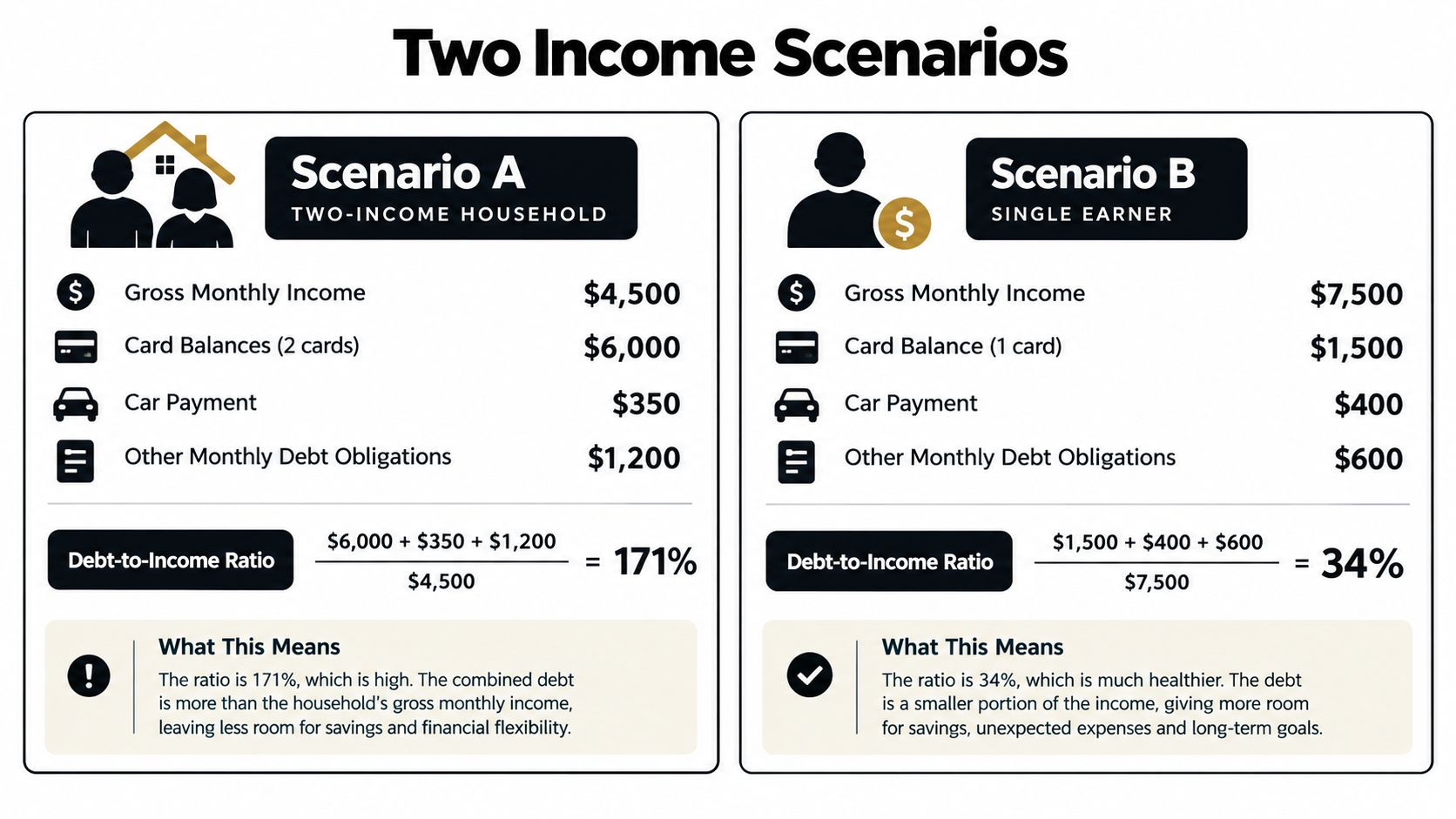
Two households can carry the same $6,000 in card balances across two cards and still face different choices. The examples below use gross monthly income, a $350 car payment, and rent of $1,200 for Scenario A and $1,800 for Scenario B. Rent matters for the household budget, but whether it enters a particular lender's DTI calculation depends on the loan and underwriting method.
Scenario A
Scenario A earns $4,500 per month. If the lender uses the 5% assumption for the card balances, the estimated card payment is $300. Add the $350 car payment, and monthly debt payments total $650. That gives a DTI of about 14.4% before any other qualifying debt obligations are included.
The balance-to-monthly-income measure is different: $6,000 divided by $4,500 is about 133%. That doesn't mean the household owes 133% of its income as a monthly payment. It means the outstanding balance is larger than one month of gross income. After rent, the assumed card payment, and the car payment, $2,650 remains before groceries, utilities, insurance, and other costs. The actual amount available for extra debt payments depends on those expenses and take-home pay.
Scenario B
Scenario B earns $9,000 per month and has the same card balance and car payment, but pays $1,800 in rent. With the same $300 assumed card payment, total monthly debt payments are still $650. DTI is about 7.2%, while the balance-to-monthly-income measure is about 67%. After rent and the assumed debt payments, $6,550 remains before other household expenses.
The contrast isn't a verdict on either household. It shows why the same balance can represent different levels of repayment pressure. Scenario B has more room in the simplified example, but its actual capacity still depends on essential expenses, income stability, and interest rates. Scenario A may need to protect cash for necessities before increasing payments.
The calculations can be adapted with a debt-to-income calculator, but the result should be read alongside the household's budget. A lender DTI is not a substitute for calculating what remains after essentials.
Why the Ratio Matters for Approvals, Rates, and New Credit Lines
Lenders use DTI as one part of an application, not as a universal score of financial health. Fannie Mae's published guidance sets a 36% maximum total DTI for manually underwritten loans, allows up to 45% when specified credit-score and reserve conditions are met, and permits up to 50% for loans evaluated through Desktop Underwriter (Fannie Mae guidance on debt-to-income ratios). These are conventional-loan underwriting limits under specific conditions, not general targets every borrower should aim for.
A borrower can have manageable utilization but still face a qualification problem if required payments take up too much gross income. The reverse can also happen: a low lender DTI may coexist with high interest costs and little money left after essentials. Different lenders and products assess applications differently, so no single DTI outcome guarantees approval, a particular rate, or a larger credit line.
The wider borrowing context is substantial. The Federal Reserve Bank of New York reported that U.S. credit-card balances reached $1.28 trillion in the fourth quarter of 2025, a 5.5% year-over-year increase (New York Fed household debt data). Aggregate borrowing doesn't show any one borrower's situation, but it helps explain why lenders pay attention to repayment obligations. For a different lending context, a DSCR loan qualification guide can help clarify how debt-service-focused lending differs from consumer DTI.
Practical Levers That Actually Lower the Ratio
Paying more than the minimum can help reduce a balance, but it doesn't automatically change the lender's DTI calculation right away. A lender may use the reported required payment, and a balance transfer or consolidation changes the calculation only if the obligation used by underwriting changes. The useful question is: which measure needs to improve, and what action moves it?

- Prioritize the card with the highest required minimum when monthly breathing room is the immediate problem. Paying it down may reduce the required payment used in DTI, depending on how the lender calculates the obligation. If the highest APR is on a different card, compare cash-flow relief with interest savings before choosing where extra money goes.
- Check the reported minimum after a paydown. Don't assume the required payment changed just because the balance did. Review the next statement or credit report, then keep documentation if a lender needs a verified payment amount.
- Consider a balance transfer when it lowers the cost of carrying debt and the transfer terms fit the payoff plan. It can shift where the balance sits and may reduce interest, but it won't necessarily lower DTI. If the new issuer's reported minimum isn't lower, the lender-facing payment may not improve.
- Compare consolidation carefully. An installment loan can replace revolving payments with a fixed payment, but fees, term length, and total interest matter. The new payment may help DTI only if it is lower than the obligations being replaced, and extending repayment can increase the time debt remains in the budget.
- Free up cash through a realistic budget and automate payments. A scheduled extra payment can make payoff more consistent, but it should leave room for essentials and avoid overdrafts. This mostly improves the balance and future interest cost; the lender DTI changes when the required payment used in the calculation changes.
- Look at income and timing, not just spending. A more predictable pay schedule, a request to shift a bill's due date, or temporary additional work may ease a short-term cash crunch. These steps can improve post-essential cash flow, though only qualifying gross income or changed debt obligations affect lender DTI.
A payoff strategy should match the borrower's actual goal: qualify for credit, reduce interest, lower monthly obligations, or create room in the budget. A credit-card debt payoff guide can help compare payoff approaches. Toya AI is one option for centralizing debt details and evaluating personalized payment choices across accounts, including how an action may affect the debt-free timeline and interest cost.
A short video can also help borrowers think through debt-payoff decisions:
Common Misconceptions That Keep People Stuck
Myth: DTI is a complete measure of financial health.
Reality: It's an underwriting measure based on qualifying debt payments and gross income. It may leave out important expenses, so a borrower can have a low DTI and still struggle to cover essentials or make extra payments. For applicants dealing with a rejection, this credit score guide for rejected applicants helps separate score-related questions from the distinct issue of monthly affordability.
Myth: Paying only the minimum means the ratio is fine.
Reality: The minimum may keep a lender-facing payment calculation steady while the balance remains expensive to carry. A manageable DTI doesn't mean a borrower is making progress toward reducing the amount owed.
Myth: Closing an old card automatically improves DTI.
Reality: Closing an account can affect utilization, but it doesn't erase a remaining balance or the payment obligation reported for underwriting. If a balance remains and a minimum payment continues to be reported, that obligation may still count. Check the balance and reported payment before closing an account.
Your First 90 Days With a Smarter Payoff Plan
Start by gathering each card's balance, APR, and reported minimum payment, plus gross income and recurring loan payments. Calculate lender DTI, card minimums as a share of gross income, and balance-to-income separately; then list essential expenses to see what cash remains.
Choose a payoff action that fits the biggest pressure point, automate payments the budget can safely support, and review the figures regularly. A tool such as Toya AI can centralize account details and help compare next-payment choices, but the household still needs to verify the numbers and protect money for essentials.
Track balances, due dates, and available cash weekly. Review DTI and the broader payoff plan periodically. The goal isn't one perfect ratio. It's a steady downward trend in debt and a budget with more room to breathe.
Toya AI helps borrowers organize balances, APRs, due dates, and payment options in one place, then compare how different payoff actions may affect interest and the debt-free timeline. If a clearer plan would make credit-card debt easier to manage, visit Toya AI to explore its debt payoff tools.
Ready to start your debt-free journey?
Toya AI builds a personalized payoff plan so you can see your debt-free date and save on interest.
Get Started Free