
Credit Card Bill Example: How to Read Every Line
The statement lands in your inbox, or in the mail, and the number at the top doesn't match anything you remember spending. You bought groceries, filled the tank, paid for a streaming service or two, and sent in a payment last month. Yet the total sits higher than you expected, and the minimum payment line looks almost random.
Nothing has gone wrong. A credit card bill is a running calculation, and every figure on it traces back to a purchase, a payment or a charge you can check yourself. U.S. credit-card balances totaled $1.182 trillion at the end of March 2025, down $29 billion from the previous quarter, according to the Federal Reserve Bank of New York. Your own statement is a small slice of that total, and it follows the same rules as every other one.
Table of Contents
- A Sample Credit Card Bill at a Glance
- Reading Each Line Without Guessing
- How Interest Is Calculated on Your Balance
- Minimum Payment and Due Date Rules
- What Paying More Than the Minimum Saves
- Mixed Balances and Your Action Plan
A Sample Credit Card Bill at a Glance
Here's an illustrative statement for a card carrying a 24% APR, with a closing date of January 15, 2026 and a payment due date of February 9, 2026.
| Line item | Amount | What it means |
|---|---|---|
| Previous balance | $1,850.00 | Balance owed when the last statement closed |
| Payments | -$200.00 | Amounts paid since the last statement |
| New purchases | +$640.00 | Charges posted during this billing cycle |
| Credits and refunds | -$40.00 | Returns or adjustments that reduce the balance |
| Fees | $0.00 | Late, cash advance or annual fees charged this cycle |
| Interest charge | +$36.90 | Finance charge on balances carried past the grace period |
| New balance | $2,286.90 | Total owed as of the closing date |
| Minimum payment due | $61.00 | Smallest payment needed to avoid a late payment |
| Payment due date | February 9, 2026 | Deadline for paying at least the minimum |
The Rule That Ties the Lines Together
Every statement follows one equation: new balance = previous balance minus payments and credits, plus purchases, fees and interest. Run it with the sample numbers and the total proves itself.
The check: $1,850.00 - $200.00 + $640.00 - $40.00 + $36.90 = $2,286.90
Two things trip people up here. The minimum payment is a separate figure from the new balance, calculated by a formula that has nothing to do with how much you owe. And the due date is the deadline for the minimum, not for the full balance, which is why an on-time payment can still leave you carrying debt.
Scale helps put the numbers in perspective. U.S. credit card balances reached approximately $1.23 trillion in the third quarter of 2025 after rising $24 billion during that quarter, a 5.75% increase year over year, according to the New York Fed's household debt report. Your balance is a rounding error against that total, and it still decides your household's cash flow.
The Two-Minute Check
Run these three steps before you read anything else on the page.
- Confirm the previous balance matches the new balance printed on last month's statement. If it doesn't, a payment or credit posted in the wrong cycle.
- Redo the arithmetic with your own figures. Any gap bigger than a few cents means a missing line.
- Circle the minimum and the due date, then note whether you plan to pay the full new balance or something less.
Reading Each Line Without Guessing
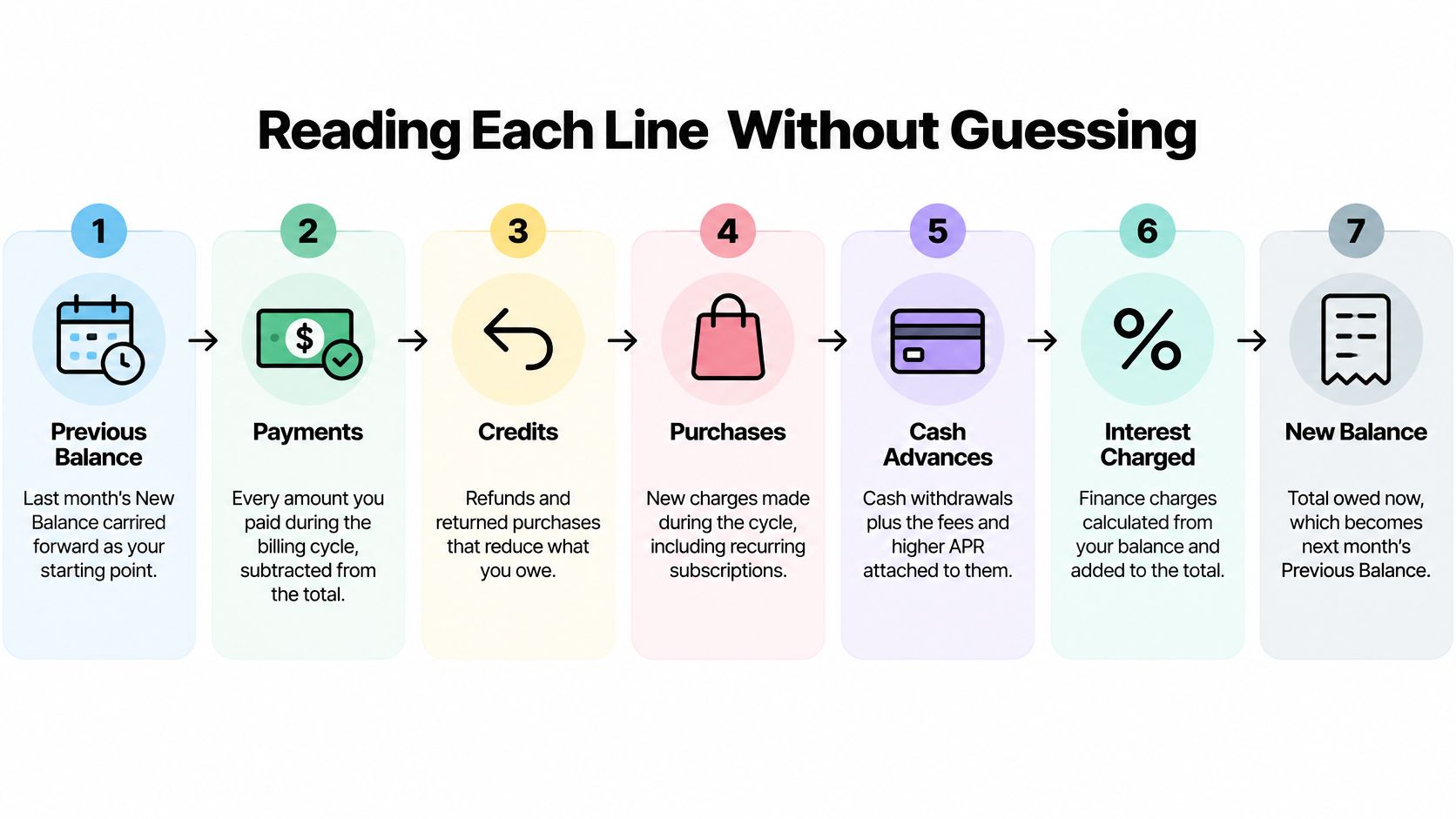
A purchase on your receipt has one date; the matching line on your statement may have another. Before treating that difference as an error, follow when the charge posted and which billing cycle captured it. Each line is an entry in a running calculation: purchases and fees add to what you owe, while payments and credits subtract from it.
Start with purchases. A charge can remain pending before it posts, so the statement date may differ from the day you tapped your card. A purchase made on January 14 may appear on the February statement if the merchant settles after the earlier cycle closes. Match the amount and merchant to your receipt before deciding whether two entries represent the same purchase.
Payments need the same date check. A payment made near the closing date may appear on the next statement. Once posted, it reduces your current balance, but it does not change the balance recorded when the earlier statement closed. The statement is a snapshot; the current balance keeps moving.
Credits also reduce what you owe, but follow the merchant's processing timeline. A return accepted at the store may take several days to reach your card. Until the credit posts, do not subtract it when checking the statement's arithmetic.
Keep fees separate from purchases. Look for late fees, cash advance fees and annual fees as individual entries, then ask the issuer to explain any fee whose reason you do not recognize.
When a Charge Looks Unfamiliar
An unfamiliar merchant name can make a legitimate purchase hard to recognize. A delivery app may bill under a parent company's name, a digital wallet may display different merchant details, or a purchase may be split across separate lines. Check those possibilities against your receipts.
Start with the posted date and search nearby email receipts. Then check app-store and streaming subscriptions, and ask whether an authorized user made the purchase. For a split transaction, add the entries and compare their combined amount with the receipt.
If the charge remains unexplained, contact the issuer promptly and identify it as unrecognized. Explain what you checked so the issuer can help distinguish a merchant-name question from a potentially unauthorized charge.
Keep the dispute deadline printed on your statement in view. Follow its timing instructions rather than counting from the day you noticed the charge.
How Interest Is Calculated on Your Balance
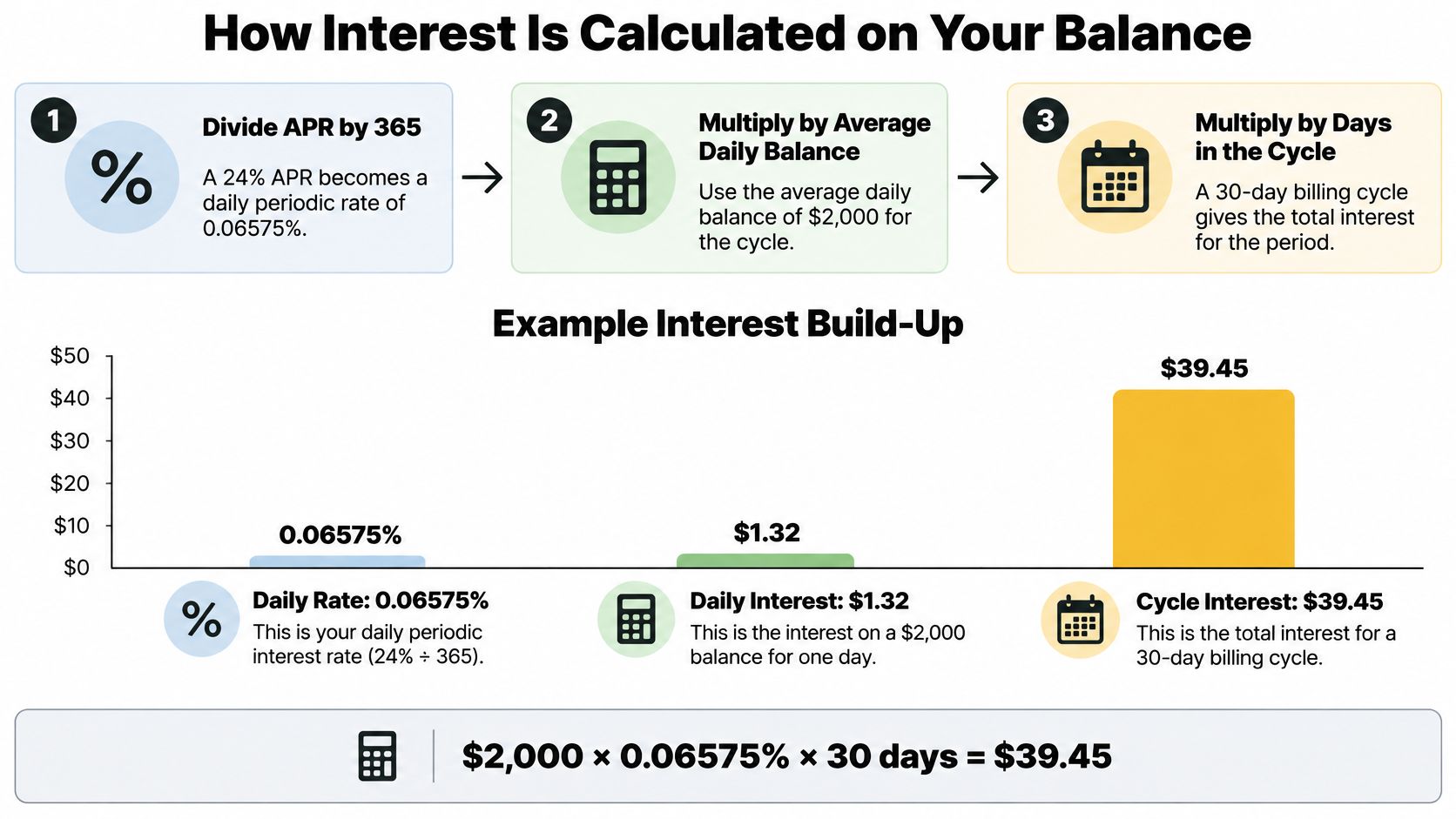
Interest is where a statement stops being a receipt and becomes a calculation. The formula takes three steps, and a phone calculator handles all of them.
- Divide the APR by 365 to get the daily periodic rate.
- Multiply that rate by the average daily balance for the cycle.
- Multiply by the number of days in the billing cycle.
Working One Balance Through the Formula
Take a $2,000 balance at 24% APR over a 30-day cycle. Dividing 24% by 365 gives a daily rate of about 0.0658%. Applied to the balance, that comes to roughly $1.32 a day, and across 30 days the cycle charge lands at about $39.45.
Issuers don't apply the rate once to the closing balance. The CFPB explains that card interest is commonly calculated daily on the average daily balance, which means the timing of a payment changes the charge (CFPB on how card interest is calculated). A payment made on day three lowers the average far more than the same payment made on the due date. That's the whole reason paying early beats paying late when the amount is identical.
Rates themselves move with the market. Federal Reserve historical data put the average rate on credit card accounts assessed interest at 15.77% in November 1994, 13.36% in November 2008 and 16.43% in the third quarter of 2020, which is why the APR printed on your own statement matters more than any rate you remember hearing (Federal Reserve historical credit card rate data). The same balance costs very different amounts across those periods.
| APR | Daily periodic rate | Approx. interest over 30 days |
|---|---|---|
| 15% | 15% ÷ 365 | About two-thirds of the charge at 24% |
| 24% | 24% ÷ 365, about 0.0658% | About $39.45 |
The grace period is the other half of the story. Pay the full statement balance by the due date and new purchases usually carry no interest at all. Carry a balance, and interest starts accruing on purchases from the day they post. Most cash advances skip the grace period entirely and begin charging immediately, which is why a cash advance line on a statement is rarely cheap.
For a deeper treatment of daily balances and compounding, this explanation of how credit card interest works covers the mechanics in more detail. If the card is a business expense account, reconciling that interest charge against your books is simpler with organized records, and Wisely accounting services handles bookkeeping and reporting for small operators.
The short video below runs the same three steps against a different balance.
Minimum Payment and Due Date Rules
The minimum payment is a formula, not a recommendation. Most issuers calculate it as a small percentage of the balance plus that cycle's interest and fees, subject to a floor amount, which is why the figure changes every month even when your spending doesn't.
A worked example from the Consumer Financial Protection Bureau shows how little progress that formula makes. Start with a $300 balance and a 1.92% monthly interest charge, paying $15 a month. You can verify each month yourself: interest first, payment second, remainder to principal. After month one the balance is $290.76, which is $300 plus $5.76 interest minus the $15 payment. By month eight the balance is still $220.92, even though $120 has gone out the door, because in that eighth month $4.44 of the $15 covered interest and only $10.56 touched principal (CFPB minimum payment worksheet).
A payment can arrive on time, clear the minimum, and still leave the balance almost exactly where it started. On-time and paid-down are two different achievements.
Federal disclosure rules acknowledge this directly. Statements must carry a prominent Minimum Payment Warning explaining that minimum-only payments mean more interest and a longer repayment period, along with an estimate of how long paying only the minimum will take and what it will cost. That warning, required on every statement under 12 CFR Part 1026, Subpart B, is the one line of your bill doing the arithmetic for you. Compare its payoff estimate against what the minimum due implies, and the gap between the two numbers is the price of convenience.
The due date carries its own risk. It falls after the closing date, and a payment that posts even one day late can trigger a late fee and, on some accounts, a penalty rate on the whole balance. The fix is dull and effective: set autopay for at least the minimum on every card, then add a calendar note to send more when the month allows. The rules behind that deadline, including how posting times and weekend cutoffs work, are explained in this guide to the credit card payment due date.
One more number worth checking while you verify your statement: your payment history shapes your credit file month by month. If rebuilding credit is part of the plan while you pay this balance down, an independent ranking of credit building apps lets you compare what each one reports and what it charges before you commit.
What Paying More Than the Minimum Saves
The gap between minimum-only and a fixed higher payment is larger than many people expect. For a $1,000 balance at 14% APR, the CFPB shows that paying roughly $20 a month takes 110 months to repay and costs about $700 in interest (CFPB guide to paying more than the minimum). That's more than nine years on a balance that started at four figures.
Run the first month by hand and the reason becomes obvious. Interest on $1,000 at 14% is about $11.67 for the month, so a $20 payment reduces principal by only $8.33. Raise the payment to $50 and the interest charge stays the same while principal reduction jumps to about $38.33, roughly four and a half times more progress for two and a half times the money.
The comparison: $20 a month grinds for nine years. $50 a month attacks the same balance at a completely different speed, because every extra dollar above the interest charge goes straight to principal.
Choosing an Amount You Can Keep
Five steps turn the statement into a payoff decision.
- Pull three figures off the statement: current balance, APR and minimum payment.
- Estimate the monthly interest with balance × APR ÷ 12. On $1,000 at 14%, that's about $11.67.
- Subtract the interest from your planned payment to see the actual principal reduction. A $50 payment yields $38.33; a $20 payment yields $8.33.
- Fix the amount and keep it identical every month. A steady payment beats a heroic one you abandon in March.
- Stop new charges or budget them separately. Fresh purchases reset the math and extend the timeline without you noticing.
Exact payoff dates depend on the issuer's calculation method, any fees added along the way, and whether the APR changes. A calculator that models the minimum-payment trap on your actual numbers is a faster way to see the difference than a spreadsheet, and this minimum payment trap calculator runs the comparison in seconds.
Mixed Balances and Your Action Plan
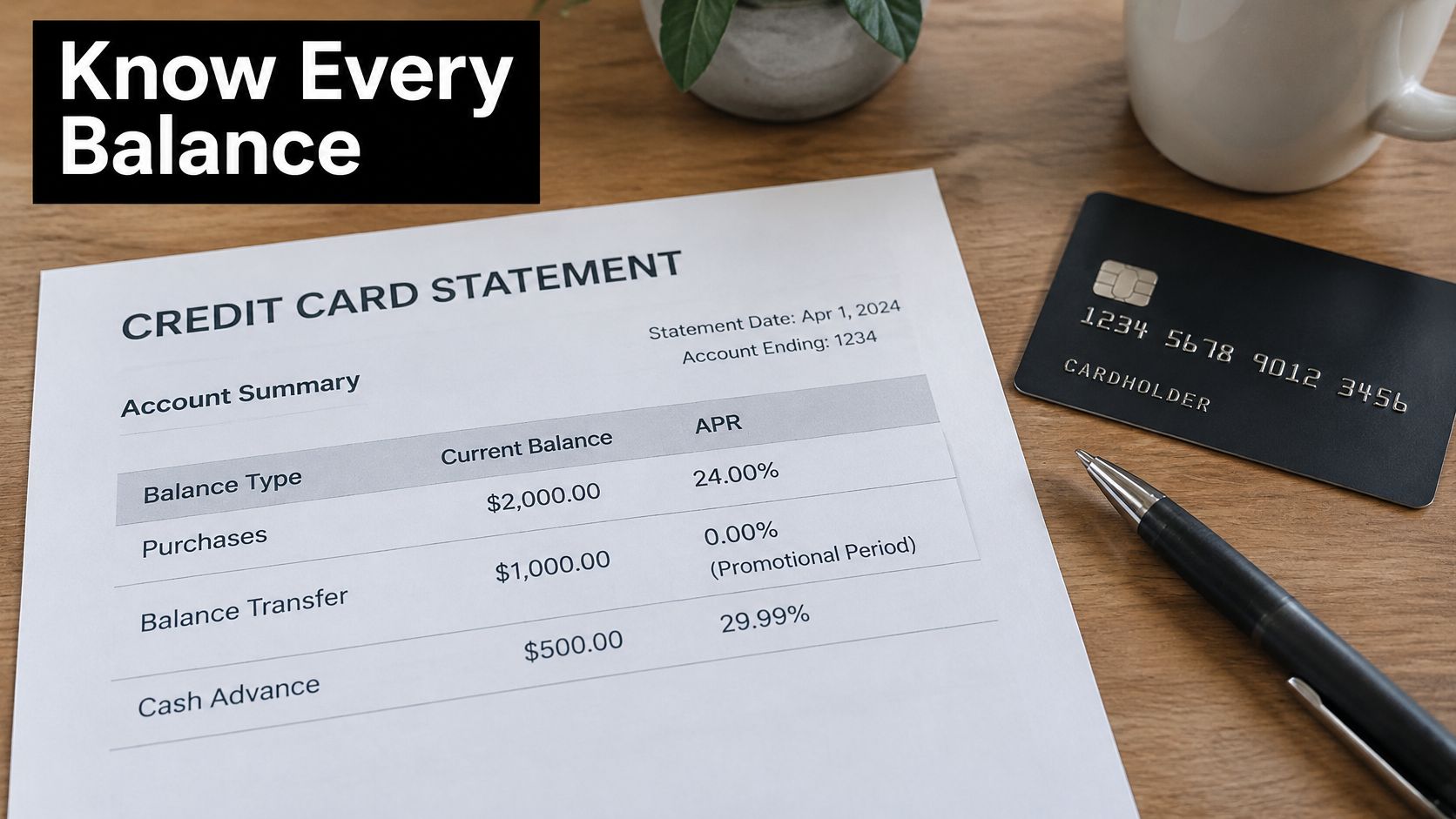
Real cards rarely carry one balance at one rate. A single statement can hold a $2,000 purchase balance at 24% APR, a $1,000 balance transfer at 0% during a promotional period, and a cash advance that carries its own rate printed elsewhere on the page.
The Order the Issuer Uses
Here's the part that surprises people. When a card has multiple rates, payments above the minimum generally go first to the balance with the highest APR, with anything remaining allocated by descending rate, as CFPB examination guidance describes (CFPB credit card account management procedures). The 0% transfer receives only its minimum share, so extra money aimed at the promotional balance does nothing to reduce current interest.
| Balance type | APR | Extra payment order |
|---|---|---|
| Purchases | 24% | First, because it has the highest APR |
| Cash advance | Printed separately on the statement | Second, unless its APR exceeds the purchase rate |
| Balance transfer | 0% promotional | Last while the promotional rate applies |
That ordering matters most when a promotion is about to lapse. Some offers convert to the standard rate on a set date, and deferred interest promotions can retroactively charge interest on the whole transferred amount if any balance remains when the window closes. Read the promotion end date on the statement and schedule a payment before it passes, not on the day it passes.
The Four-Step Routine Before the Due Date
Run this every cycle, in this order.
- Flag any unrecognized charge and note the dispute deadline printed on the statement. Contact the issuer to ask about the descriptor before filing a fraud claim.
- Set autopay for at least the minimum on every balance category, so a rate segment can never trigger a late fee on its own.
- Send any extra payment to the highest-rate category, unless the card agreement specifies a different allocation.
- Check every promotional end date and schedule the payment that clears or reduces that balance before the rate changes.
Tracking three balance types across several cards is where paper statements stop working. Toya AI shows balances, APRs, and due dates for connected debts in one view, and shows which debt to pay extra on and how much interest the user will save, so the allocation decision above happens once instead of once per card.
Toya AI builds a personalized payoff plan from your real account data, so you can see exactly how an extra $50 changes your debt-free date and total interest rather than guessing at it. Connect a card and the app lays out every balance, APR and due date in one place, then recommends the next payment to make. Visit Toya AI to start free and run your own statement through the numbers.
Ready to start your debt-free journey?
Toya AI builds a personalized payoff plan so you can see your debt-free date and save on interest.
Get Started Free