
Cash Flow Forecast Benefits That Speed Up Debt Payoff
The month looks manageable on paper. Income covers rent, childcare, groceries, and a credit card payment, yet the calendar tells a different story. Rent leaves the account before payday, childcare clears a few days later, and the card payment arrives while the balance is still recovering. A budget can show that total income exceeds total spending, while the bank account still falls short on the 12th.
That gap is a timing risk. A cash flow forecast maps expected income and expenses onto specific dates, then predicts the balance that should remain after each transaction. It gives a borrower time to move a payment, delay discretionary spending, collect money sooner, or preserve cash instead of making an unsafe extra debt payment.
Table of Contents
- Introduction Why Timing Beats Totals When You Carry Debt
- How Cash Flow Forecasting Actually Works
- Key Cash Flow Forecast Benefits for Borrowers and Debt Payoff
- Practical Examples How Forecasts Change Payoff Dates and Interest Costs
- Building Your Simple Weekly Forecast Routine
- How Adaptive Tools Keep Your Forecast Accurate as Life Changes
- Conclusion Turn Forecast Clarity Into Faster Financial Freedom
Introduction Why Timing Beats Totals When You Carry Debt
A borrower with several debts often focuses on the monthly total. The question becomes, “How much can be paid toward debt this month?” A more useful question is, “How much cash will still be available on every important date after essential bills and minimum payments clear?”
That distinction changes debt decisions. An extra payment made during a surplus week may reduce principal and help move the debt-free date forward. The same payment made just before rent, childcare, or an annual bill can push the account below zero, create a fee, and force the borrower to use expensive credit again.
Cash flow forecast benefits begin with visibility. The forecast doesn't replace a budget, and it doesn't promise that every future balance will be exact. It shows the likely sequence of money arriving and leaving, so a borrower can respond before a shortage becomes a missed payment.
For someone with freelance income, the same principle applies before debt payoff even begins. Payment timing can be affected by invoice terms, client delays, and follow-up gaps, so practical freelancer invoicing advice can help improve the accuracy of expected incoming cash.
The payoff strategy then becomes more precise:
- Protect essential liquidity: Keep enough cash available for bills that must clear before the next dependable income.
- Time extra principal payments: Send additional money when the forecast shows a genuine surplus, not merely when the monthly budget appears positive.
- Compare alternatives: Test whether paying a balance early is safer than holding cash for an irregular expense.
- Avoid replacement borrowing: A payment only helps if it doesn't require new borrowing shortly afterward.
The central idea is simple. Budgeting sets limits, while forecasting shows whether the account can survive the calendar. Once that calendar is visible, debt payoff becomes a sequence of informed decisions rather than a recurring gamble.
How Cash Flow Forecasting Actually Works
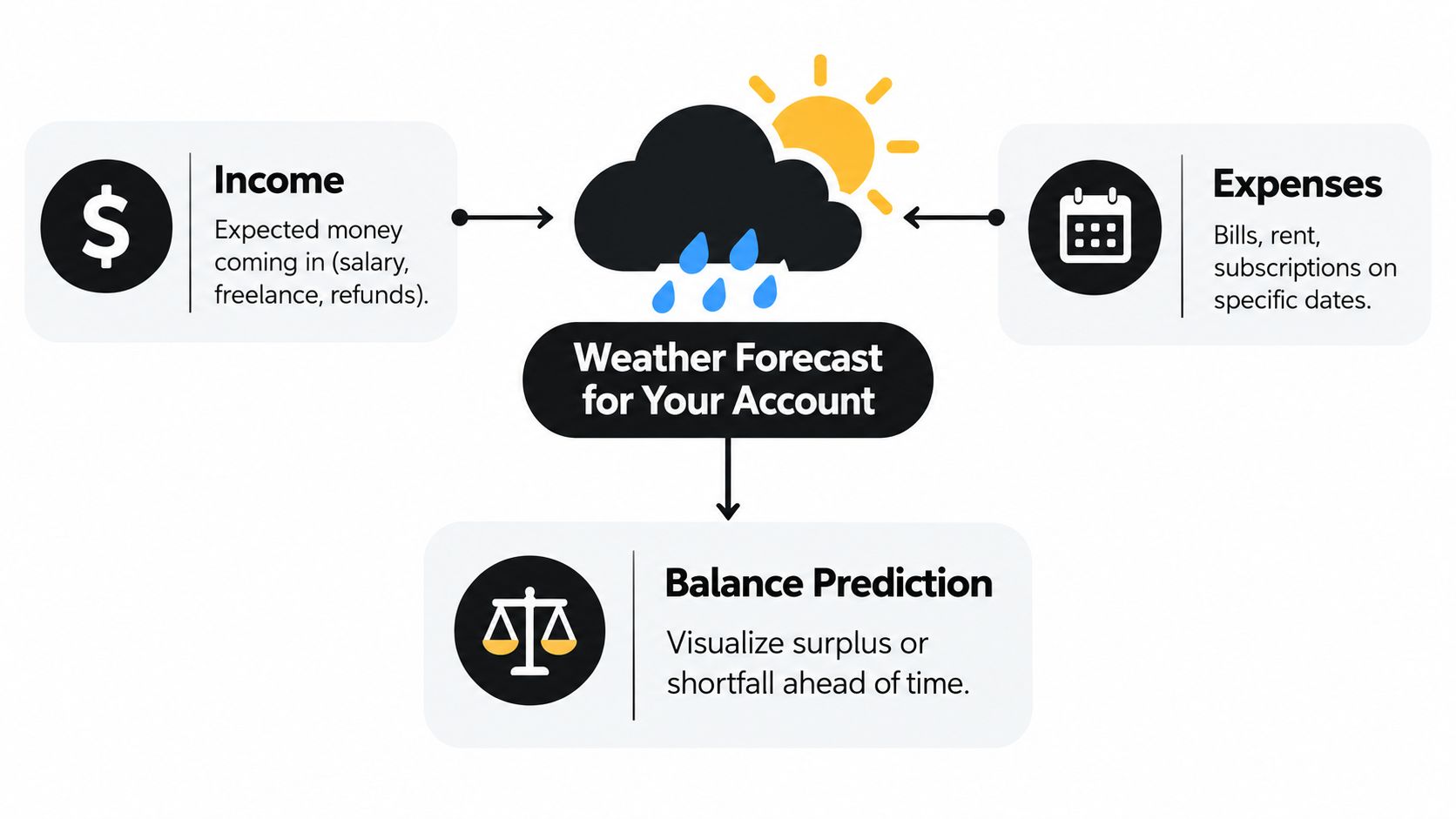
A cash flow forecast works like a weather forecast for a checking account. A weather report places expected conditions on specific days. A cash forecast places expected deposits and withdrawals on specific dates, then shows how those events may affect the balance.
Start with the current bank balance. Add expected income on the dates it should arrive, not the dates it was earned. Subtract rent, utilities, subscriptions, loan minimums, childcare, card payments, and other withdrawals on their expected clearing dates.
Forecasting is not the same as budgeting
A budget answers, “What should be spent?” A forecast answers, “What balance is likely to remain after money moves?”
Practical rule: A budget can say that a payment fits the month. A forecast checks whether it fits the date.
That difference matters for debt. Suppose a borrower has enough total income to cover a card payment, but the deposit arrives after the payment date. The forecast reveals the temporary low-balance window. The borrower can then schedule the payment after the deposit, keep a cash buffer, or contact the lender about available payment-date options.
Gather the right inputs
A useful forecast needs more than a monthly income figure. It should include:
- Opening balance: The amount available before the next expected transaction.
- Income dates: Salary, freelance payments, refunds, benefits, or other dependable deposits.
- Fixed withdrawals: Rent, insurance, loan payments, subscriptions, and utilities.
- Variable expenses: Groceries, transport, medical costs, and irregular household spending.
- Debt details: Minimum payment, due date, and any planned extra payment.
- Known exceptions: Travel, repairs, annual renewals, school expenses, or expected bonuses.
Neutral household forecasting guidance recommends reviewing at least 90 days of transaction history to understand income and expense timing, as described in this household cash flow roadmap. That review can reveal recurring patterns that a monthly budget hides, such as a subscription clearing near a loan payment or freelance income arriving later than expected.
A borrower can begin with a spreadsheet or calendar. Each week, actual transactions replace estimates, dates shift when bills change, and new information is added. For a broader explanation of the underlying process, what is cash flow forecasting offers additional context. A practical guide to cash flow forecasting can also help organize the core inputs and balance calculation.
Key Cash Flow Forecast Benefits for Borrowers and Debt Payoff
The most valuable forecast is one that changes a decision. For a borrower, that usually means preventing a payment problem, protecting liquidity, or directing surplus cash toward principal without creating a new shortfall.
Avoid fees before they appear
A date-based forecast highlights the lowest projected balance, not just the end-of-month result. If the balance dips near a bill date, the borrower can move a discretionary purchase, adjust the payment date where possible, or keep more cash in the account.
That advance notice can help prevent late payments and overdrafts. It also reduces the risk of paying one debt and then using another card to cover essentials before the next deposit.
Make extra payments without draining liquidity
An extra principal payment is useful only when the money is available. The forecast can separate safe surplus from cash that already has a job.
For example, money left after minimum payments might appear spare until an irregular insurance bill or school expense is added. Scenario-based forecasting helps compare debt service, spending, and growth choices, allowing decision-makers to identify when excess cash exists and when financing may be needed, as explained in this cash flow forecasting guide.
Reduce emergency borrowing and interest exposure
Poor visibility can force a borrower into emergency borrowing. A forecast gives earlier warning, which creates options such as delaying discretionary spending, accelerating a collection, or using an existing line of credit before bills become overdue. Business guidance from IBM on cash flow forecasting describes the same operational principle, including adjusting plans before a shortfall becomes a missed payment.
For businesses, the financial stakes can be substantial. A 2025 survey cited by Glean found that companies in the top 20% of working-capital performance achieved an average of $11 million in bottom-line benefits from reduced interest costs and improved cash-flow management, according to its cash flow management forecast. The broader lesson for households is not that every borrower will achieve that result. It's that cash timing can influence interest and liquidity decisions, making forecasting a finance capability rather than a bookkeeping task.
Improve decision confidence
A forecast lets a borrower test a lump-sum payment before sending it. The useful comparison includes the projected balance after the payment, the next major bill, the minimum-payment schedule, and the expected payoff date.
A structured time-based debt payoff plan can provide the payoff framework. The forecast supplies the missing timing layer, showing when that plan is safe to execute.
Practical Examples How Forecasts Change Payoff Dates and Interest Costs
Consider a borrower with a credit card balance and a plan to make an additional $150 principal payment. The amount fits the monthly budget, but the date determines whether it helps.
In the first version, the borrower sends the payment during a tight week. Rent has cleared, childcare is due, and the next paycheck hasn't arrived. The payment lowers the card balance, but the checking account falls too far. A fee follows, or the borrower uses the card for groceries. The apparent debt reduction is partly reversed by the new cash pressure.
In the second version, the borrower moves the same $150 to the week after payday, when the forecast shows essential bills already covered. The payment still reduces principal, but it doesn't create the same immediate liquidity gap. The payoff date can move earlier without requiring replacement borrowing, and the total interest cost can fall because the balance is reduced sooner and stays reduced.
The forecast doesn't make the interest result identical for every account. Rates, payment rules, statement dates, and new purchases all matter. It does show which timing choice is more likely to support the intended payoff path.
Two debts require a sequence decision
Now consider a borrower with a high-rate credit card and a lower-rate personal loan. One approach sends every available extra dollar to the card. Another sends a smaller extra amount to the card while preserving cash for a known irregular bill, then increases the payment after that bill clears.
The first approach may reduce interest faster if liquidity remains adequate. The second may cost less overall if the first approach would trigger new borrowing or a missed payment. A forecast allows both sequences to be modeled against actual dates rather than judged only by the monthly payment total.
A borrower can use a payoff calculator to compare the mathematical effect of different payment amounts and then place each option against the account calendar using a free debt payoff calculator.
Extra Payment Timing Decision Matrix
| Forecast Signal | Action | Why It Saves Money |
|---|---|---|
| Balance stays safely above essential bills after the payment | Pay extra principal after the next dependable deposit | Reduces principal without creating a predictable shortfall |
| Balance approaches a low point before payday | Hold the extra payment temporarily | Avoids fees and reduces the risk of replacement borrowing |
| A large irregular bill is approaching | Reserve the expected amount first | Preserves liquidity for a known obligation |
| Income timing is uncertain | Use a smaller extra payment or wait for cleared funds | Prevents an optimistic deposit estimate from disrupting the plan |
| Surplus remains after the irregular bill clears | Increase the extra payment then | Directs cash to debt once the timing risk has passed |
The practical test is not “Can the borrower afford this payment in the month?” It's “Can the borrower make this payment and still cover every important transaction before the next reliable income?”
Building Your Simple Weekly Forecast Routine
A forecast becomes useful when it stays current. A short weekly review can catch a changed bill, delayed deposit, or new expense before that event alters the debt plan.
A repeatable review
The routine starts with the actual balance, not last week's estimate. The borrower then checks recent transactions, confirms upcoming due dates, and updates any income that has moved.
A practical weekly checklist looks like this:
- Refresh the starting point: Match the forecast to the current bank balance and add transactions that have cleared.
- Confirm the calendar: Check minimum payments, rent, childcare, subscriptions, and other withdrawals coming up.
- Run a forward view: Review the next several weeks for the lowest projected balance and the first available surplus window.
- Record changes: Add known bonuses, irregular bills, rent increases, delayed income, or changes in payment amounts.
- Choose one action: Move a discretionary expense, protect cash, schedule a payment, or make an extra principal payment.
Use scenarios instead of false precision
A base case can use expected income and ordinary expenses. A what-if version can test a rent increase, a bonus that arrives late, or an irregular bill. Contemporary forecasting tools also support three to six-month base-case forecasts and longer adaptive views, but the farther the forecast reaches, the more assumptions require review.
The question isn't whether the forecast predicts the future perfectly. The question is whether it exposes a decision that needs attention today.
Safety rule: An extra payment is safe only when the projected balance remains sufficient for essential bills, minimum debt payments, and known irregular expenses until the next dependable income.
Low-balance alerts add another layer of protection. Set them high enough to give time for a decision, rather than waiting until the account is already close to zero. If the alert triggers, discretionary spending pauses first. Extra debt payments wait unless the forecast still shows a clear surplus after the warning period.
A borrower can also compare the cost of holding cash with the benefit of paying principal. Paying early may reduce interest, but preserving liquidity may be wiser when income is variable or a major bill is near. The weekly routine makes that tradeoff visible before the transfer is made.
How Adaptive Tools Keep Your Forecast Accurate as Life Changes
A spreadsheet can map dates and balances, but it needs careful manual updates. A connected tool can centralize balances, interest rates, utilization, due dates, and payment activity, reducing the chance that a changed account detail remains hidden in an old worksheet.
Automation matters most when life changes often. A paycheck date can move, a card balance can change after a purchase, or an irregular expense can appear without warning. The forecast should update when those inputs change, otherwise the borrower may act on a balance prediction that no longer reflects reality.
Look for decision support, not just dashboards
A useful adaptive system should help answer practical questions:
- Which debt should receive the next extra payment?
- What happens to the debt-free date if the payment is larger?
- How does preserving cash affect monthly interest?
- Will a payment leave enough for upcoming obligations?
- Which due dates or balances need attention first?
Toya AI is one example of a debt manager that centralizes balances, APRs, utilization, and due dates, then uses cash flow and interest information to recommend a next payment. Its cash flow forecast app can be considered alongside a spreadsheet or other financial tools, depending on how much automation a borrower needs.
The product's stated workflow includes read-only account connections through partners such as Plaid, Fincity, Spinwheel, and Quiltt, without credit pulls. It can show how a payment may change the projected debt-free date, monthly interest, and total cost. Borrowers should still review connected data and assumptions before acting.
The broader shift is from a static budget to adaptive planning. Some modern tools update forecasts in real time and extend projections to 12 months or longer, as described in this overview of tools that predict cash flow. The longer view is useful for planning, while the near-term calendar remains the best place to assess whether an extra payment is safe today.
A short demonstration can make the workflow easier to understand:
Conclusion Turn Forecast Clarity Into Faster Financial Freedom
Debt payoff improves when borrowers treat cash as a calendar, not just a monthly total. A forecast shows which deposits are dependable, which bills are approaching, and which surplus windows can support extra principal without exposing the household to a new shortfall.
The most useful cash flow forecast benefits are practical. They include earlier warning of low balances, better payment timing, safer decisions about extra principal, and less reliance on emergency borrowing. For businesses, forecasting also supports decisions about spending, financing, operations, and debt service. Xero's guidance describes how unreliable forecasts can cost U.S. mid-market companies about $465,000 annually, while 43% of U.S. mid-market firms reportedly rely on unreliable forecasts and experience unexpected cash deficits of more than $50,000 every 20 days on average, according to its cash flow forecasting guide. These figures reinforce why forward-looking liquidity management matters, although household results will vary.
Three actions can start the process:
- Review at least 90 days of transactions and mark the actual dates of income and bills.
- Build a forward balance view that includes minimum payments and known irregular expenses.
- Test each extra debt payment against the lowest projected balance before sending it.
The next time rent, childcare, and a card payment arrive before payday, the question won't remain a mystery. The forecast can show whether enough cash will be available on the 12th, what needs to move, and when debt can be reduced without sacrificing stability.
Toya AI connects debt balances, APRs, utilization, due dates, and cash flow to show how each payment can affect the projected debt-free date and total cost. Visit Toya AI to create a clearer payoff plan and turn date-specific cash decisions into steady progress.
Ready to start your debt-free journey?
Toya AI builds a personalized payoff plan so you can see your debt-free date and save on interest.
Get Started Free