
Cash Flow Forecast App Explained and How to Choose
Rent is due on Friday. A credit card payment lands on Monday. The paycheck doesn't clear until Tuesday. On paper, the month may look manageable. In the bank account, that same week can turn into a scramble.
That's the gap many people run into. Spending apps show where money went. They sort purchases into groceries, gas, subscriptions, and dining out. That's useful, but it doesn't answer the harder question: Will enough cash be in the account on the day each bill hits?
For someone trying to pay off debt faster, timing matters even more. An extra payment only helps if it doesn't create a shortfall a few days later. Sending money to a credit card too early can force someone to lean on that same card again before the next paycheck arrives. That creates stress, and it can erase progress.
A good cash flow forecast app focuses on liquidity timing. It looks ahead, not just back. It maps paychecks, due dates, recurring bills, minimum debt payments, and expected spending so a person can see when cash will be available, when it will be tight, and whether an extra payment is safe.
That's also why this category has moved into the mainstream. The global cash flow forecasting software market is estimated at about $726 million in 2025, with projected growth at a 7.4% compound annual rate through 2033, according to cash flow forecasting market research. That isn't niche software anymore. It reflects a broader shift away from static spreadsheets and toward continuously updated forecasting tools.
Table of Contents
- Introduction Why Timing Matters More Than Tracking
- What a Cash Flow Forecast App Actually Does
- Core Features That Make Forecasts Useful
- How People Use Forecasts for Budgeting and Debt Payoff
- How to Evaluate and Choose the Right App
- Common Misconceptions That Lead to Poor Forecasts
- Putting Your Forecast Into Action
Introduction Why Timing Matters More Than Tracking
Friday is payday. The checking account looks fine, so an extra credit card payment seems like a smart move. Then Monday brings rent, Tuesday brings insurance, and Wednesday brings a utility draft. By Thursday, the balance is lower than expected, and the card payment that was supposed to help now creates pressure.
That problem usually starts with timing, not with a broken budget.
A household can earn enough across the month and still run short in the middle of it because income and bills arrive on different schedules. A budgeting app may show that grocery and dining categories are under control. It still may not show that the account could dip too low next Thursday, which is the day that matters.
A cash flow forecast app puts money on a calendar. It treats cash the way a tide chart treats water level. The question is not only how much comes in this month, but when it rises, when it falls, and whether there is enough depth on the days bills clear.
A simple example
Consider someone paid twice a month. One paycheck lands near the 1st. The next lands near the 15th. Rent, utilities, a car payment, and two credit card minimums all hit in the gap between those deposits.
On paper, there may be room for an extra debt payment. On the calendar, the picture can change.
- Right after payday: The balance looks healthy.
- A few days later: Several bills pull from the same pool of cash.
- Before the next paycheck: The account gets tight enough that an early extra payment could trigger an overdraft, a transfer from savings, or another swipe on the card that was just paid down.
That is why forecasting matters for debt payoff. Paying extra is only helpful when the cash can stay out of the account without creating a new shortfall. In practice, debt progress often depends less on monthly totals and more on paycheck cadence, bill dates, and the order transactions hit.
The core task is not tracking categories but preventing shortfalls before they happen.
Recent personal finance discussion shows that many people still find spending apps useful for tracking purchases but weak at showing future cash position and income timing, as noted in this personal cash flow forecasting discussion. That helps explain why forecasts have become a separate category instead of just another budgeting feature.
What matters in practice
A useful forecast app should help answer a few plain, day-to-day questions:
- Before payday: Will the account stay positive until the next deposit?
- Before an extra debt payment: Is there cash that can safely leave the account, or only a temporary cushion?
- When income shifts: What happens if a paycheck posts late, or freelance income arrives next week instead of this week?
These are household liquidity questions. They shape whether a debt payoff plan feels steady or fragile.
What a Cash Flow Forecast App Actually Does
A cash flow forecast app acts a bit like a weather app for money. It can't remove uncertainty, but it can show the likely path ahead based on current conditions, recurring patterns, and upcoming events.
The core job
At the simplest level, the app estimates cash in, cash out, and balance by date.
That means it doesn't just total monthly income and monthly bills. It places them on a timeline. Paychecks land on specific days. Rent drafts on a specific day. Credit card minimums, loan payments, subscriptions, and utilities each have their own timing. The app combines those moving parts into a forward-looking balance view.
How it differs from budgeting
A budgeting app mostly organizes the past. It can show that a person spent too much on takeout last month or that subscriptions are creeping up.
A cash flow forecast app does something different:
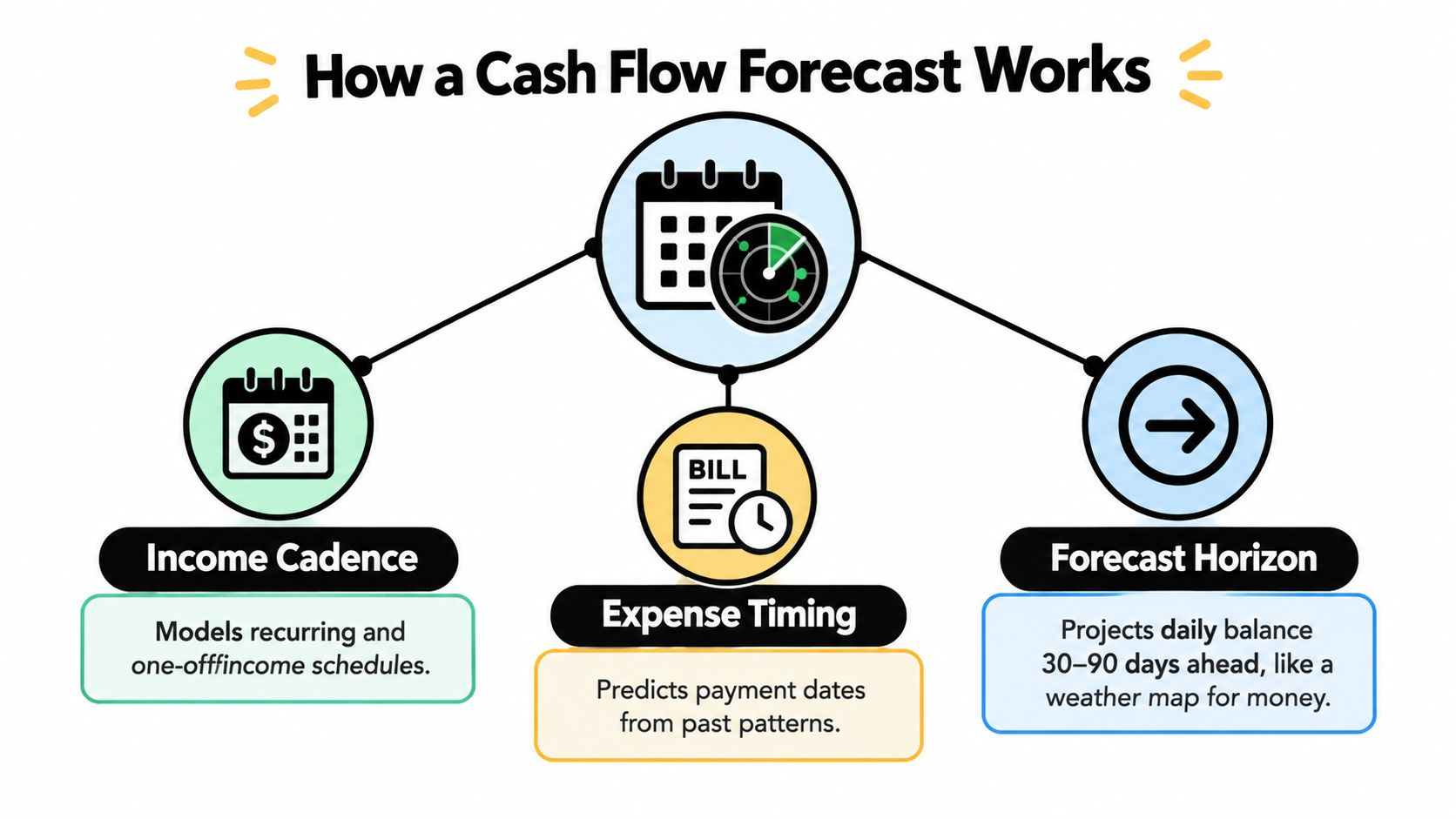
- It identifies income cadence, such as biweekly pay, monthly salary, gig payouts, or irregular deposits.
- It maps expense timing, including recurring bills and debt due dates.
- It projects the future balance path across days, weeks, or months.
Key concept: A budget explains behavior. A forecast supports timing decisions.
That's why someone managing debt often needs both. The budget helps reduce waste. The forecast decides whether money can safely move toward debt today.
For readers who want a business-oriented primer on the broader concept, this cash flow guide for small businesses offers a useful comparison between cash management and planning. For a more direct explanation of the forecasting concept itself, Toya's overview of what cash flow forecasting means gives a clear starting point.
What the app is really modeling
Under the hood, the app is trying to answer one practical question: What will the available cash likely be on each upcoming date?
That usually means modeling:
- Income sources: salary, side income, transfers, reimbursements
- Known obligations: rent, mortgage, minimum debt payments, subscriptions
- Variable spending patterns: groceries, fuel, childcare, entertainment
- Upcoming one-offs: annual renewals, travel, school costs, repairs
A basic tracker treats these as categories. A forecasting app treats them as drivers of future balance changes.
Why timing is the real value
Many people don't need a prettier spending pie chart. They need warning before money gets tight.
A stronger app makes the future visible enough to act early. If next Wednesday will be the low point of the month, the person can hold off on an extra debt payment, move a discretionary purchase, or test a different bill sequence. That's why the app's biggest value is liquidity timing, not historical reporting.
Core Features That Make Forecasts Useful
The usefulness of a forecast depends less on flashy charts and more on whether the app stays close to reality as money moves. That requires a system, not a single feature.
Data quality comes first
Forecasts only work when the app sees fresh account activity and understands what it means. Independent treasury guidance highlights how visibility into underlying cash drivers supports stronger forecasting and references about 90% quarterly accuracy when teams can clearly see those drivers, according to this cash forecast accuracy diagnostic.
For a household app, that translates into a few essential requirements:
- Reliable account connections: The app should pull bank and card activity through read-only links.
- Frequent syncing: New deposits, posted bills, and card activity should flow in quickly.
- Clear rules: Rent, minimum payments, subscriptions, and other recurring obligations should be recognized consistently.
When an app misses a bill or lags on updates, the forecast drifts. That's why account-linking quality matters so much. Readers comparing connection infrastructure may find Toya's guide to account aggregation services helpful for understanding how apps pull financial data together.
The forecast should behave like a rolling system
A strong cash flow forecast app doesn't create one static monthly estimate and leave it alone. It keeps updating as real life happens.
That means the forecast should recalculate when:
- a paycheck lands
- a credit card bill posts
- a large purchase changes expected cash
- a loan payment clears
- an irregular deposit arrives later than expected
This rolling approach matters because forecast reliability changes by horizon. One forecasting guide notes that well-run short-term forecasts often target 90 to 95 percent accuracy, while medium-term forecasts tend to be lower and long-term forecasts lower still, as explained in this guide to accurate cash flow forecasting.
Features that reduce uncertainty
A useful feature set works together. It shouldn't feel like a checklist of disconnected tools.
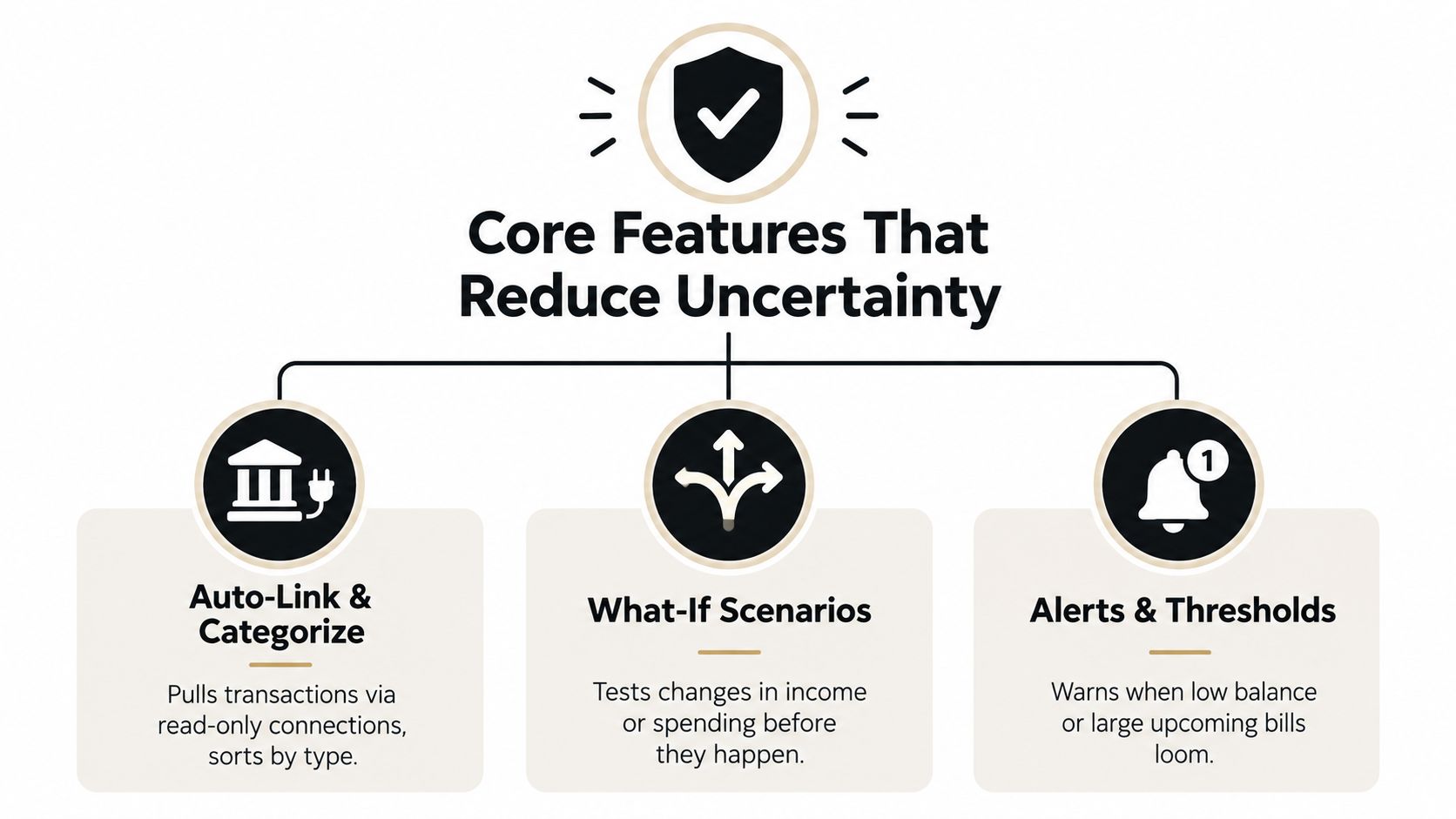
Auto-link and categorize
The app should identify incoming and outgoing transactions, group recurring items, and distinguish fixed obligations from flexible spending. A rent payment is not the same as a restaurant charge. The forecast needs to know the difference.
Driver-based forecasting
Instead of projecting from one monthly total, better apps build from the actual drivers of balance changes. For debt payoff, those drivers often include pay dates, card minimums, loan due dates, and recurring household bills.
Scenario planning
Forecasting guides increasingly treat scenario planning as essential, especially when disruption or opportunity changes the cash picture. A practical overview from Trovata notes that 2 to 4 week forecasts work best for day-to-day liquidity, while 13-week forecasts are better for budgets and longer-range planning, and that scenario planning is now a must-have, as described in this cash forecasting basics guide.
Alerts and confidence bands
The best apps don't only show one neat line. They warn when projected surplus drops below the amount needed for an extra debt payment, or when an upcoming week looks tight. They should also signal uncertainty, especially farther out.
A forecast is most useful when it says, “This payment looks safe,” or, “This week needs a buffer.”
How People Use Forecasts for Budgeting and Debt Payoff
The easiest way to understand a forecast is to watch it solve ordinary problems.
A budgeting example with a short horizon
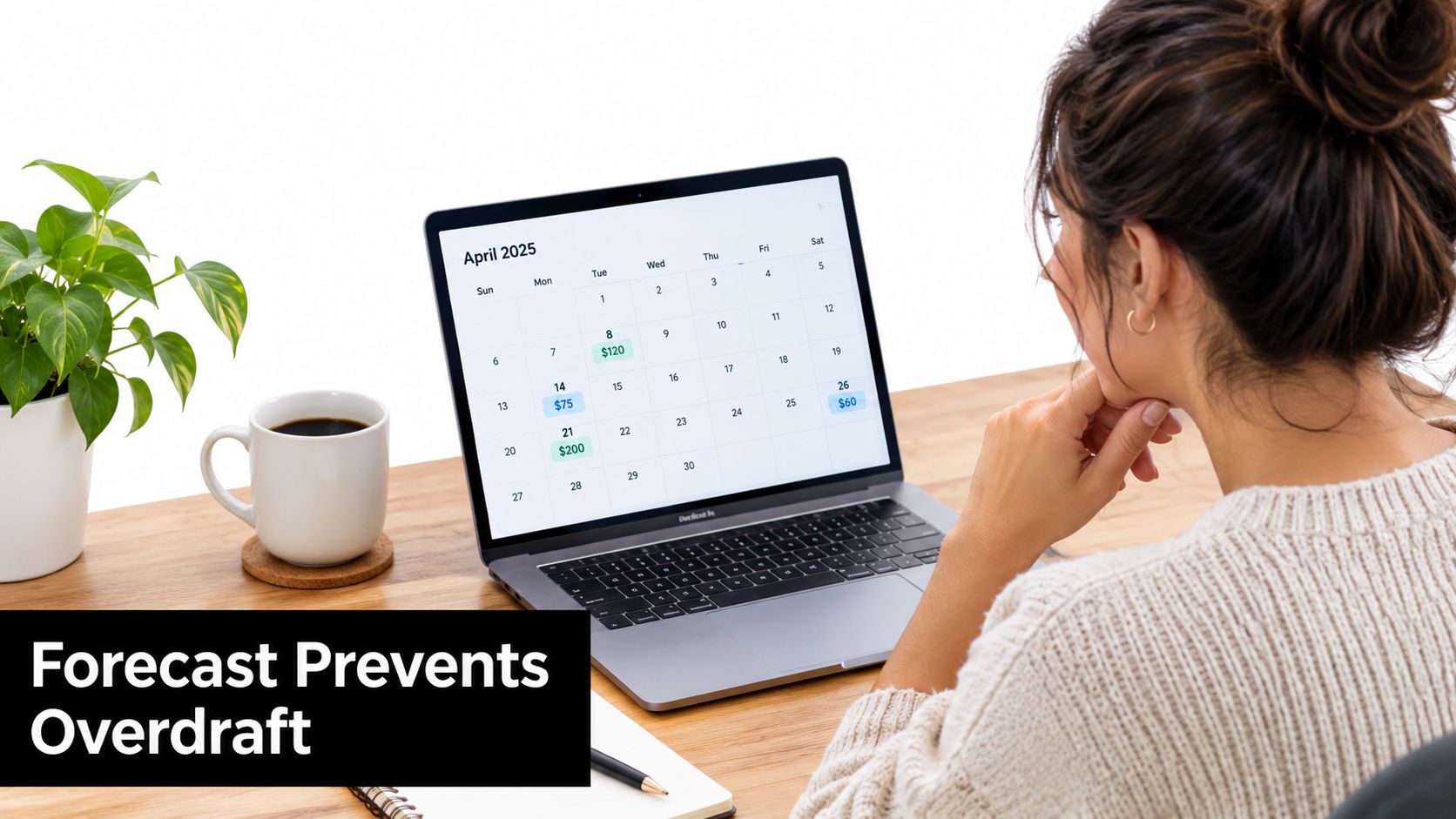
Consider someone whose bills bunch up in the middle of the month. They get paid, cover groceries, and assume the rest is fine. Then streaming renewals, a utility bill, and auto insurance all hit before the next paycheck.
A short-horizon forecast changes the decision. Instead of checking the account balance once, the person looks at the next few weeks day by day. That view can reveal a coming dip even when the current balance looks comfortable.
A simple use case looks like this:
- Today's balance looks healthy: There's no obvious problem at a glance.
- The forecast shows a low point next week: Several recurring charges post before income arrives.
- Action becomes clear: Delay a nonessential purchase, move money earlier, or pause an extra debt payment.
That's not glamorous. It is useful.
A debt payoff example where timing matters
Debt payoff gets more interesting because the best move isn't always “pay extra right now.” Sometimes the smarter move is “pay extra after the next paycheck clears.”
A forecast app helps compare both paths. If someone wants to send an additional payment to a credit card, the app can check whether that amount leaves enough room for rent, minimums on other loans, and ordinary spending before the next income date. If not, the app can suggest waiting until the cash window is safer.
The result is a debt strategy tied to timing, not just motivation.
Paying extra only works when the payment doesn't force new borrowing a few days later.
This is also where adaptive planning matters for households more than fixed monthly plans. Broader coverage of the market often frames forecasting as a treasury problem, but individuals deal with irregular income, delayed deposits, and tradeoffs between competing debts. A market overview at Dynamic Business also highlights that data collection and data quality remain major obstacles in forecasting, while the consumer challenge is often adapting continuously to changing income timing and debt obligations, as discussed in this overview of cash flow forecasting tools.
Comparing this month versus next month
A practical forecast app should also let users test alternatives.
For example:
- Option one: Make an extra payment this month and keep only a thin cushion.
- Option two: Wait until the next paycheck cycle and make the same payment with less risk.
- Option three: Split the extra amount across two dates to reduce stress on the checking account.
That sort of comparison turns debt payoff into a planning exercise instead of a guess.
For readers who prefer a visual walk-through, this short explainer helps show how forecasting fits into everyday money management.
When income isn't predictable
Forecasts become even more valuable when income changes from week to week. Freelancers, commission earners, tipped workers, and households with mixed income streams rarely fit clean monthly budgets.
In those cases, the forecast gives structure to uncertainty. A person can test what happens if income lands later, if a client pays slowly, or if one week comes in lighter than expected. The goal isn't perfect prediction. The goal is avoiding the moment when a debt payment seemed affordable until the calendar proved otherwise.
How to Evaluate and Choose the Right App
Not every app that shows future balances is equally trustworthy. The right choice depends on whether the app handles real-world timing well enough to support decisions.
Start with trust and access
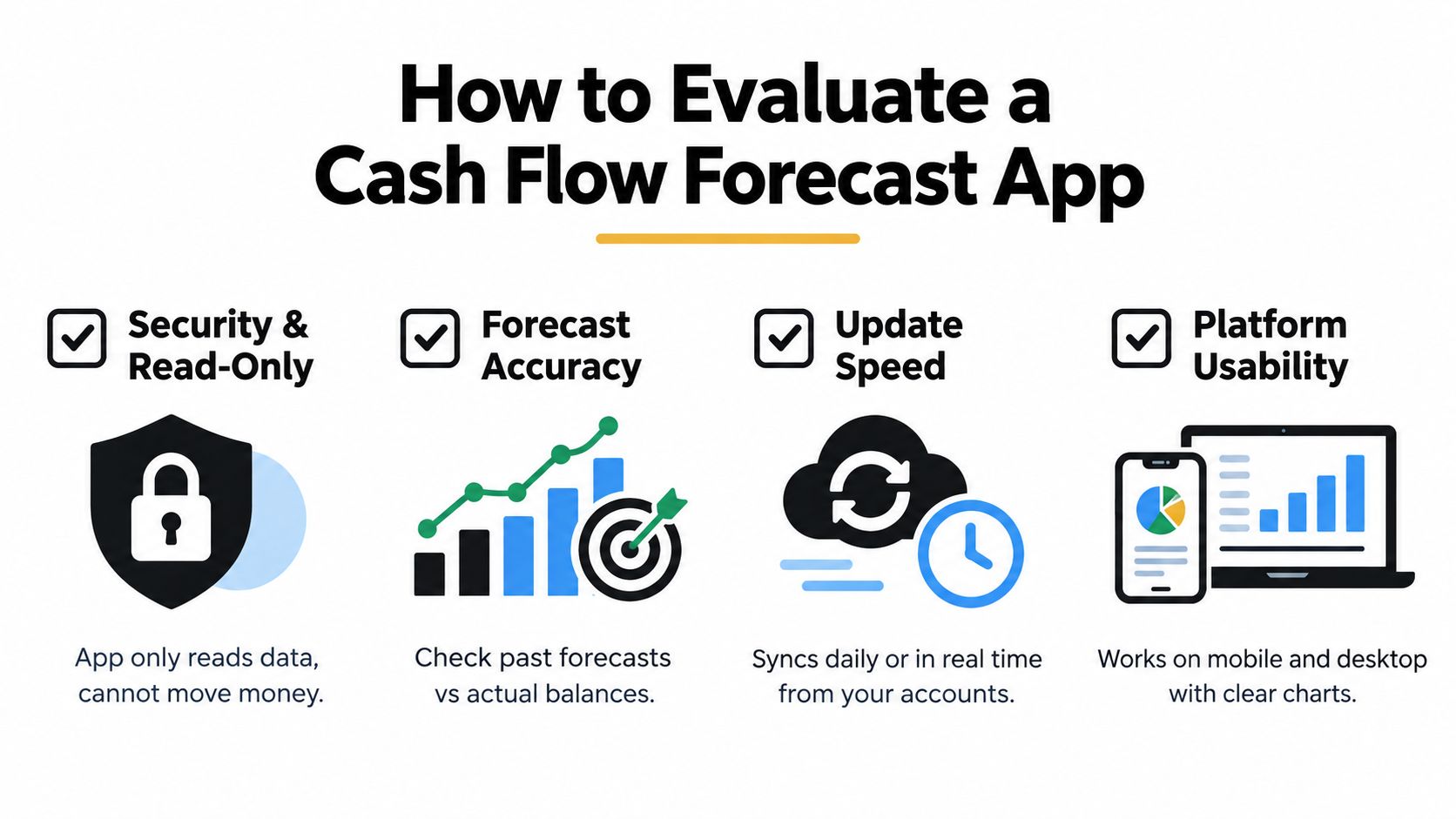
First, check how the app connects to financial accounts. It should use read-only access for visibility, not permission to move money. It should also explain its data practices clearly.
Security questions matter because forecasting only works when users connect real accounts, real debts, and real balances. A useful review framework for this side of the decision is Toya's article on financial data security.
Accuracy should be transparent
A good app shouldn't hide behind vague words like smart, predictive, or AI-powered. It should show how forecasting is evaluated.
One published benchmark reports that a 13-week forecast averages 87% accuracy, while annual forecasts fall to 72%, and it recommends targeting 90% or more for 13-week forecasts while treating performance below 80% as a sign that the process needs improvement, according to this research on cash flow forecasting accuracy.
That matters because horizon changes everything. A short view used for bill timing should be judged differently from a long-range planning view.
A finance-focused guide also recommends measuring accuracy with MAPE at 30-, 60-, and 90-day horizons, along with directional accuracy that tests whether the model correctly predicts whether cash will rise or fall, as explained in this guide to AI cash flow forecasting metrics.
Cash Flow Forecast App Evaluation Checklist
| Evaluation Criteria | What to Look For | Why It Matters |
|---|---|---|
| Security and permissions | Read-only connections, clear privacy policy, no ability to move money without separate authorization | Users need visibility without adding avoidable risk |
| Bank and card integrations | Stable syncing across checking, credit cards, and loans | Missing or delayed data weakens the forecast |
| Forecast horizons | Separate short-term and longer-term views instead of one blended line | Bill timing decisions need a different lens than broader planning |
| Accuracy transparency | Clear explanation of error tracking, past forecast versus actual comparison, and horizon-specific evaluation | Forecasts are easier to trust when the app shows how it measures itself |
| Scenario flexibility | Ability to test changed pay dates, delayed income, or extra debt payments | Real life rarely follows one fixed path |
| Debt-payoff relevance | Due dates, minimums, balances, and payoff tradeoffs built into the experience | People managing multiple debts need more than category tracking |
What to test during a trial
A free trial or demo should answer practical questions fast.
- Run a near-term check: Does the app show the next few weeks clearly enough to spot a low-balance date?
- Test one irregular event: Change an expected deposit date or add a one-time bill. See if the forecast adapts.
- Compare forecast to reality: After a few days, check whether posted transactions changed the projection the way they should.
- Review debt handling: Confirm that credit cards, loans, and minimums appear as timing-sensitive obligations, not just generic expenses.
A person choosing a cash flow forecast app doesn't need a perfect crystal ball. They need a tool that stays current, explains uncertainty clearly, and supports safer payment timing.
Common Misconceptions That Lead to Poor Forecasts
Forecasting often goes wrong because people judge it by the wrong standards.
Myth versus reality
Myth: One accuracy number tells the whole story.
Reality: Forecast quality depends on time horizon. A short forecast used to get through the next few weeks is naturally more reliable than a much longer one. Blending them into one score hides what matters.
Myth: A beautiful spending dashboard is the same as a forecast.
Reality: A dashboard can summarize where money went. It may still fail to warn that three bills hit before the next paycheck.
Myth: A monthly plan is enough.
Reality: Static monthly plans often miss the sequence problem. A month can look fine in total and still contain one dangerous week.
Why horizon matters
Independent finance research summarized in 2026 reported that 64% of treasury and finance teams were using AI or machine-learning tools for at least one part of cash flow forecasting, up from 38% in 2023 and 51% in 2024. The same source reported adoption at 79% for companies above $1 billion in annual revenue, compared with 61% for mid-market firms and 31% for smaller firms under $100 million, according to this summary of AI cash flow forecasting adoption. The lesson for consumers isn't that bigger companies have better apps. It's that forecasting is increasingly treated as a living, data-driven process, not a one-time spreadsheet exercise.
What actually matters
The strongest consumer forecast isn't the one that pretends to know the future with certainty. It's the one that adapts quickly and warns clearly.
That means users should care about whether the app:
- Updates as transactions post
- Separates near-term and longer-term views
- Flags when projected surplus isn't enough for an extra debt payment
- Shows uncertainty instead of one overconfident number
Forecasting works best when it guides the next decision, not when it tries to look impressive.
Putting Your Forecast Into Action
A forecast becomes useful when it changes behavior in small, timely ways.
A simple starting sequence
Someone using a cash flow forecast app well will usually follow a rhythm like this:
- Connect accounts securely. Link checking, credit cards, and loans so the forecast can see actual balances and obligations.
- Verify recurring drivers. Check pay dates, rent or mortgage timing, minimum debt payments, subscriptions, and insurance drafts.
- Run two views. Look at a short near-term window for day-to-day liquidity, then a broader quarter-length view for planning.
- Test one scenario. Move one paycheck date, add one annual bill, or compare an extra debt payment now versus later.
- Set a surplus threshold. Only make additional debt payments when projected cash stays above a chosen safety buffer.
That process sounds simple because it should be. The point isn't to turn personal finance into a full-time forecasting project. The point is to build enough visibility that fewer surprises slip through.
What success looks like in the first month
A person using the app effectively should start noticing a few signs:
- upcoming tight weeks become visible earlier
- extra debt payments feel more deliberate
- fewer bills arrive as surprises
- checking account decisions depend less on guesswork
A forecast also works best when it's revisited often enough to match reality. That habit of adapting matters in all kinds of financial planning. Founders describing lean operating discipline often make the same broader point. Careful timing and constant adjustment matter more than polished plans, which comes through clearly in these bootstrapping experiences at Underdog.io.
The deeper shift
The biggest benefit of a cash flow forecast app isn't that it predicts everything perfectly. It changes the question from “Can this be afforded in general?” to “Can this be afforded on this date, without causing a later problem?”
That's the question that protects bill coverage. It's also the question that helps people pay off debt with more confidence and less backtracking.
If the app helps a household avoid one avoidable shortfall, postpone one risky extra payment, or spot one better moment to attack a balance, it's already doing meaningful work.
Toya AI helps people turn this kind of timing into an adaptive debt payoff plan. It brings connected balances, due dates, loans, and credit cards into one place, then shows how each payment choice affects the path ahead as cash flow changes. Readers who want a clearer way to plan extra payments without guessing can explore Toya AI.
Ready to start your debt-free journey?
Toya AI builds a personalized payoff plan so you can see your debt-free date and save on interest.
Get Started Free