
Can I Change My Loan Repayment Plan? Your Complete Guide
Can a borrower lower this month's payment without accidentally making the loan more expensive, losing access to future options, or missing a deadline that changes the calculation? That's the gap behind the question, “Can I change my loan repayment plan?” The short answer is usually yes, but the right choice depends on the loan type, repayment history, income, family circumstances, loan dates, and the consequences attached to each option.
Federal student loans generally offer more flexibility than private loans, while mortgages use formal loss-mitigation processes rather than simple plan switches. A lower payment may provide essential breathing room, yet it can also extend repayment, increase interest, or affect eligibility later. The safest approach is to compare the new payment with the projected payoff date, total interest, documentation duties, and any future borrowing plans before accepting a change.
Table of Contents
- Can You Change Your Loan Repayment Plan
- How Federal Student Loan Repayment Plans Work
- Private Loans and Mortgage Repayment Changes
- When Changing Plans Can Increase Total Cost
- Real Borrower Scenarios and Outcomes
- How to Switch Repayment Plans Step by Step
Can You Change Your Loan Repayment Plan
Federal student-loan borrowers can generally request a different repayment plan at any time through their loan servicer. That includes asking for an income-driven repayment calculation after income falls, changing to another eligible plan, or leaving a plan whose payment no longer fits the household budget. Federal Student Aid explains the available repayment arrangements and the process for requesting a change through its repayment plan guidance.
A practical example makes the principle clearer. A borrower who leaves a higher-paying job for part-time work may submit updated income information and request a recalculation. A borrower who adds a dependent may also see a different income-driven payment because the calculation considers income and family size. The payment may be as low as $0 in some cases, but the result depends on the borrower's documentation and eligibility.
A plan change isn't the same as erasing the debt. It can alter the required payment, the repayment period, interest treatment, and the borrower's progress toward a forgiveness or discharge strategy. Some changes can also cause unpaid interest to capitalize, meaning it's added to the principal balance.
Practical rule: A borrower should never judge a plan only by its first monthly payment. The written comparison should also show the projected payoff date, balance, interest treatment, and future eligibility.
Private student loans follow lender-specific rules. Some lenders may offer hardship arrangements, temporary payment relief, or refinancing, while others may require a direct renegotiation. Mortgages are different again, because a payment change generally requires a formal modification or repayment arrangement.
Before requesting anything, the borrower should identify the loan category, current plan, servicer, interest treatment, outstanding interest, and upcoming deadlines. The request should be made in writing or confirmed in writing, with the effective date and first new payment clearly recorded.
How Federal Student Loan Repayment Plans Work
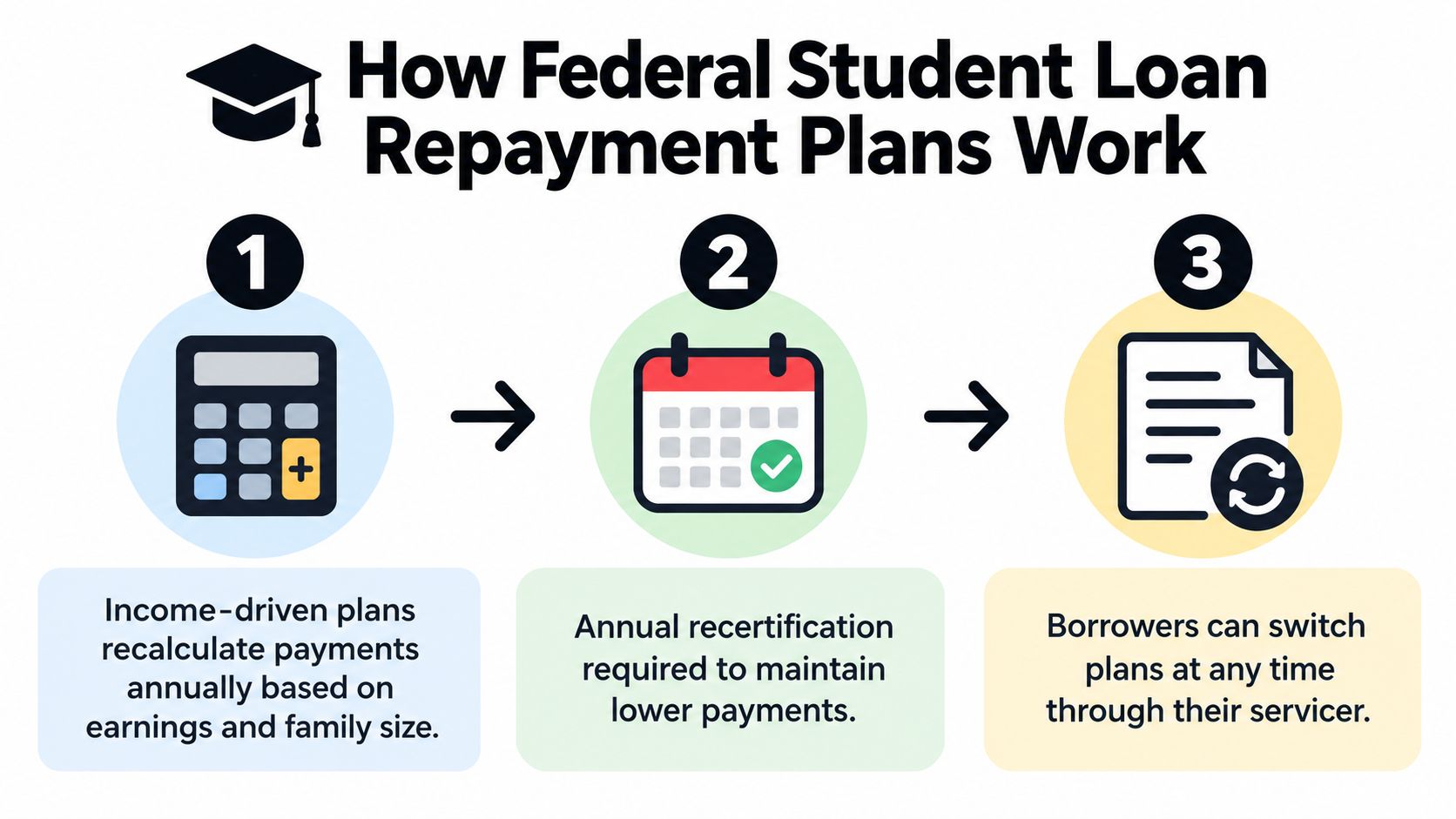
How can two federal loans lead to very different payment choices? The answer is that federal repayment plans follow different rule sets. A standard plan usually uses equal monthly payments over 10 years, while income-driven plans adjust the bill based on income and family size, as described in the Consumer Financial Protection Bureau's student-loan repayment research.
That difference matters in daily life. A borrower on a standard schedule can often predict the payment path from the start. A borrower on an income-driven plan is using a formula that has to be refreshed. Annual recertification is part of the design, even if income and household size stayed the same. If income drops, work changes, or the household adds a dependent, the borrower can usually submit updated information before the next annual review instead of waiting.
The overlooked danger is missing that recertification deadline, because the payment can reset in a way the borrower did not expect.
Why loan dates matter
Payment formulas are only part of the picture. Eligibility also depends on the loan's timeline and structure. The disbursement date matters. Whether the borrower later adds a new federal loan matters. Consolidation matters too, because combining loans can change which menu of plans remains available.
Borrowers with new loans disbursed on or after July 1, 2026 will generally choose between the Repayment Assistance Plan, or RAP, and a new tiered standard plan, while older loans may still have access to IBR, ICR, PAYE, graduated, or extended repayment, subject to transition rules. The MOHELA repayment-plan information explains that distinction.
Borrowers often lose options here without realizing it. An older loan can carry repayment choices that look stable today, but a later borrowing decision or a consolidation request can reshape the rules. It works a bit like merging two road maps into one. The route may become simpler, but some exits disappear.
A safer decision framework is to compare more than the next bill. Before changing anything, check the current payment, the recertification schedule, the payoff horizon, and whether combining loans could close off a plan you may want later. A side-by-side review such as this guide to the best student loan repayment plan can help a borrower compare those tradeoffs before making a move.
Private Loans and Mortgage Repayment Changes
Private student loans don't follow the federal repayment framework. The lender's contract and hardship policies control whether a borrower can change the payment, extend the term, obtain temporary relief, or refinance. A private lender may ask for proof of income, employment information, bank statements, or a formal hardship explanation before reviewing a request.
Refinancing can replace the original private loan with a new loan and may change the interest rate, term, or monthly payment. It can also change protections and fees, so a borrower should compare the replacement agreement with the existing contract rather than focusing on the advertised payment. Guidance on reducing the cost of private debt can complement, but not replace, the lender's written offer, such as this resource on how to pay off private student loans faster.
Mortgages use a more formal process. A homeowner generally can't select a new “plan” through a simple account setting. The servicer may evaluate a repayment plan, which spreads missed payments over a defined period, or a loan modification, which changes the underlying terms.
Modification versus repayment plan
A repayment plan can add overdue amounts to future bills. That may resolve arrears while leaving the original loan terms largely intact, but the regular payment can rise until the missed amount is repaid. A modification addresses a longer-term affordability problem by changing one or more loan terms.
A mortgage modification may include a longer repayment period, a lower interest rate, or principal forbearance or reduction. Those changes can lower the immediate payment, but they may increase the repayment horizon or total repayment cost, as explained in Freddie Mac's modification framework.
For homeowners comparing these paths, a plain-language overview of the mortgage modification process explained can help clarify the documents and decisions involved. The servicer's written proposal should show the modified principal balance, interest rate, maturity date, escrow payment, treatment of missed payments, and projected total interest.
The same discipline applies to private student loans. The borrower should request written terms, ask what happens to accrued interest and fees, and calculate whether the relief solves a temporary cash-flow problem or changes the debt's long-term cost.
When Changing Plans Can Increase Total Cost
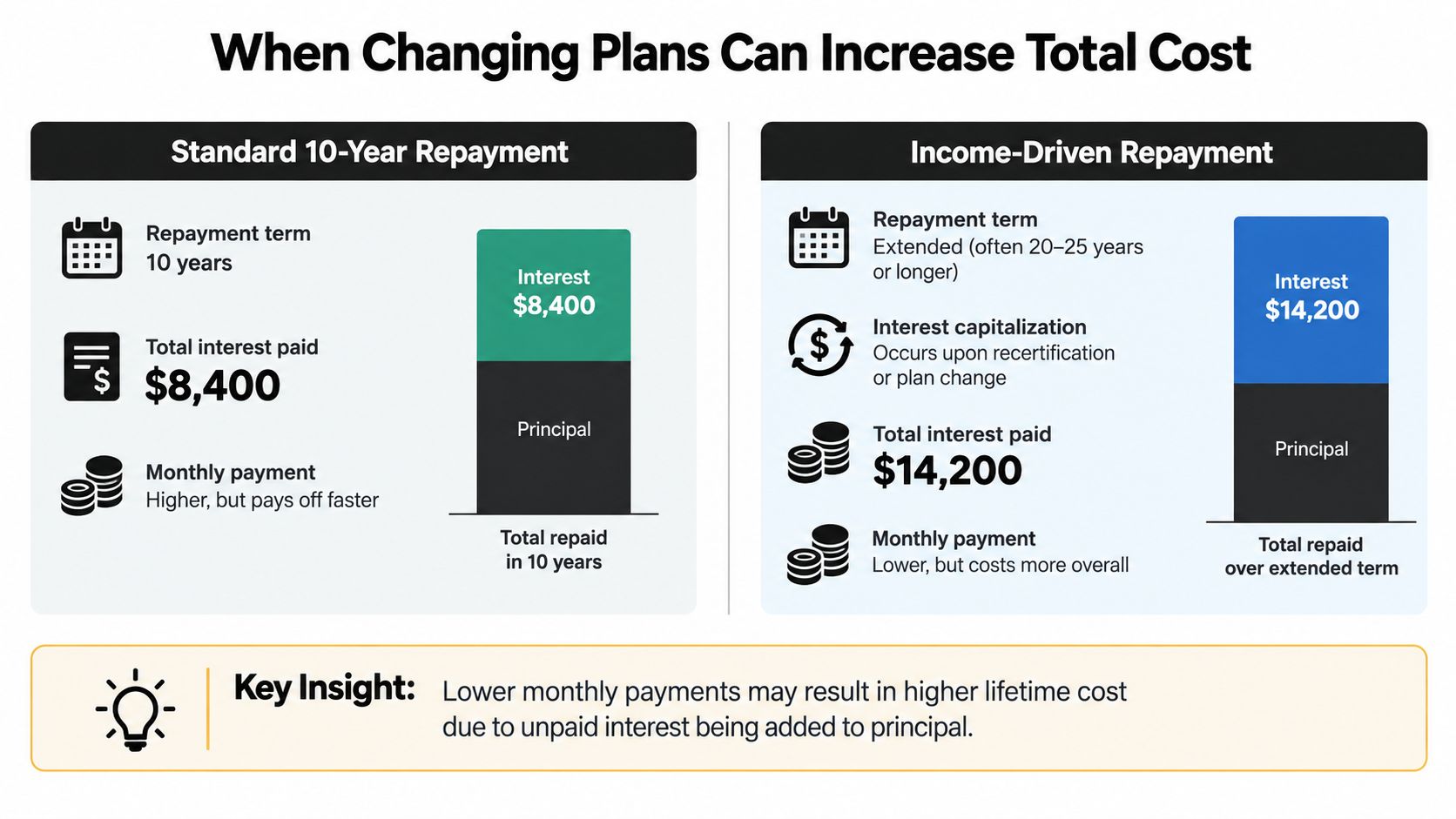
A lower monthly payment can be the right emergency decision without being the cheapest choice over the life of the loan. Income-driven repayment can improve cash flow when earnings fall, but a longer repayment period may allow interest to accumulate for longer. Switching plans can also trigger interest capitalization, which adds unpaid interest to principal and increases the balance on which future interest accrues, according to the federal income-driven repayment form.
Consider a borrower with unpaid interest of $2,000. If a plan change capitalizes that amount, the principal balance used for future interest calculations becomes $2,000 higher than it was before the change. That example doesn't predict the borrower's actual cost, because the result depends on the interest rate, payment amount, remaining term, and future plan. It does show why the borrower should ask for the balance before and after capitalization.
Four figures to compare
Before accepting a new plan, the borrower should request four outputs:
- Monthly payment: What amount will be due, and when will the new amount begin?
- Payoff date: How much longer will the borrower make payments?
- Cumulative interest: How much interest is projected under the new arrangement?
- Forgiveness progress: Will qualifying payment or discharge treatment continue under the new plan?
A borrower who switches from an income-driven plan to another arrangement may leave a plan that has accrued unpaid interest or specific eligibility requirements. Federal guidance also warns that leaving an income-driven plan or failing to recertify can lead to capitalization or a less favorable payment basis.
The recertification trap
A borrower who misses recertification may experience a payment increase even without a change in income. The problem isn't necessarily that the household can afford more. The problem is that the servicer may no longer be able to apply the income-based calculation without current documentation.
The borrower should set reminders well before the servicer's deadline, save submitted forms, and confirm that the servicer received the information. If the payment changes unexpectedly, the borrower should ask whether the change resulted from a missed recertification, an eligibility issue, a plan transition, or a capitalization event.
A payment reduction is useful only when the borrower understands what the reduction changes elsewhere in the loan.
Real Borrower Scenarios and Outcomes
What does a repayment-plan change look like once it hits a real bill, a real deadline, or a real household budget? Actual outcomes often turn on small details borrowers overlook, especially recertification deadlines and rules about which loans can stay on which plan. Earlier discussion noted that many borrowers either stay in the default option or are unsure what they selected. That confusion matters because a missed form or a plan change can alter both payment amount and future eligibility.

A job change prompts a recalculation
Jordan has a federal student loan on an income-driven plan. After changing jobs, Jordan's income falls and the household adds a dependent. Instead of waiting for the annual recertification date, Jordan contacts the servicer, submits updated income and family-size information, and asks for a written recalculation.
That choice works like updating a thermostat after the weather changes. If the old setting stays in place, the bill may no longer match the household's situation. The servicer reviews the new information and issues a revised payment that may be lower because the calculation now reflects current circumstances.
Jordan also checks two practical points that borrowers often miss. First, when does the new payment start? Second, does this update affect every loan in the account or only the loans that still qualify for that plan? Those questions help prevent a common mistake, assuming that one request automatically fixes the whole portfolio.
Lesson: A borrower with a real income or family change should request a new calculation promptly and confirm the effective date in writing.
A missed deadline causes a surprise
Riley's income has not increased, but Riley misses the annual recertification deadline. The servicer can no longer continue the prior income-based calculation on the same terms, so the monthly payment rises. The shock comes from paperwork, not from improved finances.
Riley contacts the servicer, asks what documentation is missing, and submits it. Riley also asks whether the higher payment came from the missed deadline, whether unpaid interest was capitalized, and whether returning to the prior plan is still possible for each loan. That last question matters because some borrowers assume they can go back, even after a servicing change, consolidation choice, or eligibility break complicates the path.
Lesson: Recertification is not routine mail to ignore. Missing it can raise the bill and, in some cases, interfere with the borrower's place in a plan.
A homeowner compares two forms of relief
Morgan misses several mortgage payments after a temporary income disruption. The servicer offers a repayment plan that spreads the overdue amount across future bills. That can solve an arrears problem, but it can also make each monthly payment higher for a period.
When the income problem appears likely to last longer, Morgan asks whether a modification is available and compares the written terms side by side. The key question is simple: is the problem short-term catch-up, or long-term affordability? A repayment plan addresses missed amounts. A modification can change the structure of the loan itself, which may lower the immediate payment while extending the debt or deferring part of the balance.
Lesson: The right choice depends on the type of hardship. Borrowers should compare how each option changes payment, timeline, and future flexibility before agreeing.
How to Switch Repayment Plans Step by Step
A borrower ready to change plans should treat the process like a documented financial decision, not a quick payment preference. The first task is to identify the loan type and current arrangement. Federal student loans, private student loans, and mortgages use different eligibility rules and different application channels.
Gather the right information
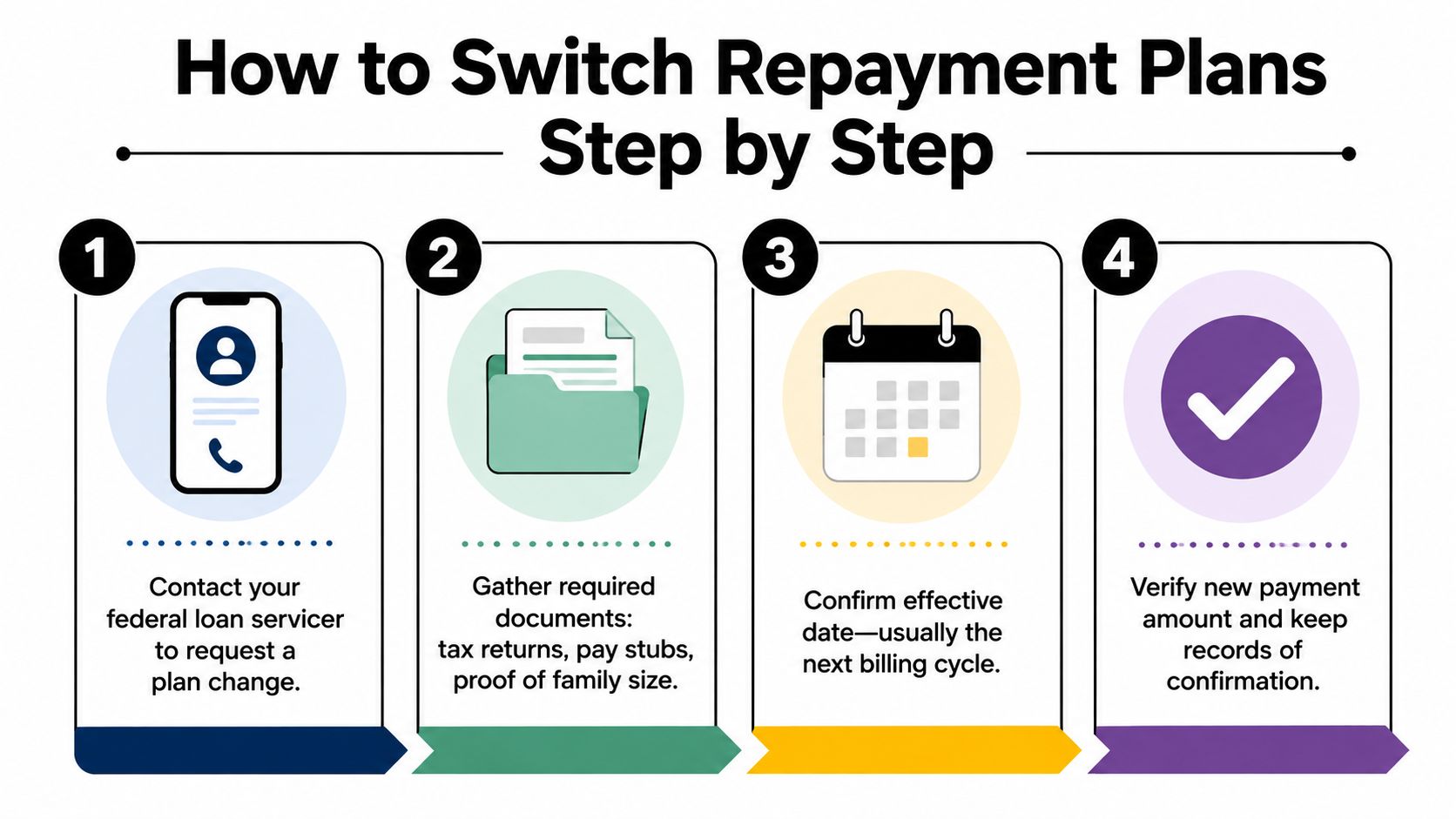
Federal borrowers should contact the loan servicer and ask which plans are currently available for each loan. For an income-driven request, the borrower should prepare current income information and family-size details. The servicer may also require supporting records, so the borrower should keep copies of tax documents, pay information, submitted forms, and confirmation numbers.
The borrower should ask four direct questions:
- Which plans are available for each loan?
- Will switching capitalize unpaid interest?
- What will the new payment and projected payoff date be?
- On what date will the new plan become effective?
A borrower with multiple loans should ask whether the request applies to all loans or only selected loans. Combining loans, consolidating, or taking out a future loan can affect eligibility, so the borrower should ask how the requested action changes the available options later.
After submitting the request, the borrower should check the account for the effective date and first payment amount. A payment shown during processing may not be the final amount. If the servicer provides a verbal answer, the borrower should request written confirmation.
Prepare for automatic placement
Federal Student Aid states that borrowers who don't select a plan after applicable notices may be placed automatically into a fixed-payment plan. For loans disbursed on or after July 1, 2026, the listed default is the Tiered Standard Plan, while borrowers can still request another eligible plan, as explained in Federal Student Aid's SAVE update.
Ignoring a notice can therefore produce a payment that doesn't match the borrower's intended income-based strategy. The borrower should read every servicer notice, record the deadline, submit the official application, and confirm the first payment in writing.
A personal tracking tool can support the comparison. Toya AI centralizes balances, APRs, due dates, and cash flow, then shows how payment changes affect projected payoff timing, interest, and total cost. Borrowers comparing options can also review how to change a plan before deciding which figures to track.
The final checklist is simple: verify eligibility, compare total cost, submit complete documents, confirm the effective date, monitor recertification, and save every response. A borrower who wants a clearer view of competing payments and payoff outcomes can visit Toya AI to connect debt information securely, review personalized projections, and track how repayment decisions change the path to becoming debt-free.
Ready to start your debt-free journey?
Toya AI builds a personalized payoff plan so you can see your debt-free date and save on interest.
Get Started Free