
Best Credit Card Payoff Strategy for Real Life in 2026
A card statement lands after rent, groceries, and a car repair have already taken their share. The minimums are covered, but the balances barely move, and the next unexpected bill could send them right back up. The best credit card payoff strategy for that situation has to do two jobs: reduce interest and stay workable when life interrupts.
The math points to paying the highest-rate balance first. But a plan only works if payments keep coming after the early burst of motivation fades. The right approach protects every account from missed payments, directs extra cash with purpose, and adjusts when income or balances change.
Table of Contents
- Why the Best Payoff Strategy Starts With Two Questions
- How Credit Card Payoff Mechanics Actually Work
- Avalanche vs Snowball With the Same Numbers
- Balance Transfer and Consolidation as Rate-Shifting Tools
- Hybrid and Adherence-First Strategies for Real Life
- Automating the Plan and Using AI to Stay on Track
- Which Strategy Fits You and Your First 30 Days
Why the Best Payoff Strategy Starts With Two Questions
Maya, a nurse practitioner, sits at her kitchen table with four card statements spread in front of her. She owes $18,400 across balances at 16%, 22%, 25%, and 29% APR. The minimums add up to $486 a month, and she has $1,100 in monthly cash flow available to put toward her debt.
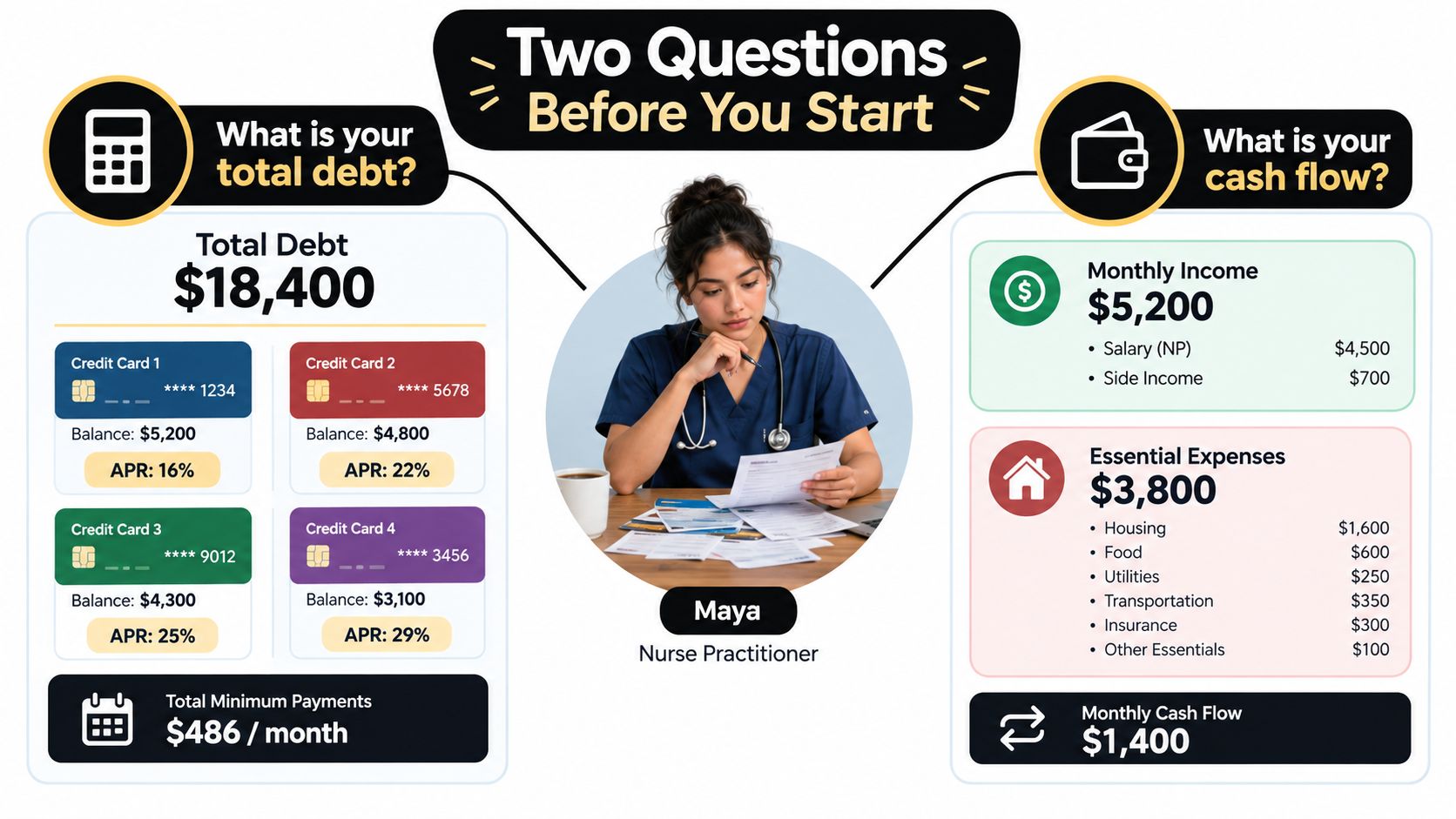
Maya's first decision is where the extra money goes. Paying the card at 29% APR first is the interest-focused choice. Paying off the smallest balance first could give her a quicker account closure and a visible win. Neither choice removes the second question: can she maintain the plan when a family expense, schedule change, or lower-income month arrives?
Those are separate problems. The first is interest optimization: which target balance makes each additional dollar work hardest? The second is adherence: which payment plan is she most likely to keep following? A payoff order that saves interest on paper can still fail if the monthly target leaves no room for ordinary surprises.
The scale of revolving debt is substantial. Aggregate U.S. credit-card balances reached $1.21 trillion in the second quarter of 2025, after rising $27 billion, or 2.3%, from the previous quarter, according to the Federal Reserve Bank of New York, as reported by Payments Dive's coverage of the Fed data. That context doesn't mean every household needs the same method. It does mean a plan should be built around actual balances, rates, due dates, and available cash, not a vague promise to “pay more.”
For Maya, the useful starting point is a clear inventory and an honest cash-flow figure. She should choose a target order, set a payment she can sustain, and decide what happens if her budget changes. The winning method is the one that balances cost savings with enough flexibility to keep moving.
How Credit Card Payoff Mechanics Actually Work
A payoff plan starts with how card interest is calculated. Many cards accrue interest daily, so an earlier payment can lower the balance used to calculate finance charges. The exact result depends on the issuer's calculation method, payment posting, fees, and any new purchases.
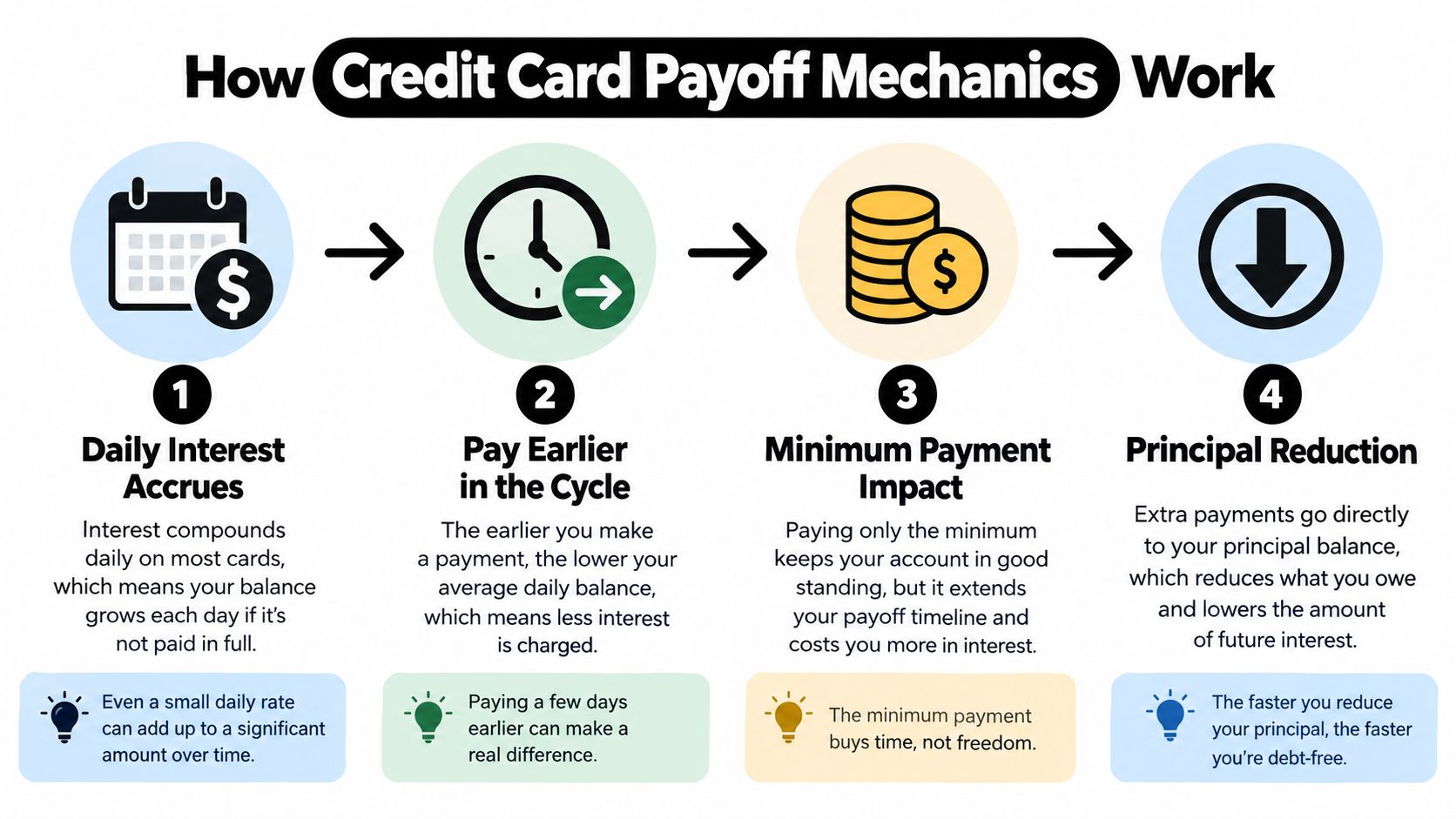
For example, a $10,000 balance at 24% APR accrues approximately $200 in interest during the first month, ignoring compounding and new charges. If the cardholder pays an extra $500 immediately, the balance falls by that amount, reducing the following month's interest by roughly $10. Those are illustrative figures, not a guarantee of the exact finance charge. The issuer's terms and timing determine the final result.
The Consumer Financial Protection Bureau explains how credit-card companies calculate interest. It also notes that when a payment exceeds the minimum, issuers generally apply the excess first to the balance with the highest interest rate, subject to account terms. For a plain-language refresher on what the stated rate means in practice, see this guide to credit card APR.
The minimum payment keeps an account current, but it doesn't make repayment cheap. The Federal Reserve Bank of Philadelphia reported that the share of active large-bank card accounts paying only the minimum reached a 12-year series high in the fourth quarter of 2024, then fell by 59 basis points in the first quarter of 2025; its report also said delinquency and charge-off measures stayed above pre-pandemic levels (Philadelphia Fed analysis).
Keep these mechanics fixed, whichever payoff method you choose:
- Cover every minimum. Schedule at least the required payment on every account to reduce the risk of late fees and payment-history damage.
- Choose one target. Put available extra cash toward a single balance rather than spreading it thinly across every card.
- Roll payments forward. When a balance is cleared, direct its former payment to the next target.
- Stop adding to the debt. New charges compete with repayment and can undo progress.
This short explainer also shows the practical relationship between payment timing, interest, and principal reduction.
Avalanche vs Snowball With the Same Numbers
The avalanche directs extra cash to the card with the highest APR, while the snowball targets the smallest balance first. Both require minimum payments on every other account. If a borrower keeps the same total payment amount and follows the plan, avalanche generally costs less in interest because it tackles the most expensive balance first.
Maya's card rates range from 16% to 29%, so her highest-rate target is clear. But the balances also matter. If her lowest balance sits at the lowest APR, snowball may close an account sooner, while avalanche could leave her without an early payoff milestone. The actual interest total and debt-free date depend on her balances, payment timing, and charges, so no honest comparison can assign exact outcomes without those details.
| Method | Order rule | Total interest | Months to debt-free | First account closed |
|---|---|---|---|---|
| Avalanche | Highest APR first | Usually lower when other factors are equal | Depends on balances and payment amount | Highest-rate card |
| Snowball | Smallest balance first | Can be higher than avalanche | Depends on balances and payment amount | Smallest-balance card |
Behavior can change the result. A peer-reviewed study found that borrowers using the snowball rule reduced their average number of payments by 15% and their median number by 9%, despite generally paying more interest than an APR-ranked approach (academic study of debt repayment methods). A separate academic analysis estimated that following snowball rather than an interest-minimizing approach led to 1.8%–4.3% additional interest on average (analysis using Survey of Consumer Finances data).
Those findings point to a practical choice, not a moral one. Avalanche is the stronger default when payment discipline is solid and rate differences are meaningful. Snowball can be the better fit when a fast account closure makes the difference between staying engaged and abandoning the plan.
Choose avalanche when steady follow-through is realistic and high rates are costing you. Choose snowball when an early win is what will keep you paying.
Balance Transfer and Consolidation as Rate-Shifting Tools
Changing the order of repayment isn't the only way to cut interest. A balance transfer or consolidation loan can shift debt to a different rate structure, but neither option removes the need for a clear payment plan.
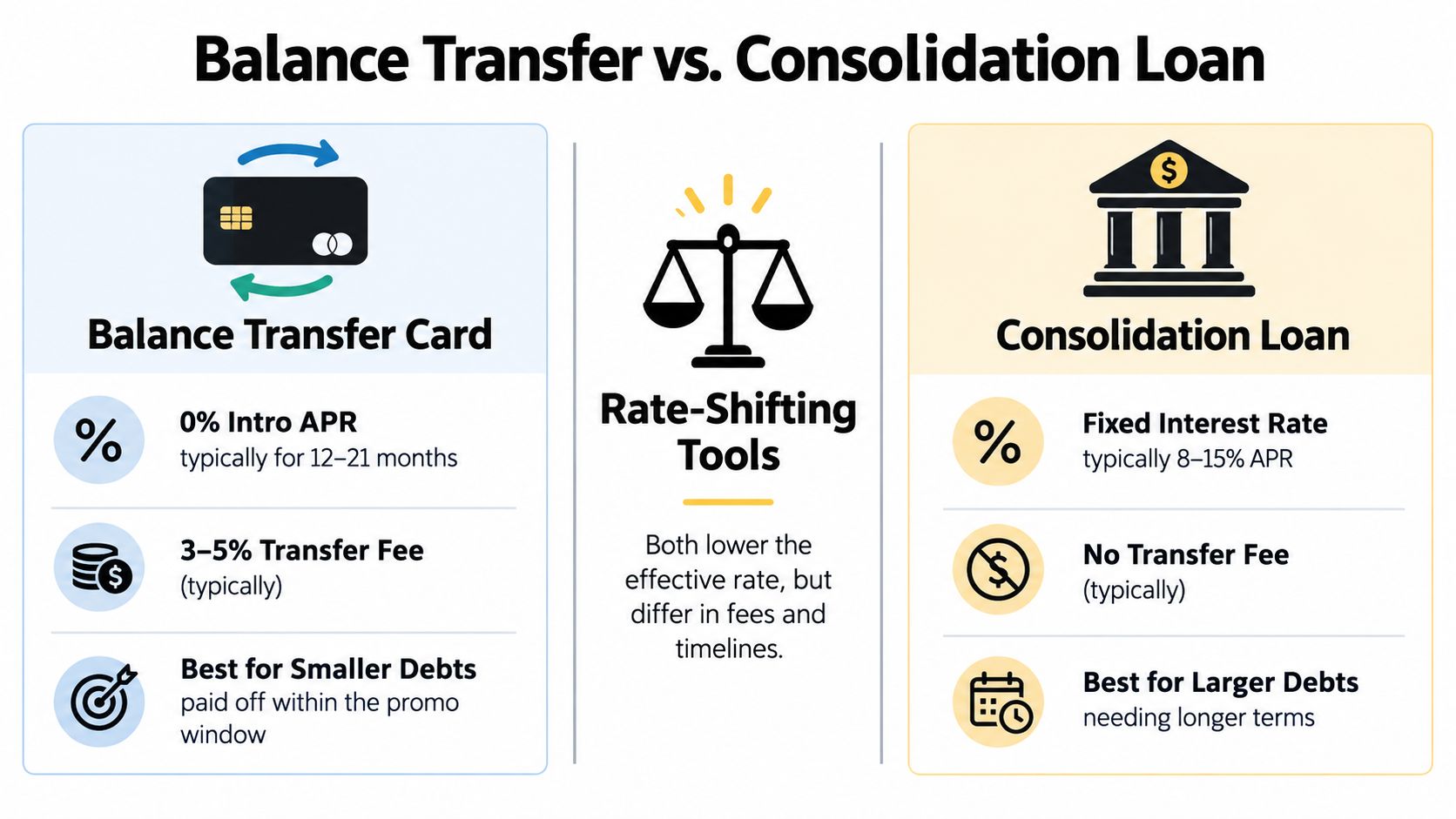
A balance transfer may make sense when a borrower qualifies for a promotional rate, understands the fee, and can repay the transferred amount before the promotion ends. For a simplified example, moving $7,000 from a card at 24% APR to a card at 0% for 18 months could avoid roughly $1,400 in interest over that period if the full amount otherwise remained at 24%. That estimate ignores the transfer fee and assumes the promotional terms hold. A fee of 3% to 5% would reduce the savings, and any remaining balance after the promotional period could face the card's regular APR.
A consolidation loan replaces several card payments with one fixed payment. It can help if the loan's rate is lower and the borrower doesn't stretch repayment so long that fees and interest erase the benefit. It can also simplify due dates. But it doesn't stop someone from running the cards back up after consolidation.
| Decision point | Balance transfer card | Consolidation loan |
|---|---|---|
| Rate structure | Promotional rate, then the terms set by the issuer | Fixed rate and repayment schedule |
| Costs to check | Transfer fee and post-promotion APR | Origination fees and total interest over the term |
| Useful when | The balance can be paid down during the offer period | A lower rate and manageable fixed payment are available |
| Main risk | Promotion ends before repayment is complete | Cards accumulate new balances after the loan pays them off |
Rate-shifting deserves extra scrutiny when debt is tied to housing. Homeowners weighing property-based options can compare remortgaging options for debt alongside unsecured choices, while carefully considering the consequences of securing borrowing against a home. For a closer look at card-specific transfer considerations, read this guide to credit card debt balance transfers.
A lower rate is useful only if the new terms are better and the borrower follows through. Research on payment prompts found that behavior tends to cluster around paying in full or near the minimum, with few intermediate payment amounts; disclosure changes increased payments by about $19 per month on average (CFPB-backed payment behavior research). That's a reason to set a concrete payment target, not to assume a new card or loan will create one automatically.
Hybrid and Adherence-First Strategies for Real Life
The choice doesn't have to be all avalanche or all snowball. A hybrid plan clears one small, manageable balance first, then switches to avalanche for the remaining cards. That can create an early milestone without giving up interest-focused targeting across the larger balances.
The trade-off is straightforward. If the smallest balance also carries a high APR, the hybrid's first move may still align with avalanche. If it carries a much lower APR, paying it first can cost more than immediately targeting the most expensive balance. A borrower should treat that extra interest as the price of a motivational boost, then avoid turning one quick win into a permanent detour.

Sometimes the core problem isn't payoff order. It's cash-flow instability. Recent survey evidence indicates that 72% of surveyed U.S. cardholders had reduced balances only to see them rise again, while 58% reported significant stress or anxiety related to debt (ConsumerAffairs coverage of the survey evidence). When balances keep returning, a plan that sends every spare dollar to debt may leave too little cash for irregular bills or emergencies.
If a cash-flow shock keeps putting new charges on the cards, build a modest buffer and choose a payment amount you can keep making. A perfect APR ranking won't help if it triggers fresh borrowing or missed minimums.
A useful distinction is whether the borrower faces an interest problem or a solvency problem. Someone with reliable income who can cover essentials and minimums can focus on avalanche or a hybrid. Someone whose income varies, whose balances rebound, or who can't afford minimums needs to stabilize cash flow first. If minimum payments aren't affordable, contact the issuer or a qualified nonprofit credit counselor before missing them.
Automating the Plan and Using AI to Stay on Track
Automation reduces the chance that a carefully chosen payoff method slips because a due date gets missed. The FTC recommends recording each card's due date, paying at least the minimum on every account, and contacting the creditor promptly if the minimum can't be met. It also notes that paying more than once a month can accelerate repayment because extra money reaches principal sooner (FTC advice on paying card debt).
Set automatic minimum payments for every card, then schedule extra payments around paydays if cash flow allows. Verify that each payment is credited promptly and that split payments don't leave the required minimum unpaid by the due date. If a card's APR changes or a new charge appears, update the target order and payment estimate rather than relying on an old spreadsheet.
Toya AI is one option for borrowers who want that information consolidated. It connects accounts through partners such as Plaid, Fincity, Spinwheel, and Quiltt, then organizes balances, APRs, utilization, and due dates in a dashboard. Its plan can recalculate as balances and cash flow change, showing how a payment affects the debt-free date, monthly interest, and total cost. Anyone comparing digital money tools can also consider 1chat privacy-first AI chat as a separate resource for private AI conversations.
An adaptive tool is most useful when it acts as a trigger, not a substitute for judgment. When a rate changes, a balance rebounds, or income shifts, the next payment decision may need to change with it. Learn more about AI debt management and use any tool's projections as a prompt to review actual account terms and affordability.
Use the AI layer to spot the change and make the next move visible. It can't create cash flow or guarantee that a plan fits; the borrower still has to choose a payment that can be sustained.
Which Strategy Fits You and Your First 30 Days
The best fit depends on what threatens progress most: a high APR, too many balances, unstable cash flow, or the risk of missing minimums. Use this quick match to choose a starting point.
| Borrower profile | Recommended approach | Automation focus | Metric to watch |
|---|---|---|---|
| One card with a high APR | Avalanche, unless a rate-shifting offer clearly lowers the cost | Automatic minimum and early extra payment | Interest and balance change |
| Several cards, stable income | Avalanche, or snowball if early closures sustain effort | Due-date reminders and rolled-forward payments | Payoff date and total interest |
| Variable income or recurring balance rebound | Hybrid or adherence-first plan with a cash buffer | Recheck the plan after income or balance changes | Whether balances rebound |
| Minimums are becoming unaffordable | Contact issuers or a nonprofit credit counselor before missing payments | Due-date alerts and hardship follow-up | Delinquency risk |
The cost of staying at minimum-only payments can be stark. On a $5,000 balance at 22% APR, the first month's interest is approximately $91.67. A fixed $250 monthly payment clears the balance in about 26 months, while one illustrative minimum-payment schedule takes roughly 230 months and generates about $8,099.70 in interest; actual terms depend on the issuer's formula, APR, fees, and payment timing (FTC guidance on credit-card repayment costs).
Start with a simple sequence: collect the latest statements, list every balance, APR, minimum, and due date, then automate minimum payments. Choose a first target and a payment amount that leaves room for essential expenses and a small emergency reserve. Review the plan when income changes or a balance rises, and track whether the debt is shrinking, not just whether one account closes.
Toya AI brings balances, APRs, utilization, and due dates into one dashboard, then helps map payments to an adaptive debt-payoff plan. Visit Toya AI to see how its projections can turn your next payment into a clear, trackable step.
Ready to start your debt-free journey?
Toya AI builds a personalized payoff plan so you can see your debt-free date and save on interest.
Get Started Free