
Auto Loan Payoff Early: How to Save Interest Safely
A borrower opens the banking app after payday and sees enough cash to make an extra car payment. The temptation is straightforward: send the money, shorten the loan, and stop paying interest sooner. Then the competing needs appear: a repair bill, a credit-card balance, and savings that still feel thin.
An auto loan payoff early strategy should start with those competing demands, not the satisfaction of a disappearing balance. Early repayment works when the contract rewards it, the household can spare the cash, and another debt doesn't deserve the money first.
Table of Contents
- How Much Faster Extra Payments Shorten the Loan
- Check Your Contract Before Sending Extra Money
- Biweekly, Rounding Up or Lump Sums Compared
- How to Make Extra Payments Count Step by Step
- Refinancing or Paying Ahead Through the Break-Even Test
- Rank Your Auto Loan Against Other Debt
- Decide Whether Early Payoff Fits Your Budget
How Much Faster Extra Payments Shorten the Loan
Start with the scheduled payment. In NerdWallet's early-payoff example, a $30,000 loan at 6% for 60 months has a payment of about $579.98, nearly $4,800 in total interest, and approximately $800 in interest savings when the borrower adds $100 monthly, bringing payoff to about month 50.
The following hypothetical comparison extends that baseline. The estimates assume monthly simple-interest calculations, no prepayment charge, extra payments beginning with the regular schedule, and immediate principal application. Actual daily-interest results can shift with payment dates and the final partial installment.
Payoff timing and interest saved on a $30,000 loan at 6% for 60 months
| Extra payment | Monthly payment | Payoff month | Approximate interest saved |
|---|---|---|---|
| None (scheduled) | $579.98 | 60 | $0 |
| +$50 a month | $629.98 | About 55 | $470 |
| +$100 a month | $679.98 | About 50 | $800 |
| +$200 a month | $779.98 | About 43 | $1,390 |
| $2,000 lump sum in month 12 | $579.98, plus the lump sum | About 56 | $510 |
These are planning estimates, not lender payoff quotes. The important comparison is the direction and scale of the change: a manageable recurring addition can remove several scheduled payments without requiring enough cash to close the entire account.
A lump sum and a monthly habit solve different problems
A lump sum removes a block of principal immediately. Recurring extras keep reducing the balance throughout the repayment period, but they also require an ongoing commitment from the household budget.
The table doesn't compare equal amounts of extra cash. The larger monthly additions eventually contribute substantially more than the single lump sum, so their greater savings aren't evidence that recurring payments always outperform an equally sized payment made earlier.
For a borrower with predictable income, a smaller automatic addition may be easier to maintain than an ambitious target that gets abandoned. Someone receiving a bonus may prefer a lump sum while keeping the normal monthly budget unchanged.
Planning rule: Choose the largest extra payment that remains affordable during an ordinary difficult month, not just a good month.
An auto-loan payment estimator can compare proposed amounts before the borrower changes payment instructions. The useful inputs are the current balance, contractual APR, remaining term, and proposed extra payment.
The resulting savings estimate still needs a contract check. A calculator can model interest, but it can't establish whether the lender charges for prepayment or handles extra funds as intended.
Check Your Contract Before Sending Extra Money
Before increasing an auto loan payment, check how the contract calculates interest and what it says about early repayment. Simple interest is calculated on the outstanding principal, so paying principal down sooner reduces the balance used to calculate future interest.
A precomputed interest contract sets the finance charge at origination. Paying early may bring a rebate for unearned interest, but the savings can be lower than a standard amortization calculator shows. That difference can change whether an extra payment is worth committing.
Read the documents in this order
- Find the prepayment clause. Review the signed retail installment contract, not a dealer's summary or a sample agreement.
- Read the Truth in Lending disclosure. Check the interest method and any charge for early repayment. If the wording is unclear, ask the lender for an explanation in writing.
- Distinguish partial payments from full payoff. Confirm whether the clause covers extra principal payments, paying off the account, or both.
- Check the state rules that apply. Some states prohibit penalties for certain loans. The relevant rule depends on the actual agreement, so a general online statement may not settle the question.
The Consumer Financial Protection Bureau's prepayment guidance says whether a prepayment penalty applies depends on the contract terms and state law.
If documents conflict, don't rely on a verbal assurance from the dealership. Ask the lender to clarify which contract language governs before sending extra money. Keep the answer with your agreement.
The signed contract is the starting point. Get conflicting language clarified in writing before paying ahead.
For example, before using a bonus for a principal payment, ask the lender to identify the applicable clause and explain how it applies to that specific payment. A fee or restriction could reduce the value of paying early, so resolve it before moving money.
Record the answers to these checks. If the fee provision remains unclear, pause and get clarification rather than assuming the more favorable interpretation.
Biweekly, Rounding Up or Lump Sums Compared
A fixed monthly extra suits borrowers with a reliable surplus because it's easy to automate and reconcile. The scheduled payment remains separate from the optional acceleration amount, making it easier to reduce the extra without missing the required installment.
A household budget should determine the method rather than the appeal of a payment trick.

Extra-payment methods matched to cash flow
| Method | How it works | Best for | Watch out for |
|---|---|---|---|
| Fixed monthly extra | Same amount added monthly, such as a hypothetical $100 | Predictable surplus | Reduce optional extras before required payments become unaffordable |
| Biweekly payments | Half a payment every two weeks, producing 13 full payments annually | Paychecks arriving every two weeks | Third-party setup fees and lender handling of partial payments |
| Round up each payment | In the example, pay $600 or $650 instead of $579.98 | Variable income with a small surplus | Small additions are easy to skip |
| Annual lump sum | Apply an available tax refund, bonus, or windfall to principal | Irregular income | Confirm principal reduction rather than payment advancement |
Biweekly payments aren't a special interest discount
The calendar calculation produces 26 half-payments, equivalent to 13 full payments annually. Using the hypothetical scheduled payment above, the additional annual payment averages approximately $48 extra per month.
The benefit comes from paying more over the year and, where applicable, reducing principal sooner. It doesn't come from a special lender discount for choosing that schedule.
Some third-party programs charge setup fees. Direct payments can avoid that expense, but only if the servicer accepts the arrangement and credits the funds appropriately. A lender that holds partial payments until a full installment arrives may not deliver the timing benefit a borrower expects.
Consider a nurse with variable shifts. Rounding up during busy months may fit better than committing every paycheck to an aggressive extra amount. A freelancer might reserve money for taxes first, then apply an available surplus after filing.
The sustainable method is the one the borrower can maintain through at least a hypothetical twelve-month budget cycle. Whatever the method, the scheduled payment remains the floor, not an amount to skip because earlier extras created a payment cushion.
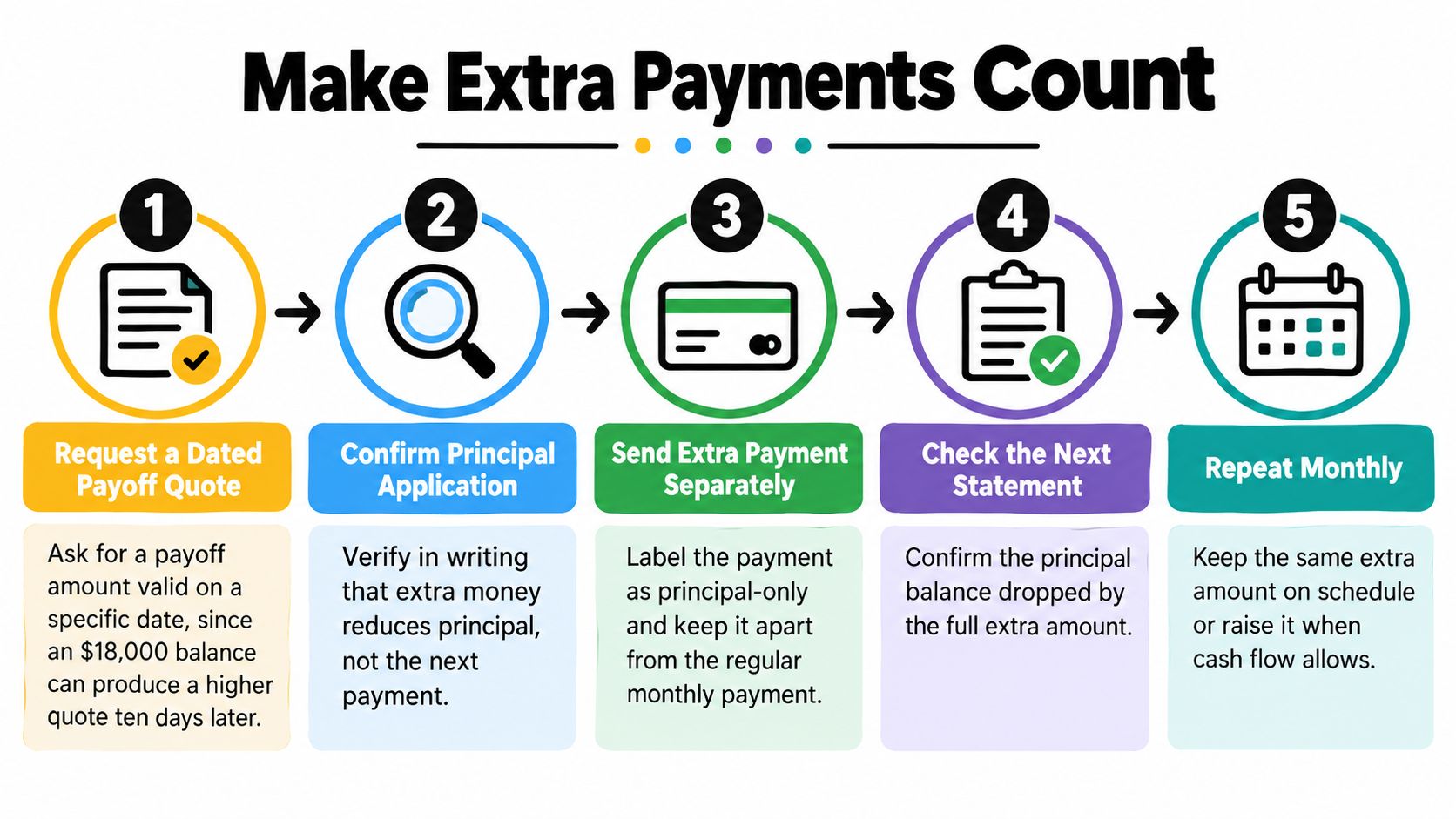
How to Make Extra Payments Count Step by Step
A successful extra payment requires more than a transfer confirmation. The borrower needs evidence that the lender applied the funds correctly and that the account remains on schedule.
The process below separates payment instructions from verification.
Prepare the account before accelerating it
Request a dated payoff quote. The CFPB's payoff guidance explains why the payoff amount can exceed the displayed balance; for example, an account showing $18,000 may require more ten days later because interest accrued and an unpaid late fee remains. Request the quote's expiration date, payment instructions, and an itemized breakdown rather than sending the displayed balance to close the account.
Resolve fees and accrued interest. The CFPB's payment-allocation guidance describes the usual order as fees, then accrued interest, then principal; its worked example leaves $400 for principal from a $600 payment when $40 in fees and $160 in interest are due. Ask the servicer whether any outstanding charges would absorb part of the intended extra payment.
Confirm the principal-payment procedure. Some portals provide a dedicated principal field; others require a separate transaction or instructions through customer service. Follow the servicer's process and retain written confirmation of how the extra funds will be applied.
Verify the result rather than trusting the button
Submit the extra with clear instructions. Use the principal-only option when available, or send a separate payment as directed. A free-text memo alone isn't reliable evidence that the lender will override its normal allocation rules.
Inspect the next statement. Compare the opening principal, regular payment allocation, extra payment, and closing principal. A later due date isn't proof of failure by itself, but payment advancement without the expected principal reduction needs investigation.
Repeat and document closure. Save confirmations and reconcile statements while acceleration continues. After the final payment, obtain written confirmation of a zero balance and ask when and how the lien or title release will be completed.
The distinction between a regular payment and an extra principal payment is especially important with autopay. A borrower who submits extra money manually should verify that the regular automatic installment will still process as expected.
The statement, not the payment-screen label, is the final check. If the allocation is wrong, contact the servicer promptly, request correction, and preserve the transaction record.
The embedded video offers another way to review early-payoff considerations before changing the payment routine.
If an extra payment leaves no cash for emergencies, pause it.
Refinancing or Paying Ahead Through the Break-Even Test
Consider a hypothetical refinance comparison: an $18,000 balance at 9% over 36 months carries about $2,590 in remaining interest, compared with about $1,710 at 6% over the same period. The approximate $880 difference falls to about $380 after a hypothetical $500 refinancing fee, before any old-loan penalty.
That example shows why a lower APR isn't enough. A longer replacement term can consume the remaining savings, even while producing a more attractive monthly payment.
Compare total cost, not just the installment
The Federal Reserve's analysis of high auto-loan payments provides context for evaluating payment affordability. For a full early payoff, the practical calculation is:
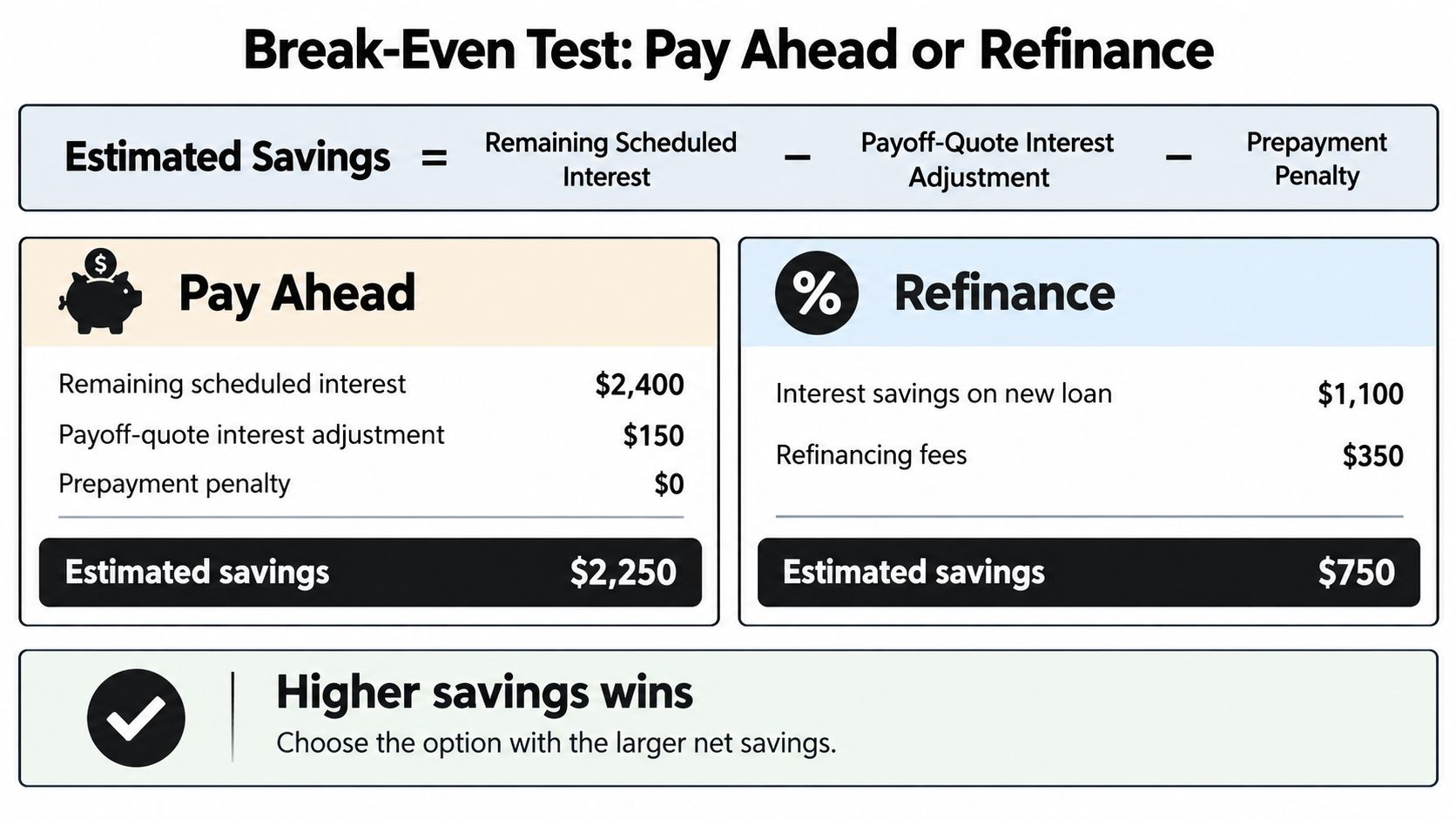
Estimated savings = remaining scheduled interest − payoff-quote interest adjustment − prepayment fee.
The adjustment should represent interest included in the payoff transaction that hasn't already been accounted for in the comparison. Don't subtract the same accrued interest twice. Partial prepayments require a revised amortization schedule rather than treating all remaining interest as avoidable.
The visual illustrates the comparison structure; actual decisions require matched balances, payment dates, and terms.
Paying ahead versus refinancing on the same balance
| Factor | Pay ahead on current loan | Refinance into a new loan |
|---|---|---|
| Upfront cost | Possible prepayment charge; verify processing charges | Old-loan penalty plus origination or documentation fees |
| Interest effect | Reduces interest under existing terms | Helps when the new APR and term reduce total cost |
| Credit impact | No new application; final closure may affect the score | Usually a hard inquiry and a new account |
| Flexibility | Optional extras can stop while required payments continue | Lower payment possible, but the term may extend |
| Negative equity | Extra principal narrows the shortfall | May carry the shortfall into replacement financing if approved |
| Best when | Existing rate is costly and penalties don't erase savings | Rate reduction outweighs fees without an unfavorable term extension |
Paying ahead preserves the existing agreement and avoids a new application. Refinancing can improve required cash flow, but its savings must survive every transaction cost.
Request both a dated payoff quote and a written refinance estimate. Compare total remaining payments, fees paid separately, and the proposed completion date before signing.
Rank Your Auto Loan Against Other Debt
An auto loan should not get extra cash solely because its balance feels manageable. Compare its cost with your other obligations, while keeping enough cash available for ordinary bills and unexpected expenses. A starter reserve of one month of essential expenses can help keep a surprise repair off a credit card.
Rank cost alongside payment risk
Where extra cash goes by debt situation
| Your situation | Put extra cash toward | Why |
|---|---|---|
| No emergency fund | Build one month of essential expenses first | Helps keep a surprise repair off a card |
| Card APR above auto loan APR | Credit card first | Higher-rate balances generally cost more |
| Auto loan APR above card promo rate | Auto loan, while funding card repayment before promotion expiry | Compare the current APRs and plan around the deadline |
| Any payment already late | Catch up on the late payment first | Avoid further fees, credit damage, and collection risk |
| Negative equity, payments current | Maintain payments and add extra cautiously | Principal reduction can narrow the shortfall, but does not restore vehicle value |
| Hypothetical student loan near 5%, auto loan at 6% | Auto loan after establishing reserves | The higher APR generally takes priority, subject to loan protections |
For example, a hypothetical card charging 22% normally deserves extra money before an auto loan charging 6%. If the auto loan is at 11% and a card has a temporary low-rate promotion, set a date-based plan to clear the card before its promotional terms expire. The rate comparison only works if required payments stay current.
Payment reliability can outweigh the interest-rate ranking. Federal Reserve analysis found auto-loan delinquency broadly flat through the first half of 2025 before increasing in the third quarter. Keep required payments on every account current before sending optional extra money to a loan with a higher rate.
Negative equity changes the trade-off. Paying down principal can reduce the gap between the loan balance and the car's value, which may make a future sale easier, but it does not reverse depreciation. Putting all available savings toward that gap can leave too little cash for a repair and force new borrowing. Extra principal is useful only if the remaining cash still meets near-term needs.
Priority check: Pay a late required bill before making an optional early payment on another account.
Use a debt-priority guide to organize competing obligations. Write down the order before sending extra money: catch up on overdue accounts, protect cash for essential expenses, then direct the remaining surplus toward the highest-cost eligible debt. If a promotional rate or loan protection affects the comparison, account for its terms before choosing where the next extra payment goes.
Decide Whether Early Payoff Fits Your Budget
A conservative five-point yes test gives the borrower a decision rather than another calculator result:
- Cash reserve: At least one month of essential expenses remains, or three months with variable income.
- Payment stability: No late payments during the past twelve months.
- Verified savings: Interest avoided clearly exceeds applicable charges.
- Cash comparison: Loan APR exceeds the after-tax savings yield.
- Vehicle equity: A sale wouldn't leave an unpaid shortfall.
These are planning guardrails, not lender requirements. For retirement-sensitive decisions, Prime Journal's money guidance for adults over 50 offers broader budgeting context.
The decision should be recorded before changing payments.

For example, a hypothetical borrower with two months saved, clean payment history, a penalty-free 6% loan, 2% savings yield, and positive equity could consider $100 extra monthly. Someone owing $3,000 more than the vehicle's value should reassess liquidity before accelerating.
If multiple tests fail, maintain scheduled payments and fix the weakest point first. If all pass, request the dated payoff quote and prepare an after-payoff plan.
Toya AI brings connected debt balances, APRs, and due dates into a personalized payoff plan and models how extra payments change projected interest and completion dates. Borrowers can visit Toya AI to compare an auto-loan acceleration plan against competing debts, then submit payments through their lender.
Ready to start your debt-free journey?
Toya AI builds a personalized payoff plan so you can see your debt-free date and save on interest.
Get Started Free