
Auto Loan Payment Estimator: What It Is and How to Use It
A shopper has two SUVs bookmarked, similar cargo space, different price tags, and no clear idea what either one would do to the household budget. One dealer advertises a low monthly payment, while the other highlights a lower price. Before scheduling a test drive, the shopper can enter each vehicle's price, down payment, estimated APR, and loan term into an auto loan payment estimator and see which option deserves closer attention.
That first number is useful, but it isn't the whole decision. A responsible estimate should also reveal the amount financed, total interest, payoff timeline, and how the new loan fits alongside credit cards, student loans, and other financial commitments.
Table of Contents
- What an Auto Loan Payment Estimator Does
- The Inputs That Drive Your Monthly Payment
- How the Math Turns Inputs Into a Payment
- Three Real Scenarios You Can Run Right Now
- Where Estimators Lead You Astray
- From Estimate to Payoff Plan With Toya
- Putting Your Estimate to Work This Week
What an Auto Loan Payment Estimator Does
A shopper comparing two SUVs can turn a few guesses into a useful budget test with an auto loan payment estimator. The tool applies a vehicle price, down payment, APR, and loan term to project a monthly bill. Depending on the calculator, the inputs may also include a trade-in, taxes, registration costs, and fees.
The calculation follows a clear path:
- Enter the vehicle price.
- Subtract the down payment and any net trade-in value.
- Add taxes and fees that will be financed.
- Enter an estimated APR and loan term.
- Review the projected payment and total borrowing cost.
Suppose one SUV costs more but has a lower estimated APR, while another costs less with a higher rate. Running both sets of figures creates a fair first comparison. The monthly payment is only the starting point. The estimate also gives the balance and total borrowing cost you can place beside credit cards, student loans, and other debts. If the rate or term changes, update the estimate and see how the broader payoff plan changes with it.
What the calculator can't do
An estimator doesn't pull credit, approve a loan, or lock in an APR. It only applies loan math to the figures entered by the user. A lender may offer different terms because the final APR can reflect credit history, loan-to-value percentage, vehicle age, loan amount, and lender fees, as explained by U.S. Bank's vehicle-loan payment calculator.
Treat the result as a planning figure, not a promise. It can show whether a vehicle belongs on the shortlist, while a lender quote replaces assumptions with verified terms.
Practical rule: Use the estimator before negotiating, then replace every guess with verified lender and dealer figures.
The tool fits between online research and a formal application. It can expose an unrealistic budget, compare shorter and longer terms, and show whether the proposed payment leaves room for other debt payments. Use an out-the-door price, rather than the advertised sticker alone, for a more useful estimate.
The Inputs That Drive Your Monthly Payment
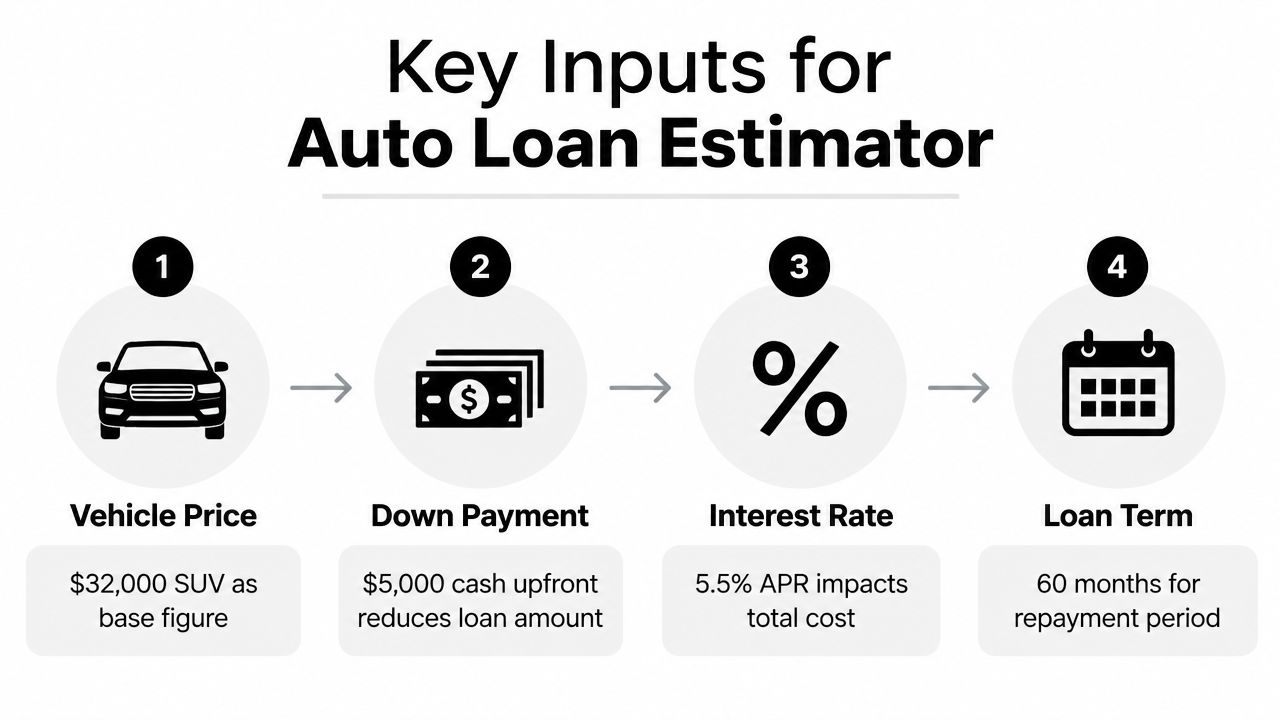
A $32,000 SUV can produce very different monthly payments depending on the figures entered. Change one input at a time, and the reason for each change becomes easier to see.
Start with the amount being financed
The purchase price is only the first line. A $32,000 vehicle may also bring sales tax, title and registration charges, documentation fees, and optional products. Those costs can raise the balance even though they do not change the advertised price.
Shopping for a used Camry? Checking Toyota Camry price details helps you judge whether the asking price is reasonable before you finance it.
A $5,000 down payment brings the starting balance to $27,000, before taxes and fees. Interest then applies to a smaller amount, which usually lowers the monthly payment.
Add trade-in equity carefully
A trade-in can reduce the new loan like another down payment, but only its net equity counts. If the vehicle is worth more than its payoff balance, the difference lowers the amount financed. If the payoff balance is higher than the vehicle's value, the shortfall can increase the new loan instead.
Net trade-in equity reduces the amount financed the same way a down payment does. A $30,000 purchase with $5,000 down and $2,000 in equity starts at $23,000 before taxes and fees.
Estimate APR, not just a headline rate
APR describes the yearly borrowing cost and may include fees alongside interest. The rate entered into an estimator remains an assumption until a lender reviews the borrower's qualifications. Allstate's auto finance calculator guidance explains that APR can vary with credit score, lender conditions, vehicle details, repayment term, loan amount, and other qualifications.
Two shoppers financing the same SUV may therefore receive different payments because their approved APRs differ. A small rate change can also alter the payoff amount that belongs in a broader plan for credit cards, student loans, or other debts.
Choose the term with caution
The term is the repayment period in months. Comparing 48, 60, and 72 months shows the tradeoff clearly: a longer term generally lowers the required monthly payment, while keeping the balance outstanding longer can allow more interest to accumulate.
Enter the out-the-door price, down payment, net trade-in equity, APR, and term together. Then update the estimate whenever a lender changes the rate or a dealer changes the final price. That revised payment and balance give your payoff plan figures it can use, rather than relying on the first estimate.
How the Math Turns Inputs Into a Payment
Each monthly payment has two jobs. One portion covers interest charged on the remaining balance, and the rest reduces principal. As principal falls, the interest portion changes, so the loan doesn't behave like a simple division of the starting balance.
The standard amortization equation is:
Payment = Principal × monthly rate ÷ (1 − (1 + monthly rate)^−number of payments)
The monthly rate comes from the APR divided by the number of months in a year, and the number of payments comes from the loan term. In plain language, the formula spreads repayment across the selected term while accounting for interest on the unpaid balance.
For the comparison below, the financed balance is $27,000 and the APR is 6.5%. The figures are rounded estimates produced from the standard amortization formula.
| Term | Monthly Payment | Total Interest Paid | Total Paid |
|---|---|---|---|
| 48 months | $640.08 | $3,723.84 | $30,723.84 |
| 72 months | $453.32 | $5,639.04 | $32,639.04 |
The 72-month loan lowers the monthly bill by about $186.76, but the borrower pays about $1,915.20 more in interest over the life of the loan. That difference is why a lower payment doesn't automatically represent a cheaper loan.
Why rate changes deserve a second calculation
A higher APR affects every remaining payment because interest is calculated from the unpaid balance. On a six-year term, a one-point APR increase can add hundreds of dollars to total interest, depending on the balance and the exact rate.
A shopper should therefore run at least two rate scenarios, one based on a realistic best case and another based on a less favorable approval. The monthly interest calculation guide can help explain why the interest portion changes as the balance declines.
The same formula produces very different results for new vehicles, used vehicles, and borrowers with weaker credit. Price, down payment, APR, and term must be read together rather than judged through the monthly figure alone.
Three Real Scenarios You Can Run Right Now
Three shoppers can enter the same four categories of information and receive very different financial outcomes. The examples below use rounded payment calculations, with taxes and fees excluded so the loan assumptions remain easy to compare.
A new-car purchase
The first shopper considers a $32,000 new car, places 10% down, and finances the remainder at 6.5% APR for 60 months. The down payment is $3,200, leaving $28,800 financed.
The estimated payment is about $563.50 per month. Total payments are about $33,810, including approximately $5,010 in interest.
That payment may look manageable in isolation, but the shopper still needs to add insurance, fuel, maintenance, and any financed purchase costs. A lender or dealer may also quote a different APR after reviewing the application.
A used-car purchase
The second shopper chooses a $16,000 used car, puts 20% down, and finances the rest at 7.2% APR for 48 months. The down payment is $3,200, producing a financed balance of $12,800 before taxes and fees.
The estimated payment is about $307.80 per month. The borrower pays about $14,774 over the full term, including approximately $1,974 in interest.
The lower price and larger down payment reduce the principal substantially. The shorter term also limits the number of months during which interest can accrue, although the vehicle's age and condition may create different ownership costs outside the loan.
A borrower with weaker credit
The third shopper considers a $12,000 vehicle, puts 5% down, and receives an estimated 14.9% APR over 72 months. The down payment is $600, leaving $11,400 financed before taxes and fees.
The payment is about $241.20 per month. Total payments reach about $17,366, including approximately $5,966 in interest.
The longer term keeps the required payment within reach, but the high APR makes the loan expensive relative to the amount borrowed. The shopper should test whether a larger down payment, less expensive vehicle, co-borrower, or improved credit profile could reduce the rate or principal before signing.
| Scenario | Price | Down Payment | APR | Term | Monthly Payment | Total Interest |
|---|---|---|---|---|---|---|
| New car | $32,000 | $3,200 | 6.5% | 60 months | $563.50 | $5,010 |
| Used car | $16,000 | $3,200 | 7.2% | 48 months | $307.80 | $1,974 |
| Weak-credit borrower | $12,000 | $600 | 14.9% | 72 months | $241.20 | $5,966 |
The third shopper has the lowest payment but pays more interest than the used-car shopper. That contrast captures the main lesson: payment affordability and debt efficiency are separate questions. A car-loan payoff calculator can help test how extra principal payments or a faster payoff target changes the timeline.
Where Estimators Lead You Astray
A payment estimate can be correct and still answer only part of the buying decision. The larger question is whether the car will remain affordable after depreciation, insurance, and changes in your household debt plan.
Two gaps the calculator cannot show
Depreciation can outrun principal reduction. Suppose you finance $20,000 and still owe $17,500 after some payments. If the vehicle's market value has fallen to $15,500, selling it leaves a $2,000 gap. The estimate shows the scheduled payment, but not the cash needed to exit the loan.
The same mismatch matters when replacing the car. A borrower may need to pay the gap before qualifying for the next vehicle, even though every payment was made on time. Check the projected balance against a conservative resale value before treating the loan as an easy trade-in.
APR and interest rate describe different costs. A lender might advertise a 5% interest rate while fees raise the loan's APR to 5.8%. On a $20,000 balance, the difference is not just a label. It changes the cost used to compare that offer with another lender's quote.
Ask whether the quoted APR includes fees, and whether a promotional rate requires giving up a cash rebate. Compare offers using the same vehicle price, down payment, term, and financed amount. Otherwise, a lower advertised rate may not be the lower-cost choice.
Add the estimate to the larger debt decision
Insurance creates another budget test. A lender may require full-coverage and collision protection, while gap insurance could help if the balance exceeds the vehicle's value. The estimator cannot determine whether those premiums fit alongside rent, credit-card payments, or other minimums.
A useful next step is to place the estimated auto payment beside every debt payment. If rates or terms change, update the auto-loan inputs and reconsider which balance receives extra money. A payment that fits alone may still delay the household's overall payoff target.
A low monthly payment answers one question. It does not show whether the borrower can sell the car, cover insurance, or reduce the full debt load on schedule.
From Estimate to Payoff Plan With Toya
An isolated payment is a snapshot. A payoff plan places that payment beside every other obligation and asks a more useful question: what should the household pay next, and when will the full debt load disappear?
A shopper can start with hand-entered figures, such as the estimated auto-loan balance, APR, minimum payment, and term. That approach is useful for early comparisons, but the forecast changes if the final lender rate, financed fees, or trade-in balance differs from the estimate.
Why connected data improves the plan
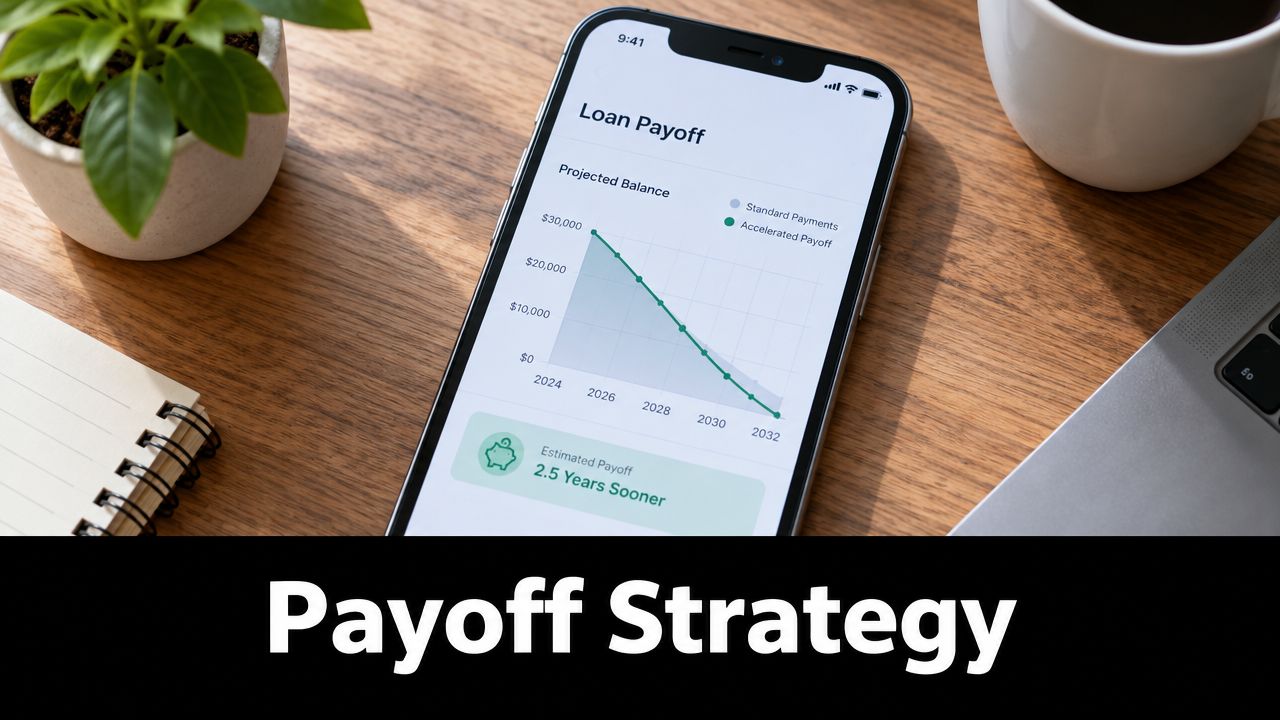
With a connected account, Toya AI can place the auto loan alongside credit cards, student loans, personal loans, and other balances. Its planning view uses current balances, APRs, minimums, utilization, and due dates to calculate a debt-free timeline and show how payment changes affect interest and payoff timing. Account connections use read-only access through financial-data partners, and a user can also begin with a quick calculator before connecting accounts.
The difference is practical. A typed estimate might assume a payment stays unchanged, while a connected plan can update when the lender confirms the final APR or the account balance changes. The borrower can compare an avalanche approach, which prioritizes higher-cost debt, with a snowball approach, which prioritizes smaller balances for quicker visible progress.
The account aggregation services overview describes the account-connection foundation behind this kind of synchronized financial picture.
A new auto payment can also change the amount available for other goals. If the car loan replaces an older payment, the plan may redirect the freed cash. If it adds a new obligation, the plan may show whether credit-card repayment slows or whether an extra principal payment remains realistic.
The video below provides another way to visualize how a payoff forecast can support decision-making.
The important shift is from “What will the car payment be?” to “How does this loan change the household's payoff path?”
Putting Your Estimate to Work This Week
A useful estimate should lead to a short verification process, not sit unused in a spreadsheet. During the next seven days, the shopper can turn assumptions into lender-ready facts.
- Request three lender quotes: Ask each lender for the same term length so APR and payment comparisons remain fair.
- Verify the APR: Confirm whether the quoted APR includes fees, rate buy-downs, automatic-payment conditions, or other requirements.
- Request the financed amount: Ask whether sales tax, title, registration, dealer fees, and add-ons are included now or added later.
- Compare total interest: Review the lowest monthly estimate beside the total interest paid over the full term.
- Check the broader budget: Include insurance, fuel, maintenance, existing debt payments, and monthly income before accepting the loan.
- Update the payoff plan: Enter the verified loan terms and existing debts into a planning tool so the car payment becomes part of a live strategy.
A lender-approved payment can still be too large for the household's full financial picture. The strongest decision balances the monthly obligation, total interest, payoff date, vehicle value risk, and progress on other debts.
Toya AI helps shoppers turn an auto loan estimate into an adaptive payoff plan across auto loans, credit cards, student loans, and other debts. Enter the verified loan terms or connect eligible accounts to see how payment choices affect the debt-free date, monthly interest, and total cost, then visit Toya AI to start planning.
Ready to start your debt-free journey?
Toya AI builds a personalized payoff plan so you can see your debt-free date and save on interest.
Get Started Free