
APR vs Interest Rate Personal Loan: Which Costs More
The interest rate is the lender's charge for using the principal, while APR adds finance charges such as origination fees into one annual percentage, so APR is equal to or higher than the rate when fees apply.
If two personal loans both advertise 10%, why can one leave a borrower with less cash and a higher total cost than the other? That gap is where most APR vs interest rate personal loan comparisons go wrong, because the advertised rate describes only part of the price. A borrower who compares the wrong number can pick the loan that looks cheaper and pay more for it.
Table of Contents
- APR and Interest Rate Side by Side
- How Origination Fees Push APR Above the Interest Rate
- Why Loan Term Changes the APR Gap
- Total Repayment Shows What the Loan Really Costs
- How to Compare Personal Loan Offers Step by Step
- Which Offer to Choose in Your Situation
APR and Interest Rate Side by Side
The clearest way to separate the two figures is to ask what each one counts. The Consumer Financial Protection Bureau guide to interest rate and APR explains that the stated interest rate measures only the lender's charge for using the principal, while APR combines that rate with finance charges, including applicable origination and administrative fees.
That distinction changes how a borrower should read an offer. The interest rate drives the interest that accrues on the outstanding balance each period. APR standardizes the broader borrowing cost so offers with different fee structures can be compared on the same basis.
APR and Interest Rate Compared on the Same Criteria
| Criterion | Interest Rate | APR |
|---|---|---|
| What it measures | Lender's charge for using the principal, as a yearly percentage | Yearly cost of borrowing, interest plus finance charges such as origination fees |
| Includes upfront fees | No | Yes, when the fee counts as a finance charge |
| Matches the other figure | Equal to APR when the loan has no fees | Equal to the interest rate when the loan has no fees |
| Best use | Seeing how interest accrues on the outstanding balance | Comparing offers that have different fee structures |
| Where to find it | Rate section of the loan offer | Truth in lending disclosure in the loan agreement |
A Worked Example With a Fee
Say a borrower takes a $10,000, 24-month loan at a 10% interest rate and pays a 5% origination fee of $500. The rate stays at 10%, but the borrower doesn't receive the full $10,000 economically because $500 is withheld or added as a financing cost while repayment is based on the contractual loan amount. The APR rises above 10%, to approximately 15% under a simplified comparison, although the legally calculated APR depends on the payment schedule and timing of disbursement.
Remove the fee and the picture changes. With no additional fees, APR and the interest rate may be identical, which is why a wide gap between them is itself useful information. It signals that fees, not just interest, carry a meaningful share of the cost.
Reading rule: Find the APR in the loan agreement disclosure, then use the interest rate to understand how monthly interest builds on the balance.
Borrowers comparing revolving credit face a related labeling problem, and a separate explainer on how credit card APR works helps separate a card's ongoing APR from a personal loan's disclosed APR. For a personal loan, the practical habit is simple. Don't rank offers by the nominal rate alone when one lender charges upfront fees and another doesn't.
How Origination Fees Push APR Above the Interest Rate
Two lenders can advertise the same rate and deliver different amounts of usable money. That difference in proceeds, not a change in the stated rate, is what pushes APR upward.
The diagram below traces how an upfront fee changes the result for two otherwise similar offers.
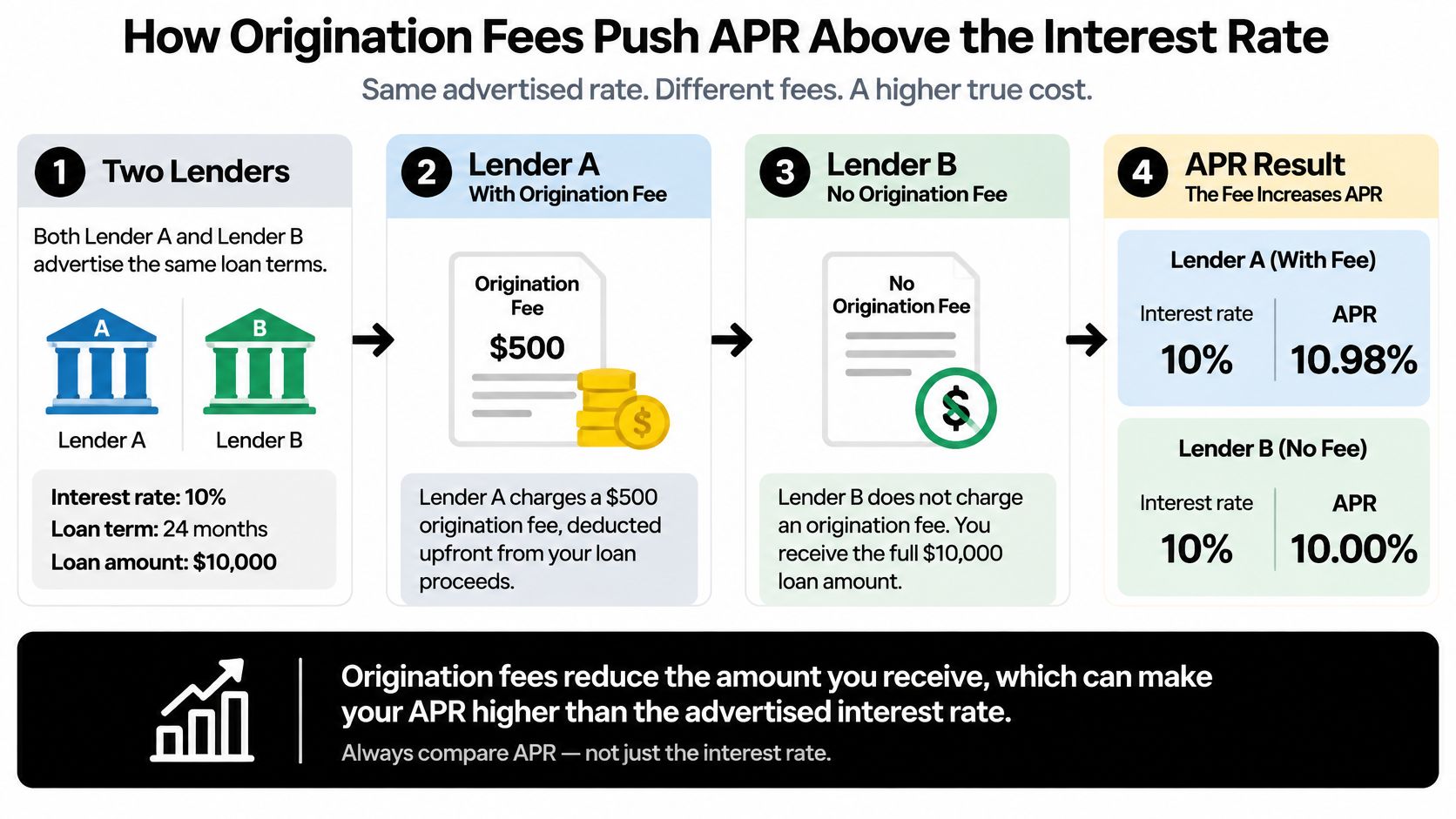
Two Lenders, One Advertised Rate
Say two lenders each advertise 10% on a 24-month, $10,000 loan, but one charges a $500 origination fee while the other charges $100. According to the Federal Reserve Regulation Z material on APR determination, APR reflects credit costs over the repayment term through prescribed actuarial or U.S. Rule methods, rather than adding a fee percentage to the interest rate.
The borrower who pays $500 receives $9,500 in usable funds if the fee is withheld, yet still makes payments based on the $10,000 loan. The borrower who pays $100 keeps more of the proceeds, so that fee moves APR much less. Both loans can truthfully carry a 10% interest rate while producing different APRs.
APR isn't calculated by writing 10% plus 5% and calling the sum the answer. The exact result depends on four inputs that interact with each other:
- Amount financed: The amount of credit provided after prepaid finance charges are accounted for.
- Finance charges: The dollar cost of credit, including interest and fees that count as finance charges.
- Timing of advances: When the borrower receives the funds.
- Repayment schedule: When payments are due, how many there are, and how much each payment is.
A Four Part Check for Any Disclosure
A borrower doesn't need to reproduce the lender's actuarial calculation. The disclosure already contains the standardized result, and a short check confirms whether the numbers fit together.
- Confirm the amount financed. This shows how much credit the calculation treats the borrower as receiving.
- Confirm the finance charge in dollars. A percentage can hide scale, while the dollar figure states what credit costs over the scheduled term.
- Confirm the payment schedule and first payment date. Timing affects APR because money received sooner and repaid later has a different cost profile.
- Compare the disclosed APR with the interest rate in the offer. The size of the gap points to the role fees play in the total price.
Which Fees Count and Which Do Not
Origination fees and applicable administrative fees count as finance charges when they're imposed as a condition of the credit, so they're reflected in APR. A late payment fee is different because it depends on a future missed payment rather than the scheduled cost of obtaining the loan, so it isn't included in the disclosed APR. That boundary matters, since APR captures scheduled borrowing costs, not every possible charge that could arise later.
A wide gap between the rate and APR means fees carry much of the borrowing cost. A narrow gap means the rate does most of the work.
The actionable move is to use the standardized APR printed in the disclosure, not a borrower estimate built from the rate and fee percentages. The gap then becomes a screening tool. When the gap is large, a borrower should ask whether another lender offers the same usable proceeds with a smaller upfront charge, even if that lender's stated rate looks slightly higher.
Why Loan Term Changes the APR Gap
Term changes APR because an upfront fee gets spread across a different number of months. The fee in dollars can stay exactly the same while its annualized effect shrinks or grows.
Under Regulation Z in the Electronic Code of Federal Regulations, APR relates the amount and timing of funds received to the amount and timing of required payments and is calculated using an actuarial or equivalent method. That timing link is why a fee hurts more, in APR terms, on a short loan.
How Fees and Term Change APR on Sample Personal Loans
| Loan Example | Stated Rate | Fee | Term | Approximate APR |
|---|---|---|---|---|
| $10,000 personal loan | 10% | None | 36 months | About 10% |
| $10,000 personal loan | 10% | $500 origination | 36 months | About 13.5% |
| $10,000 personal loan | 10% | $500 origination | 24 months | About 15% (simplified) |
| $20,000 personal loan | 12% | $1,000 origination (5%) | 60 months | About 14.2% |
Reading the Rows in Order
The first row is the baseline. A $10,000, 36-month loan at 10.00% with no fee has an APR near 10.00%, because there's no extra finance charge for APR to absorb.
The second row keeps the amount, rate, and term but withholds a $500 origination fee. The borrower receives only $9,500 while payments are calculated on the $10,000 note balance, lifting the effective APR to approximately 13.5% under common closed-end APR conventions.
The third row shortens the term to 24 months with the same $500 fee. The approximate APR rises to about 15% under a simplified comparison because the borrower spreads that fixed upfront cost over fewer months. Annualized, each month carries a larger share of the fee.
The fourth row moves in the other direction. A larger $20,000 loan at 12% over 60 months with a $1,000 fee produces an APR of about 14.2%, a smaller increment above its stated rate than the short loan shows, even though the fee itself is twice as large.
The Approximation Warning
These figures are approximate, not quotes. The legally calculated APR depends on the payment schedule and the timing of disbursement, so the disclosed APR for the actual offer in hand controls the comparison. A borrower who treats a rounded example as a lender's promised APR risks comparing an illustration against a real disclosure.
Short loans are therefore highly sensitive to fees. A modest rate advantage can disappear quickly when a lender takes several hundred dollars at origination and the borrower repays over two years instead of five. Long loans dilute the fee's APR effect, although a longer schedule can still produce more total interest dollars because the balance remains outstanding for more months.
Term rule: When two offers have different terms, APR alone doesn't settle which one is cheaper. Compare the term alongside the APR before deciding.
That rule prevents a common ranking error. A lower APR attached to a much longer term isn't automatically the cheaper loan in dollars, and a higher APR on a short loan isn't automatically the more expensive one.
Total Repayment Shows What the Loan Really Costs
APR answers a rate question, but payoff decisions are made in dollars. A borrower needs to know the monthly payment, the total sent to the lender, and how much usable cash arrives at the start.
The Federal Reserve educational lesson on loan costs describes APR as an annualized measure combining interest and upfront loan costs, while Regulation Z treats it as a standardized disclosure rather than the contract's nominal interest rate alone. For a fully amortizing loan, the payment comes from the periodic rate, principal, and number of payments, and total cost equals all scheduled payments plus any fees.
The $20,000 Example in Dollars
A $20,000, 60-month loan at 12.00% nominal interest has a payment of about $444.89 and scheduled payments of roughly $26,693 before fees. That means the borrower repays the $20,000 principal plus about $6,693 in interest if every payment is made as scheduled.
Add a 5% origination fee of $1,000 and usable proceeds fall to $19,000. Repayment doesn't fall with it, because the balance remains $20,000, and the fee raises the economic APR to roughly 14.2%. A borrower who needed the full $20,000 for a specific expense would come up $1,000 short unless the loan amount were increased or other funds covered the gap.
Seven Figures to Set Side by Side
A complete comparison puts rate and dollar figures on the same page:
- Nominal rate: The rate that determines periodic interest on the balance.
- APR: The standardized annual cost including finance charges.
- Origination fee: The upfront charge, stated in dollars and as a percentage.
- Net proceeds: The cash the borrower can use after withheld fees.
- Monthly payment: The scheduled cash outflow each month.
- Payoff date: The month the loan ends if payments stay on schedule.
- Total repayment: Every scheduled payment combined, with fees accounted for.
Writing those figures down exposes trade-offs that a single percentage hides. A lender can lower the monthly payment by stretching the term, which improves monthly cash flow while increasing the months over which interest accrues. The result often costs more in total even when the payment feels easier to carry.
The reverse also holds. A higher APR can cost less in dollars when the loan is repaid substantially faster, while a lower APR may still generate more total interest if its term is longer. Borrowers who want the mechanics of that trade-off can work through a personal loan repayment schedule and watch how each payment splits between principal and interest over time.
Turning the Figures Into a Payoff Decision
For a borrower managing several debts at once, the loan's APR also determines where an extra payment does the most good. Toya AI recommends which payment to make next and shows the impact on time and interest, so a borrower can see whether extra money saves more on the new loan or on an existing balance. Its value preview calculator gives a quick debt-free estimate from three numbers, and connecting accounts in the app gives exact results.
Lower monthly payments usually mean paying more in total. A shorter term usually means a higher payment and a lower total cost.
The practical test has two parts. First, the monthly payment must fit the borrower's budget without crowding out essential expenses or minimum payments on other debts. Second, among offers that pass that test, the borrower should favor the one with the lowest total repayment for the amount of usable cash received.
How to Compare Personal Loan Offers Step by Step
Comparing offers works best as a fixed procedure, applied the same way to every lender. Skipping steps is how a stated rate from one lender ends up compared against another lender's APR.
The checklist below summarizes the sequence before the detailed steps.
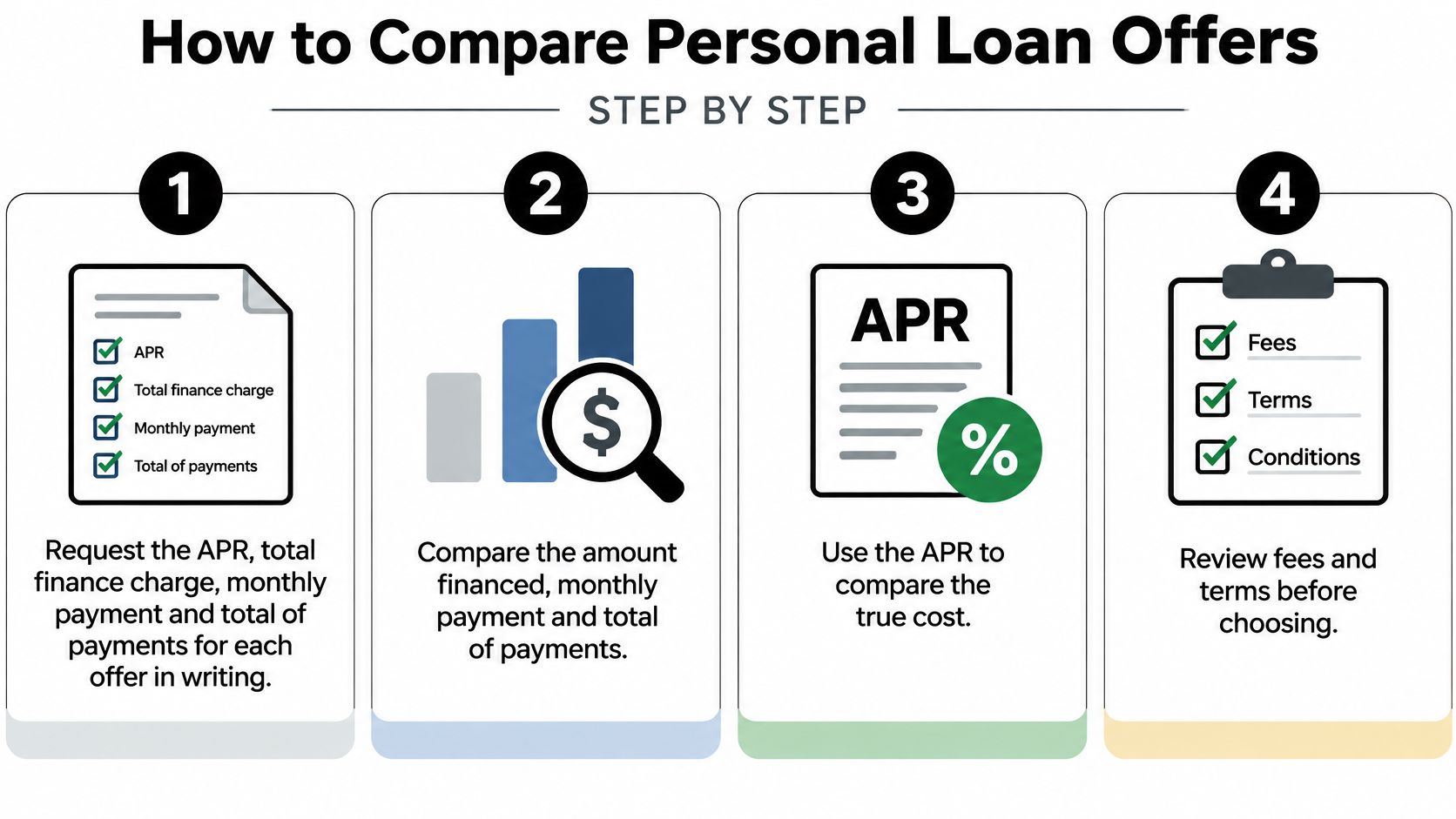
The Six Steps
1. Request the disclosure figures in writing. For each offer, the borrower should obtain the APR, total finance charge, monthly payment, and total of payments. The Consumer Financial Protection Bureau loan costs guide notes that APR calculates interest plus fees and can show which option is less expensive over the full loan term. Written figures prevent a marketing rate from standing in for the actual offer.
2. Compare the amount financed, not just the loan amount. Net proceeds after fees can differ from the headline amount, so two $10,000 loans may deliver different amounts of usable cash. This step prevents a borrower from paying repayment costs on money that never arrived.
3. Check whether early payoff is allowed without a penalty. APR describes cost over the full scheduled term, and a borrower who repays early won't experience that full-term cost in the same way. A prepayment penalty can also erase part of the interest saved by paying ahead, so the contract language matters before signing.
4. Hold amount, term, and repayment frequency constant before comparing APRs. APR rankings are cleanest when the loans share the same structure. If amounts or terms differ, total payments and net proceeds give a fairer comparison than APR alone.
5. Calculate two differences for each pair of offers. The first is the difference in total of payments, which shows lifetime cost. The second is the difference in monthly cash flow, which shows budget pressure. An offer that saves money overall but strains each month may still be the wrong choice for a tight budget.
6. Choose the lowest total cost that fits the monthly budget. This final filter combines the rate comparison with affordability. A loan that triggers missed payments or new card balances isn't cheap in practice, whatever its APR says.
Loan A Against Loan B
Say Loan A offers $10,000 at 11% with a $600 origination fee, while Loan B offers the same amount at 12% with no origination fee. Loan A has the lower stated interest rate, but its fee may make its APR higher than Loan B's, particularly for a short loan term. Over a longer term, the fee spreads across more scheduled payments, which can change the comparison.
That example shows why the steps run in order. A borrower who stops at the stated rate picks Loan A automatically, while a borrower who reaches the total of payments sees whether the $600 fee outweighs the one point rate advantage. The answer depends on term, so both disclosures need the same term before the ranking means anything.
Documents to Gather First
- Written offer or disclosure from each lender: Shows APR, amount financed, finance charge, and total of payments.
- Fee schedule: Confirms origination, administrative, and prepayment charges.
- Payment schedule: Lists payment amount, number of payments, and due dates.
- Current budget figures: Confirms the monthly payment the borrower can sustain.
With those documents in hand, the comparison becomes arithmetic rather than guesswork. The borrower ranks real disclosures instead of advertised rates.
Which Offer to Choose in Your Situation
The right number to lead with depends on the borrower's situation. Four common cases cover most personal loan decisions, and each one points to a different figure.
The photo below shows the kind of side by side review that turns two disclosures into a decision.

Situation 1 Short Term Borrowing With an Upfront Fee
Rely on APR. On a short loan, an upfront fee's annualized effect is largest, so APR exposes the cost that the stated rate leaves out. Setting APR aside here risks choosing a loan with an attractive rate whose fee consumes the entire advantage within the first year.
Situation 2 Equal Fees and Equal Terms
When fees and terms match, the stated rate and APR rank the offers the same way, so either figure can decide. The borrower can set the rate versus APR debate aside and check secondary terms instead, such as payment due dates or autopay discounts stated in the offer. Ignoring the fee check entirely would still be a mistake, because the ranking only holds once equality is confirmed in the disclosures.
The short video below walks through how an extra payment changes a payoff timeline, which connects directly to the early repayment case.
Situation 3 Planned Early Repayment
Rely on the prepayment terms and an estimate of interest to the actual payoff date. A borrower who plans to repay in half the scheduled term shouldn't treat full-term APR as the personal cost of the loan. The risk of ignoring prepayment language is paying a penalty that reduces the benefit of every extra payment.
This is also where tracking matters after the loan is taken. Toya AI shows balances, APRs, and due dates for connected debts in one view, and its free tier lets users connect unlimited accounts, see all debts in one dashboard, and track balances, APRs and due dates at no cost, with no time limit. Every account starts with a 14-day Pro trial with no credit card required, and users can keep the Free plan forever or upgrade anytime.
Situation 4 Market Benchmarks and Advertised Averages
Rely on personalized disclosures, and set published averages aside as quotes. Average personal loan rates are reference points, not offers, because a lender's price depends on credit history, loan amount, term, and fees. A borrower who treats an average as an entitlement may reject a solid offer or accept a weak one for the wrong reason.
Borrowers weighing whether new credit is needed at all may also compare a loan against carrying a card balance, and a breakdown of personal loan versus credit card debt lays out that cost comparison. For someone who needs quick cash and owns an item of value, the Idaho Pawn & Gold Exchange guide explains how a pawn loan works as an alternative route, with its own costs and risks to weigh.
A plain example ties the four cases together. A 10% loan with a large fee can cost more than a 12% loan with no fee, depending on term and amount financed. The stated rate favors the first loan, while APR and total payments can favor the second.
Decision rule: Shortlist offers by APR, confirm the total of payments and monthly payment, check prepayment terms, borrow only the amount needed, and choose the lowest cost option that fits the monthly budget.
APR answers which offer costs more to borrow, while the interest rate explains how interest accrues each month. A borrower who uses each number for its own job can read any disclosure with confidence.
Borrowers ready to put APR comparisons into a payoff plan can connect their loans and cards in Toya AI, see every balance, APR, and due date in one dashboard, and get a clear recommendation for which payment to make next. Starting free takes minutes, and the plan updates as balances change, so each extra payment goes where it saves the most interest.
Ready to start your debt-free journey?
Toya AI builds a personalized payoff plan so you can see your debt-free date and save on interest.
Get Started Free