
APR vs Interest Rate: What Each Number Really Costs
The interest rate is the annual price of borrowing the principal, while APR adds required upfront finance charges and expresses that total cost on an annual basis. A mortgage quoted at 6.00% interest can carry an APR above 6.00% once points and lender fees are counted, and that difference is the whole game when you're choosing between offers.
Most borrowers shop the headline percentage and skim the disclosure box on the way to signing. That order is backwards, and it's how two offers advertising identical rates end up thousands of dollars apart over the same term.
Three forces widen the gap between the advertised rate and what you pay: fees taken out before the money reaches you, the number of months you carry the balance, and how often interest gets added to it. None of them changes the headline number. All of them change the cost.
So what should you compare? The answer depends on the question you're asking, and that's where the confusion starts.
Table of Contents
- APR and Interest Rate at a Glance
- Where to Find APR and Interest Rate on Your Offer
- How Upfront Fees Push APR Above the Rate
- How Compounding and Term Change Total Cost
- Credit Card APR Types and Monthly Interest Math
- When APR Matters Most and When the Rate Does
- Compare Two Offers and Choose the Cheaper Debt
APR and Interest Rate at a Glance
Same advertised rate, different bill. How?
An interest rate is the annual price of the lender's principal, stated as a percentage of the amount you borrow. APR is wider. It combines that rate with required costs such as origination charges, points, broker fees and other finance charges, then states the result as an annual percentage. The Consumer Financial Protection Bureau describes APR as a standardized comparison measure that incorporates interest and fees, which makes it more useful than the interest rate alone when you weigh one offer against another.
A lender with the lower nominal rate can still charge enough fees to produce a higher APR and a larger total cost. The gap widens fastest when fee menus differ, or when the term is short. A fixed fee spread across only a few months pushes the annualized figure up quickly.
| Criterion | Interest rate | APR |
|---|---|---|
| What it measures | Price of borrowing the principal | Interest plus required upfront finance charges |
| Fees included | Usually no | Yes, qualifying charges such as origination fees and points |
| Usual position against the rate | The baseline figure | Higher than the rate when fees are present |
| Best use | Estimating monthly interest on the balance | Comparing offers with different fee structures |
| Credit card reading | Periodic rate applied to balances | Annualized APR shown on the disclosure, with separate fees listed |
That frame is the whole distinction.
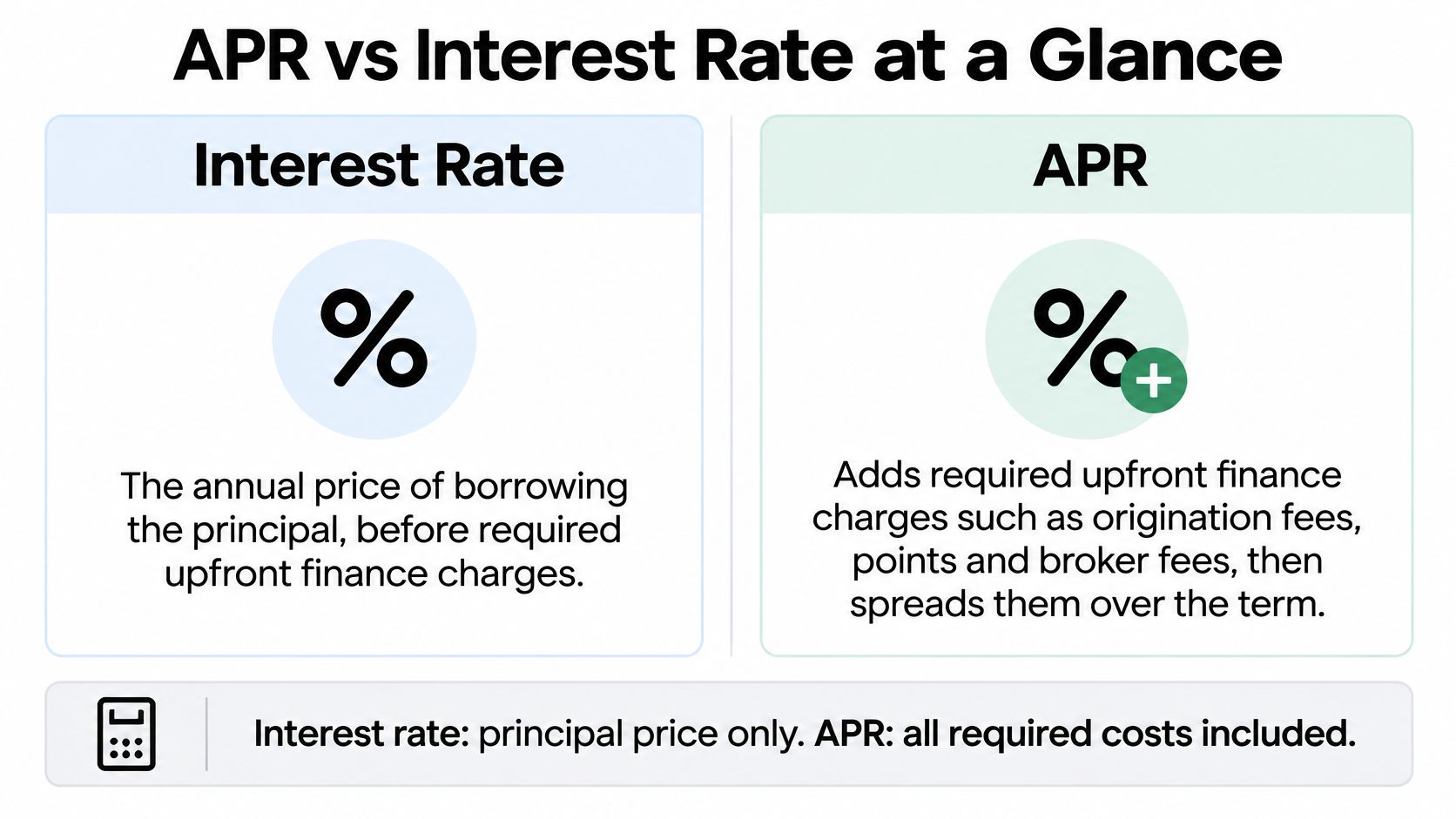
Take a mortgage quoted at 6.00%. That 6.00% prices the principal alone. Discount points and lender fees can lift the APR above 6.00% while the rate does not move. Two lenders can both advertise 6.00% and still show different APRs, so the same headline number hides different total costs.
Short, fee-heavy loans stretch that spread further. On property deals, which investors hard money suits comes down as much to fee tolerance as to the quoted rate.
Working rule: use the interest rate to estimate what the balance costs you each month, and use the APR to rank competing offers. Mixing the two, one loan's APR against another loan's rate, is how the expensive offer starts looking cheap.
Both figures are percentages, which is why borrowers swap them. They answer different questions. The rate estimates this month's price on the balance you carry. The APR ranks offers when the fee lists do not match. Sort by APR first, then check the term, because the same upfront fee annualizes into a larger APR on a short loan than on a long one.
Where to Find APR and Interest Rate on Your Offer
Every regulated loan offer carries the same figures in predictable places. Knowing which line holds which number removes the guesswork, and it takes about four minutes per offer once you've done it twice.
- Find the APR in the Truth in Lending disclosure box. Federal law requires creditors to disclose it, and it already includes qualifying finance charges, so you don't have to hunt through the fee schedule to build it yourself.
- Find the interest rate on the note's rate line. This is the number that prices the principal alone, and it's the one most advertising leads with.
- Read the finance charge and the amount financed. The amount financed is the cash you receive after prepaid fees come out, and the finance charge is the dollar cost of credit. Both sit in the same disclosure box.
- For a credit card, check the periodic disclosure. It lists the purchase APR, the cash-advance APR and any penalty APR separately, plus the annual fee. One advertised rate never tells the whole story on a card.
Write all four figures onto a single sheet per offer: APR, interest rate, amount financed and scheduled payment. Keep the term in months next to them. That sheet is what the comparison at the end of this article runs on, and it's far more useful than a screenshot of a rate quote.
Locating rule: if a cost isn't printed in the disclosure box, treat it as marketing until the lender puts it in writing. A fee that only exists in a phone conversation doesn't exist for comparison purposes.
If the APR line isn't obvious on a particular offer, ask the lender to point to it. They're required to disclose it, and a lender who hedges on that question is telling you something about how the rest of the process will go.
How Upfront Fees Push APR Above the Rate
Why can two loans show the same interest rate and still cost different amounts?
An upfront fee cuts the cash you receive, while the payments stay tied to the full stated loan amount. The rate on the note can stay put. What changes is the cost of each dollar that reaches you. APR is built to show that gap: it spreads the finance charge over the amount financed, the money left after prepaid fees come out, rather than over the larger number on the application.
Take a plain case. A lender offers $10,000 and collects a $300 origination fee before disbursing the loan. You sign for $10,000 and receive $9,700. Interest is still figured on the larger figure, and the payment schedule still repays that larger figure. You are paying for dollars that never arrived. That is why the APR can print above the interest rate without anyone editing the rate line.
Prepaid charges that count as finance charges work the same way. Discount points and a broker fee the lender requires either shrink what you net or add dollars you must repay. The finance charge, the funds received, and the timing of each payment all move the annualized figure together.
| Charge | Usually in APR? | Effect on borrowing cost |
|---|---|---|
| Origination fee | Yes | Reduces the amount financed, raising APR |
| Discount points | Yes | Prepaid interest that lowers the rate while raising upfront cost |
| Broker fee | Yes, when the lender requires it | Adds to the finance charge |
| Appraisal fee | Depends on disclosure rules | Real cash cost that may sit outside APR |
| Late payment fee | No | Raises total cost without changing the APR calculation |
Inclusion rules differ by product, so read the disclosure line by line instead of assuming every charge is captured. An appraisal paid at closing is still real money leaving your account when it never enters the APR. A late fee can raise what you eventually pay and leave the APR untouched, because it is not part of the original finance charge.
Use one check on every offer before you trust a headline percentage. Record the cash you receive, every upfront fee, the term in months, and the scheduled payment. Divide the fees by the amount financed. That percentage is the fee's weight on the money in your hands. A fee equal to several percent of what you receive is far more punishing across 24 months than across seven years, because those same dollars are spread over fewer years. Rank the offers by that total cost, not by the advertised rate alone.
How Compounding and Term Change Total Cost
APR is a nominal annual figure. What your balance really pays depends on how often interest is added to it, and on a loan the difference between the quoted rate and the effective annual rate can be meaningful.
| Compounding | Periods per year | Effective annual rate on a 12% nominal rate |
|---|---|---|
| Annual | 1 | 12.00% |
| Quarterly | 4 | 12.55% |
| Monthly | 12 | 12.68% |
| Daily | 365 | 12.75% |
Most installment loans amortize on monthly payments, so the gap between the nominal rate and the effective rate stays small in practice. Revolving balances work differently: a card accrues interest through a daily periodic rate, so any balance you carry grows faster than the monthly figure suggests.
The bigger lever is time, and here the amortization schedule does the talking.
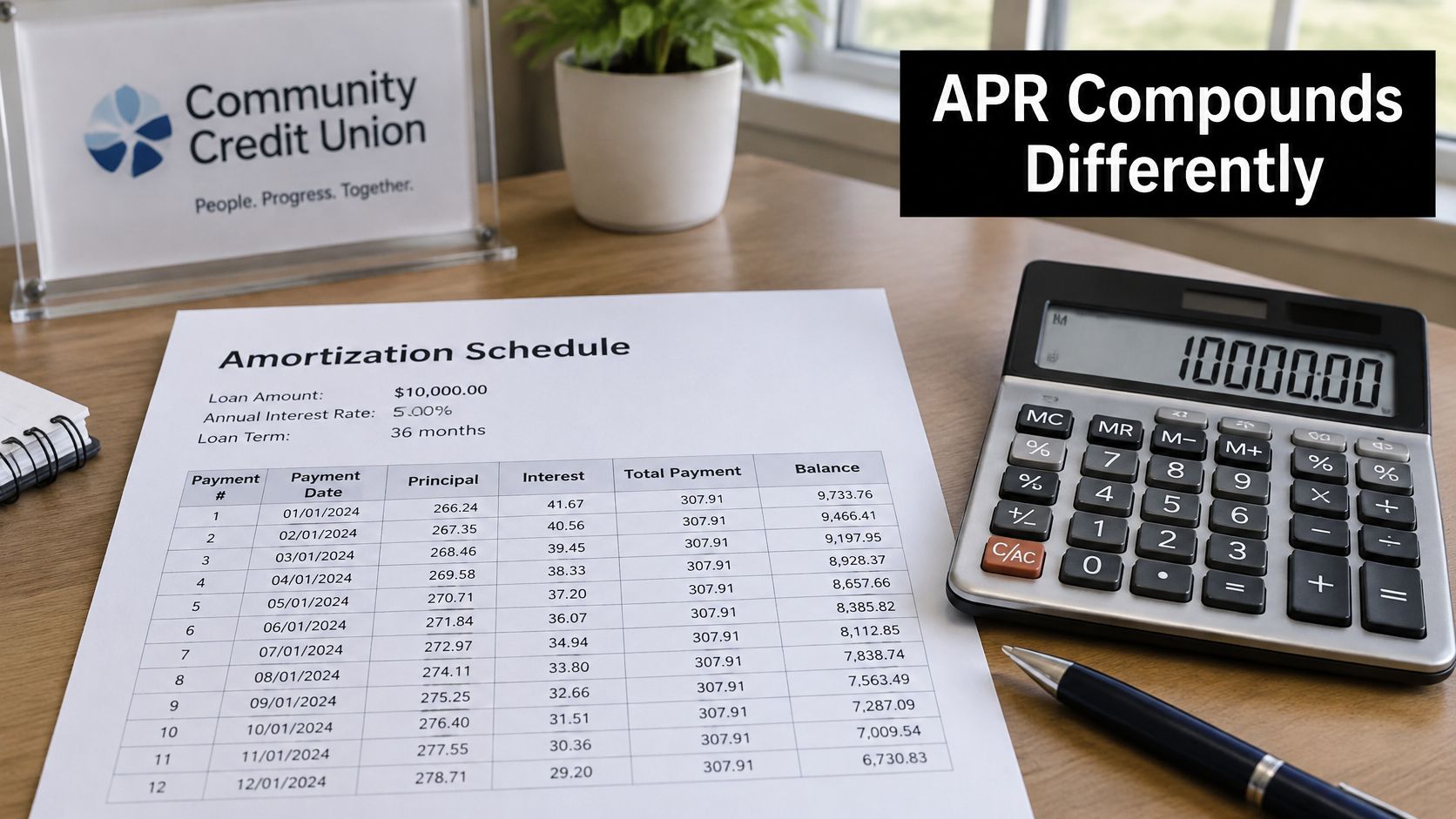
Say you borrow $20,000 at 8% APR. Stretch it across 36 months and the payment lands near $623, with roughly $2,430 of interest paid over the life of the loan. Stretch the identical loan across 84 months and the payment drops to about $312, but the interest climbs to roughly $6,180. Same principal, same rate, more than double the cost, purely because the balance stays outstanding longer.
Term rule: a lower monthly payment is not a discount. It's a longer rental of someone else's money, and the rent gets paid in full before you own anything.
Compare total repaid across terms rather than the APR alone, and run every offer at two term lengths before you commit to a payment you can live with. If you want to see how an annual rate converts into a monthly charge, this walkthrough of how to calculate monthly interest works through the division step by step.
Credit Card APR Types and Monthly Interest Math
Card APR is a periodic rate annualized for the disclosure, which makes the monthly math easy to reproduce. A card with a 24% APR and a monthly periodic rate carries 2% per month (24 divided by 12). On a $1,000 balance, that's roughly $20 of interest for one cycle before the issuer's specific average-daily-balance method, payments, new purchases or fees adjust the exact figure, as the Federal Reserve's open-end credit guidance explains.
That simple conversion is the fastest sanity check you own. Multiply the balance you carry by the APR, divide by 12, and you have a working estimate of the monthly cost of that balance.
| APR type | When it applies | What to check |
|---|---|---|
| Purchase APR | New purchases when the balance is not paid in full | Grace period and when interest starts |
| Cash advance APR | Cash withdrawals and cash-like transactions | Separate rate plus the transaction fee |
| Balance transfer APR | Balances moved from another card | Length of the intro period and the transfer fee |
| Penalty APR | After a late or returned payment | The trigger and how long it lasts |
| Promotional APR | A limited-time offer | Expiry date and the ongoing rate after it |
Cash advances deserve their own warning. They typically carry a separate APR plus a flat or proportional fee charged from the first dollar, with no grace period, so the effective cost of pulling $200 from an ATM can be far above the advertised purchase rate. Penalty APRs work the same way in reverse: one late payment can reprice the whole balance, and the disclosure states both the trigger and how long the higher rate applies.
Promotional offers need the same scrutiny. A no-interest furniture promotion is only free if the balance is cleared before the period ends, and the fine print on avoiding deferred interest on furniture shows how the expiration date decides whether you paid nothing or paid everything at once.
Check the purchase APR, the cash-advance APR, the penalty APR and the annual fee side by side rather than fixating on one headline rate. When you want the exact interest figure instead of an estimate, work through what average daily balance means so the statement arithmetic stops being a mystery.
When APR Matters Most and When the Rate Does
Two questions, two numbers. Use the APR to compare offers that carry fees, and use the interest rate to estimate what an existing balance costs you. The Consumer Financial Protection Bureau's mortgage guidance makes the first half explicit: a lender offering 6.00% interest with substantial upfront fees may have a higher APR than a lender offering 6.25% with minimal fees. The second half follows from how APR is built, since a rate applies to a balance you already owe while an APR describes a deal you haven't signed yet.
APR has a hard limit, though. It isn't a universal measure of every cost, and the charges and calculation rules depend on the product. Comparing a closed-end mortgage against a home-equity line of credit can mislead, because the two products don't share the same fee structure or the same calculation method.
Where each number earns its keep:
- Mortgage offers: APR is the first filter because lender fees vary wildly between quotes. The trap is buying a lower rate with discount points and celebrating the rate while the APR rises.
- Carrying a card balance: the periodic rate is what hits you every cycle, so the monthly conversion matters more than a comparison you're not shopping.
- Short-term personal loans: fees dominate here. Say a $500 fee sits on a 24-month loan; the same fee on a seven-year loan is spread across three and a half times as many payments and weighs far less per year.
- Promotional 0% offers: the rate you should compare is the ongoing APR the balance reverts to, plus what happens to anything still owed when the promo period ends.
- Auto dealer financing: dealers can stretch the term to shrink the payment, and the trap is comparing monthly payments across different terms instead of APRs on identical ones. Weigh a cash rebate against a subvented rate rather than assuming the low rate always wins.
- Ranking existing debts: APR decides where extra money goes, not balance size. The account charging the most per dollar is the one to attack first.
Decision rule: APR is the first filter for new offers, and total repaid over the actual term settles the choice. If the two disagree, the total wins.
Compare Two Offers and Choose the Cheaper Debt
Six steps take you from a stack of quotes to a defensible decision on total cost rather than a headline percentage.
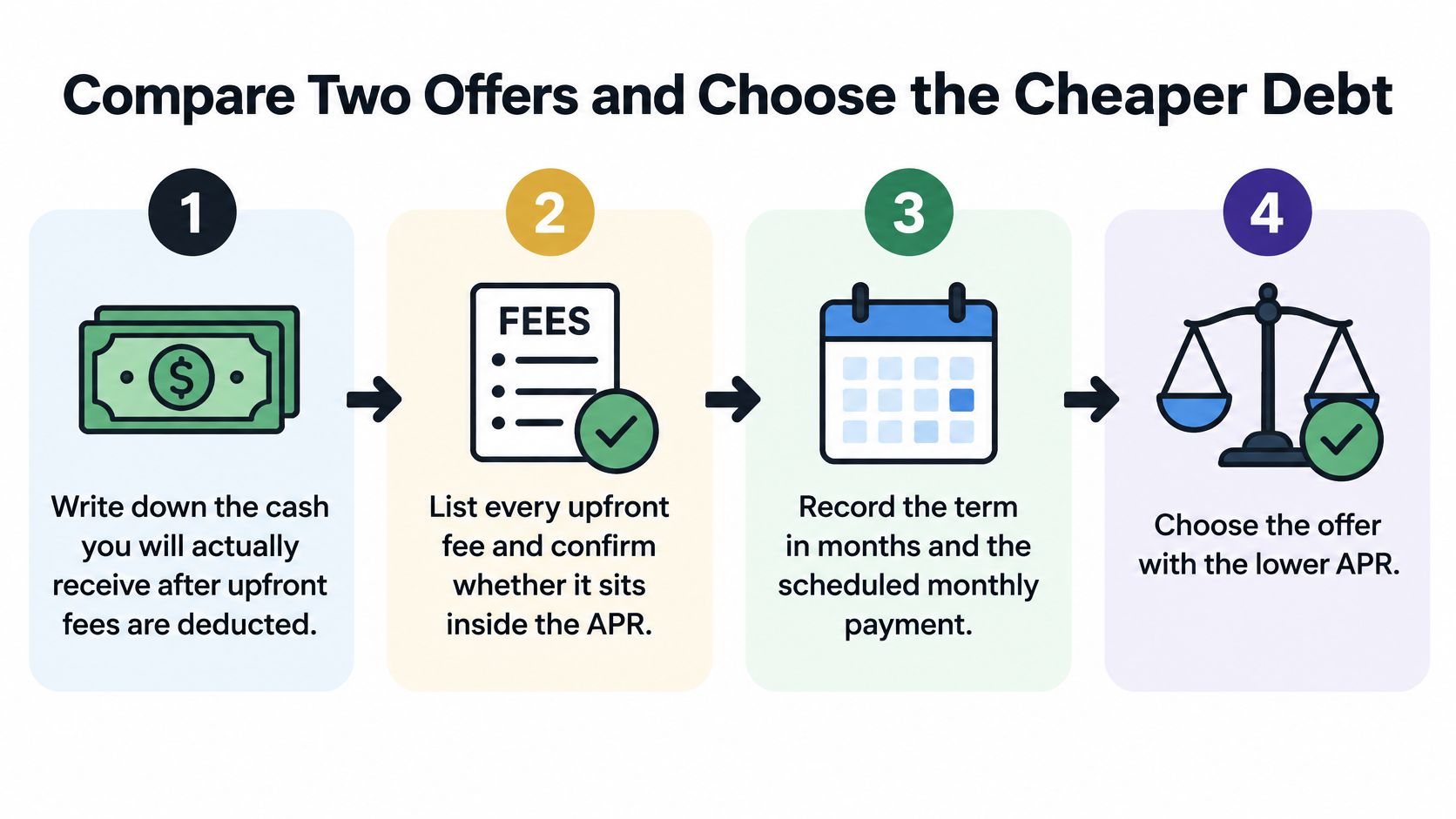
- Write down the cash you'll receive after upfront fees are deducted. This is the amount financed, not the loan amount.
- List every upfront fee and mark whether it sits inside the APR. Anything outside the APR still comes out of your pocket.
- Record the term in months and the scheduled monthly payment next to it.
- Multiply the payment by the number of months to get total repaid.
- Subtract the cash received from total repaid to get the cost of credit in dollars.
- Compare totals only across identical terms. If the terms differ, rank by APR first, then weigh the monthly payment against the total.
Run it on a pair of offers and the arithmetic gets blunt. Offer A is a $10,000 loan with a $200 fee, so you receive $9,800, repaid over 36 payments of $300. Total repaid is $10,800, and the cost of credit is $1,000. Offer B has no fee, pays $10,000, and runs 36 payments of $310. Total repaid is $11,160, and the cost is $1,160.
Compare the monthly payments and you see a $10 gap. Compare the totals and the payment gap accumulates to $360 across 36 months, while the true cost gap is $160 because Offer A hands over $200 less. The fee raises Offer A's APR above its nominal rate, and the dollar math confirms what the APR already told you, which is exactly why the two measures agree when you use them correctly.
The same discipline applies to debt you already have. List each balance, its APR and its due date in one view, rank them by APR and the fees attached to each, then send every extra dollar to the most expensive balance first. That's the approach Toya AI builds into its app: connected accounts show balances, APRs and due dates in a single dashboard, and the payoff planner recommends which payment to make next while showing how each choice moves your debt-free date and total interest. Its preview calculator returns a quick estimate from three numbers, and connecting accounts sharpens it to exact figures, while the free tier connects unlimited accounts and tracks balances, APRs and due dates with no time limit.
Shopping a financed purchase, whether it's a vehicle or something smaller, works the same way. A side-by-side view of golf cart financing options shows how much the dealer's terms and an outside lender's terms can diverge once fees enter the frame. To check the arithmetic on any quote before you sign, this interest rate and APR comparison tool runs the conversion for you.
Pick one real offer or one real debt this week and run the six steps on it. Write the cash received, the fees, the term, the payment, the total repaid and the cost of credit on one page. The number at the bottom is the only one that decides which debt is cheaper.
Toya AI turns the comparison method in this article into a working plan. Connect your accounts and it shows every balance, APR and due date in one dashboard, then recommends which payment to make next and how much interest that choice saves. Start free at Toya AI to see your debt-free date, then let the planner tell you which balance to attack first.
Ready to start your debt-free journey?
Toya AI builds a personalized payoff plan so you can see your debt-free date and save on interest.
Get Started Free