
AI Debt Management Guide: How Smart Tools Pay Off Balances

A kitchen counter can turn into a debt command center overnight. One statement shows a balance at 24.99% APR, another carries 18%, a personal loan costs 11%, and a car note sits at 7%. The minimum payments consume $1,140 from a $3,900 take-home income, before rent, groceries, and daycare. An extra $200 feels helpful, but deciding where it should go becomes another exhausting calculation.
That's the problem ai debt management tries to solve. It doesn't erase balances or replace judgment. It acts as a decision engine, weighing interest cost, available cash flow, and the behavioral friction that makes a plan difficult to follow. The useful question isn't which app claims to use the smartest algorithm. It's whether the tool clearly shows the trade-offs behind the next payment.
Table of Contents
- When the Statements Stack Up and the Math Stops Making Sense
- What AI Debt Management Actually Does Behind the Dashboard
- Inside the Math How AI Picks Your Next Best Payment
- How Toya AI and Similar Apps Compare to Traditional Advice
- What to Look For Before You Hand Over Your Accounts
- Where AI Helps and Where a Human Voice Still Matters
- A Practical 30 60 90 Day Routine for Paying Off Debt With AI
- Turning Overwhelm Into a Measurable Path Forward
When the Statements Stack Up and the Math Stops Making Sense
The borrower in this situation has about $19,200 spread across several accounts. Minimum payments keep the accounts current, but late fees and changing balances steadily make the total harder to control. Every month brings the same choice: send the extra money to the card charging the most interest, or eliminate the small account that's creating mental clutter.
A spreadsheet can show the answer for one moment. It struggles after a paycheck changes, a payment posts, an APR moves, or an unexpected repair takes priority. By the third month, the person managing the spreadsheet is often also managing work, childcare, bills, and the emotional weight of opening another statement.
The decision behind the stress
Suppose the borrower has $200 available after essentials. Sending it to the highest-rate card may reduce interest more efficiently. Sending it to the smallest balance may create a quick win and free a minimum payment sooner. Neither choice is automatically correct for every person, because the lowest mathematical cost and the easiest plan to maintain can point in different directions.
A useful debt tool should make that tension visible instead of hiding it behind a single green progress bar. It should show what happens to the payoff date, interest cost, and monthly obligations when the borrower changes the target.
Practical rule: A repayment recommendation is useful only when the borrower can see what it prioritizes and what it sacrifices.
Before connecting accounts, borrowers may also need to understand the broader credit picture, especially when missed payments are already affecting future borrowing. A plain-language credit score guide for bad credit can help explain how payment history, utilization, and account activity fit into the situation.
The purpose of ai debt management is therefore narrower and more practical than “letting AI handle finances.” The system absorbs repetitive calculations so the borrower can spend attention on decisions that require context, such as whether to call a lender, preserve an emergency cushion, or accept a temporary reduction in extra payments.
What AI Debt Management Actually Does Behind the Dashboard
Behind the dashboard, most payoff planning begins with three inputs: balances, APRs, and available cash flow. The system uses those inputs to recommend a next-best payment, usually the account to target and the amount that can be sent without breaking the rest of the monthly plan.
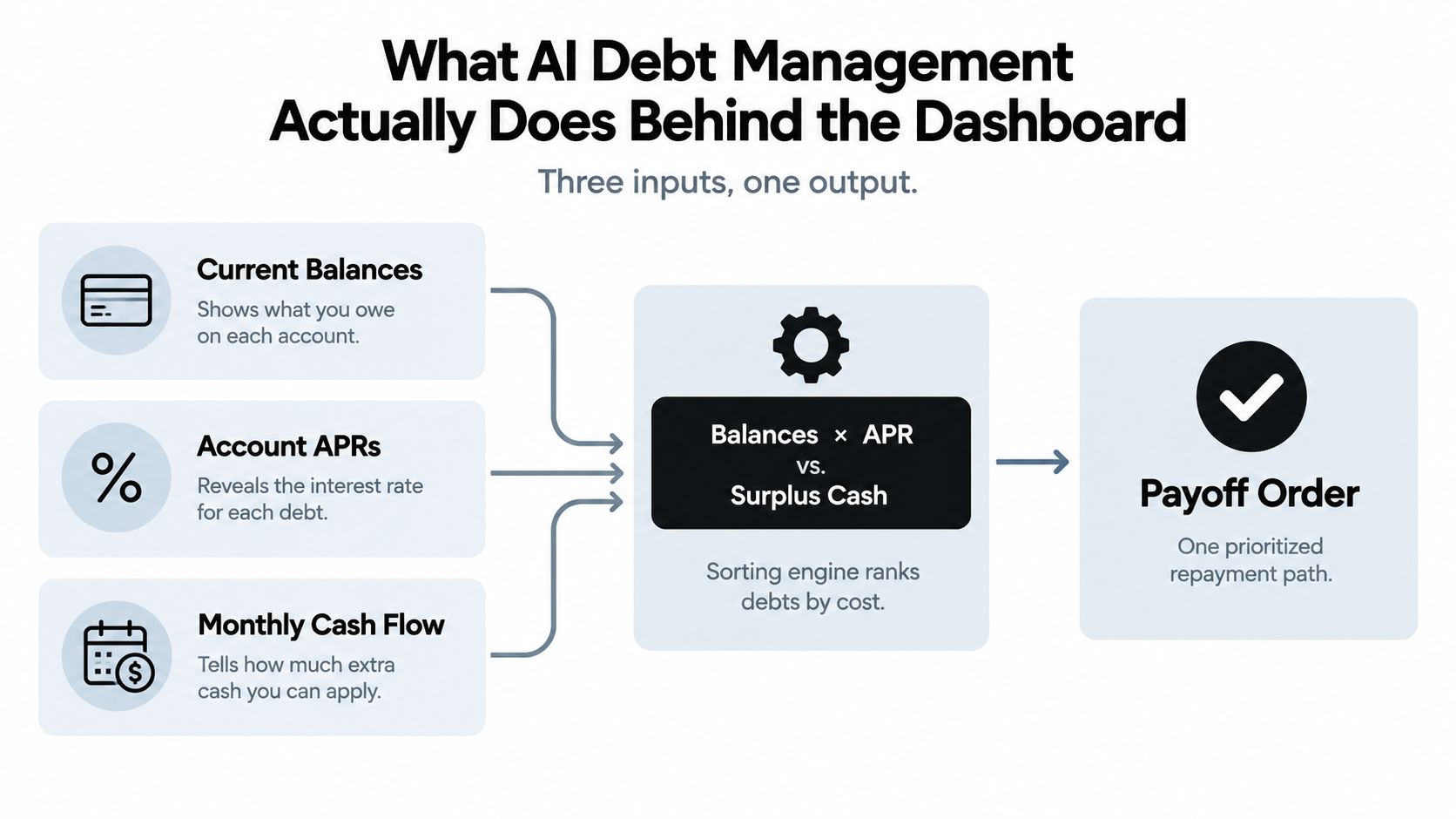
Three inputs shape the recommendation
Current balances tell the system how much remains on each account. A small store card may be close to elimination, while a larger credit card may be generating more interest every day.
Account APRs show the price of carrying each balance. A debt with a high rate can deserve extra attention even when its balance is larger, because each unpaid dollar costs more over time.
Monthly cash flow limits what the borrower can safely send. A plan based on gross income rather than money left after rent, food, transport, and other essentials can look efficient on screen and fail in real life.
The restaurant-tab analogy makes the process easier to follow. Four friends share a meal, but each ordered something different. One person tracks the dishes, tax, and tip, then identifies which unpaid portion should be settled first. An AI payoff engine performs a similar sorting job across accounts, except it also recalculates when the total changes.
The output is a next-best action
A static plan says, “Pay the highest-rate account first.” An adaptive system should say, “After today's minimums, send the available surplus to this account, because that choice produces this projected payoff path.” If a balance updates or income changes, the recommendation should change with it.
Account connections also matter because manually entered numbers age quickly. A reader exploring account aggregation services can compare how different systems gather balances and transaction data before choosing a setup.
For broader prevention ideas, borrowers may find Athens debt avoidance strategies useful as a companion resource. The payoff engine handles sequencing, but avoiding new fees, missed due dates, and unaffordable borrowing still depends on everyday decisions.
Inside the Math How AI Picks Your Next Best Payment
Consider a representative portfolio with four accounts:
- A credit card with a $7,500 balance at 24.99% APR
- A credit card with a $4,200 balance at 18.99% APR
- A personal loan with a $6,800 balance at 11.5% APR
- A store card with a $900 balance at 28.99% APR
The borrower can direct an additional $400 per month after covering minimum payments. The avalanche approach sends that extra amount to the highest APR, the 28.99% store card, while the snowball approach also targets the store card because it has the smallest balance. In this particular portfolio, both methods begin with the same account, but the broader logic differs when balances and rates don't line up.
What the sequence changes
The store card is cleared in three months under the modeled avalanche path. Its freed $130 payment then rolls into the 24.99% card, creating a larger attack on the next expensive balance. Across the modeled repayment period, the avalanche route saves roughly $612 in lifetime interest over 28 months.
The snowball route creates a quick psychological win in month two in the modeled comparison, but it costs about $315 more in interest. That difference illustrates why a tool should show both outcomes rather than label one method universally correct.
| Metric | Avalanche, Highest APR First | Snowball, Lowest Balance First |
|---|---|---|
| Extra monthly payment | $400 | $400 |
| First target | 28.99% store card | $900 store card |
| Store card result | Cleared in three months | Quick win in month two |
| Freed payment shown in model | $130 | $130 |
| Modeled lifetime-interest result | Roughly $612 less interest | About $315 more interest |
| Modeled repayment period | 28 months | 28 months |
The broader evidence supports caution about treating snowball as a universal optimization. A peer-reviewed analysis found that snowball repayment can cost households 1.8% to 4.3% more interest than an interest-minimizing order, while reducing the modeled number of payments from 202 to 143 in the paper's cases. The study estimated an aggregate transfer of $46.2 billion to $53.9 billion from borrowers to lenders. Those findings appear in the peer-reviewed analysis of debt repayment strategies.
A practical credit card payoff calculator with amortization can help borrowers inspect the same trade-off before committing. The key is not memorizing “avalanche” or “snowball.” It's entering real balances, rates, and surplus cash, then checking how the recommendation changes when one variable moves.
How Toya AI and Similar Apps Compare to Traditional Advice
Different debt channels solve different problems. A budgeting app may organize transactions, a nonprofit counselor may help create a structured repayment arrangement, and an AI payoff app may continuously rank the next payment.
For a borrower with $7,400 across three cards, the difference becomes clear when conditions change. If a $1,200 medical card at 0% APR becomes the practical target after cash flow dips, an adaptive system can recalculate around that new constraint. A generic app may display the balance and leave the ordering decision to the user. A counselor may need a scheduled review before revising the written plan.
| Capability | Toya AI | Generic budgeting app | Nonprofit credit counselor |
|---|---|---|---|
| Centralizes account information | Connects accounts in read-only mode through financial-data partners | Often organizes transactions and account information | Collects information during counseling |
| Recomputes next payment | Recalculates when balances, due dates, or cash flow change | Usually leaves sequencing to the user | Revises according to counselor availability and review cadence |
| Explains payoff trade-offs | Shows how payment choices affect timing and interest | Commonly displays raw numbers and budgets | Explains options through a human conversation |
| Handles emotional or hardship context | Provides calculations, not personal negotiation | Provides tracking and alerts | Can discuss hardship and creditor options |
| Best fit | Borrowers who want adaptive next-action guidance | Borrowers who mainly need spending visibility | Borrowers who need human support and structured counseling |
Cadence matters more than the label
The important distinction isn't that one channel is “smart” and another is “old-fashioned.” It's how often the plan responds to reality. An AI tool can update after a balance or payment changes. A budgeting app may update transactions without deciding what to do next. A counselor brings judgment and empathy, but the plan may be reviewed on a calendar rather than after every financial event.
The CFPB describes a debt management plan as an arrangement typically made through a nonprofit credit counseling agency, combining credit card debts into one monthly payment and generally lasting three to five years. During that period, consumers generally can't use credit cards or open new lines of credit, as explained in this overview of debt management plans.
Before choosing a channel, borrowers should ask whether it updates the recommendation, merely records the data, or provides a person who can interpret a hardship. Those are different services, and a useful plan may combine them.
What to Look For Before You Hand Over Your Accounts
Connecting a bank or card account gives a debt tool more accurate inputs, but accuracy isn't enough. Borrowers should test whether the app explains its decisions, protects the data, and allows a human to review an unusual situation.
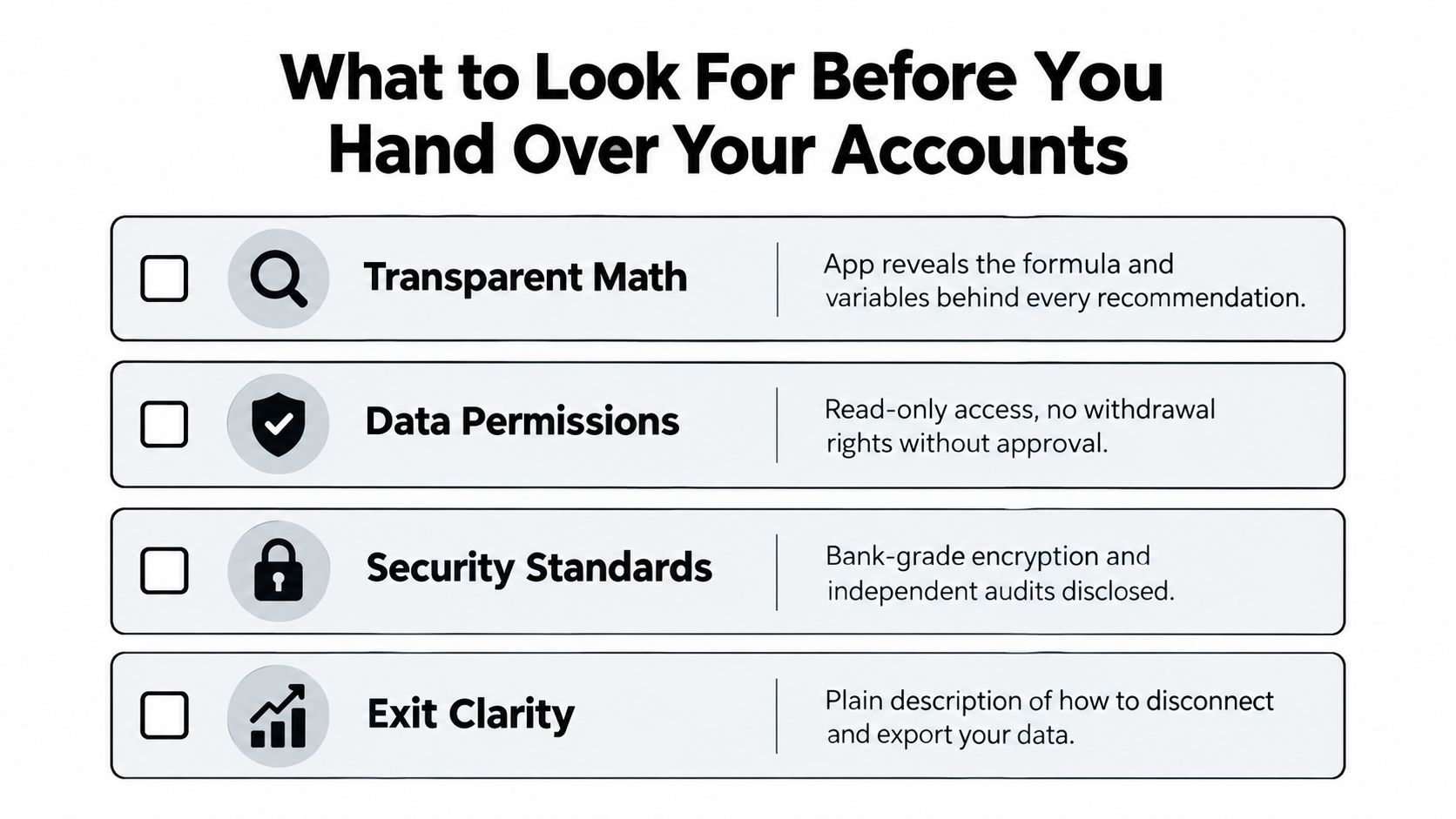
Four checks before connecting
Transparent math. The app should show the variables behind a recommendation, including balance, APR, minimum payment, and available surplus. A quick test is to change the extra payment amount and see whether the payoff schedule explains the new result.
Adaptive re-planning. A serious system should respond when income, balances, or due dates change. The under-a-minute test is simple: adjust a cash-flow input and confirm that the next-best payment moves or clearly stays the same for a stated reason.
Privacy posture. Read the permissions screen carefully. Read-only access is different from the ability to move money, and borrowers should understand whether data is stored, shared, tokenized, or used for advertising. Security claims should include meaningful documentation, such as independent audit information, rather than vague “bank-level” language.
Human review and exit clarity. Math can rank accounts, but it can't negotiate with a hospital billing office or explain a job loss to a lender. The app should say how a user can request help, disconnect accounts, export the schedule, and delete stored information.
The financial data security guide can help readers build a sharper list of questions before granting access. A privacy policy that answers those questions directly is more useful than a decorative security badge.
Where AI Helps and Where a Human Voice Still Matters
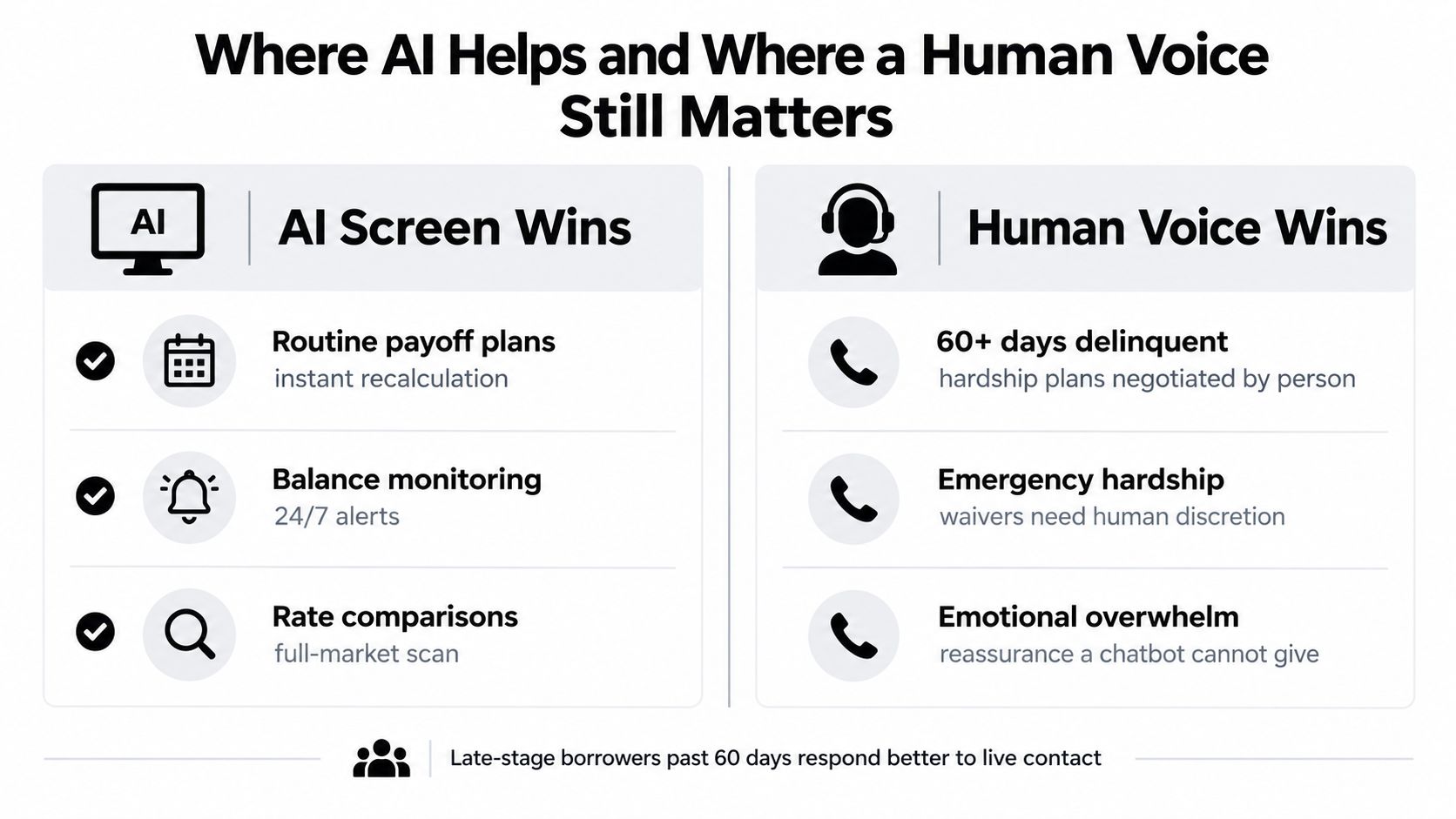
AI isn't automatically the right channel for every debt stage. It works well when the borrower needs repeated calculations, reminders, and account monitoring. It becomes less suitable when the debt problem involves shame, illness, job loss, disputed charges, or a request for special treatment.
A large experimental study across 11 European countries found that people viewed human debt interactions as fairer and more likely to encourage reciprocity, while AI was viewed as more efficient. Human contact also produced more empathy, but the study didn't find that AI reduced trust overall. A separate experiment found that AI callers underperformed human callers around one month past due, with the net present value of repayments collected by AI callers peaking about 9 percentage points lower than human callers at that stage. The findings are discussed in the research on AI and debt collection interactions.
Match the channel to the situation
When accounts are current but cash flow is tight, an automated recommendation can prevent a missed payment. It can identify the next affordable action without requiring the borrower to rebuild a spreadsheet after every paycheck.
When delinquency becomes serious, a human voice may matter more than a faster calculation. A borrower who is more than 60 days delinquent may need a hardship arrangement, fee discussion, or explanation of circumstances that a chatbot can't negotiate with discretion.
A simple rule: Early-stage strain calls for transparent automation. Late-stage delinquency calls for transparent automation plus a human escalation path.
Trust deserves its own check. Only 13% of Americans named AI tools among their most trusted financial-advice sources, rising to 17% among Gen Z and Millennials, according to reported 2026 survey findings on AI and financial decision-making. Among people who trust AI, just 14% rely on it alone, while 54% still seek human guidance. Readers looking for a practical framework can also review this practical guide to AI trust.
A Practical 30 60 90 Day Routine for Paying Off Debt With AI
An algorithm can recommend a payment, but the borrower still has to verify the inputs, move the money, and override the plan when circumstances change. A 30-60-90 day routine turns the recommendation into a repeatable process.
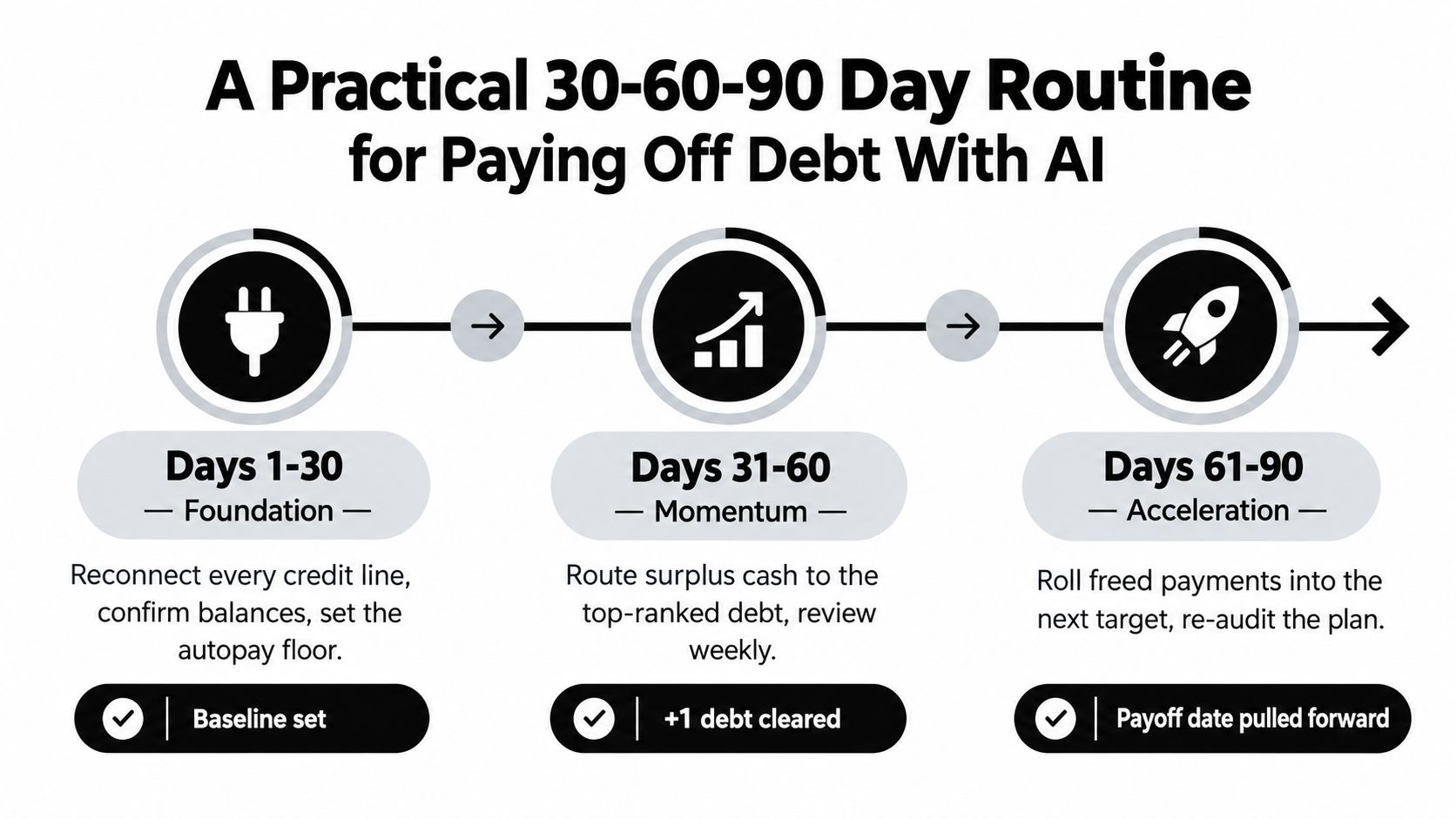
Days 1 to 30 establish the baseline
Reconnect every credit line and confirm that balances, APRs, minimum payments, and due dates are accurate. Enter at least two months of cash-flow information so the system can distinguish a normal surplus from a one-time good month.
Keep minimum payments protected first. Then inspect the recommended extra payment and ask whether it leaves enough room for essentials and predictable bills. If a connected account displays a wrong rate or a missing fee, correct the data before judging the recommendation.
Days 31 to 60 test the plan
Run a lower-income scenario. Reduce the available surplus and check whether the system produces an affordable next action rather than preserving an unrealistic payoff date.
Change the extra payment amount and inspect the result. A useful tool should show how the adjustment affects interest, timing, and the target account. The borrower should also review the plan after each payment posts, because the next account may change when a balance falls.
Days 61 to 90 build the habit
Automate the recommended transfer only after the amount has been reviewed. Schedule a short monthly check-in to compare the projected payoff date with actual progress, confirm that accounts remain connected, and look for unexpected interest or fee changes.
Override the plan after a surprise medical bill, an income interruption, or an APR change when a promotional rate expires. A debt plan is a disciplined routine, not a command that outranks basic financial safety.
The routine is the control system. The algorithm only supplies the calculation.
Turning Overwhelm Into a Measurable Path Forward
AI debt management works best as a clarity layer, not a magic eraser. It can turn several statements into one ranked next step, but the borrower still decides how much cash is safe to commit, whether a human needs to intervene, and which trade-off is acceptable.
Four questions should come before any account connection:
- Where is the financial data stored, and who can access it?
- What event triggers a new payoff recommendation?
- Can the borrower export the payoff schedule and account history?
- What happens after cancellation, and how can connected accounts be disconnected?
The decision engine should also surface the difference between interest efficiency and behavioral simplicity. The CFPB's debt snowball worksheet describes starting with the smallest debt and redirecting that payment to the next smallest. The CFPB's highest-interest-rate repayment method instead directs extra money toward the debt with the highest rate while minimum payments continue elsewhere. A useful tool can display both paths and explain the cost of choosing one.
Borrowers should inspect how much personal data the tool ingests, how often it recalculates, and whether it supports human advice when delinquency becomes severe. Regulatory details can matter too. For example, Illinois' Predatory Loan Prevention Act caps interest on covered consumer loans at 36% APR, a threshold described in the Illinois consumer-credit information. A tool should never treat refinancing as automatically beneficial without checking the actual rate, fees, term, and eligibility.
The category's value isn't a particular heuristic. It's the shift from staring at five statements to seeing one defensible next action, one projected payoff month, and a clear explanation of what changes when cash flow changes.
Toya AI centralizes balances, APRs, utilization, and due dates, then uses that information to recommend the next best payment and show how choices affect interest and the debt-free date. Readers who want to turn the decision-engine approach into a connected, adaptive payoff plan can visit Toya AI and review the available tracking and optimization options.
Ready to start your debt-free journey?
Toya AI builds a personalized payoff plan so you can see your debt-free date and save on interest.
Get Started Free