
After Car Loan Is Paid Off: Your Smart Next Steps

The final payment clears on a Tuesday, the loan app flashes a zero balance, and most borrowers assume the job is finished. Then nothing arrives in the mail, the title never shows up, and a credit score dips for no obvious reason. That gap between paying and actually being done is where money and time get lost.
After car loan is paid off, the smart move isn't a celebration lap. It's a short administrative project with deadlines, documents, and verification steps. Borrowers who treat payoff that way protect a future sale, catch reporting errors early, and turn a freed payment into lasting progress instead of quiet lifestyle inflation.
Table of Contents
- The First 30 Days After Your Final Payment
- Getting the Title and Lien Release in Order
- What Really Happens to Your Credit Score
- Insurance Changes That Actually Save Money
- Where to Send the Money You No Longer Owe
- Mistakes Most Borrowers Make After Payoff
- Your 90-Day Payoff Closure Checklist
The First 30 Days After Your Final Payment
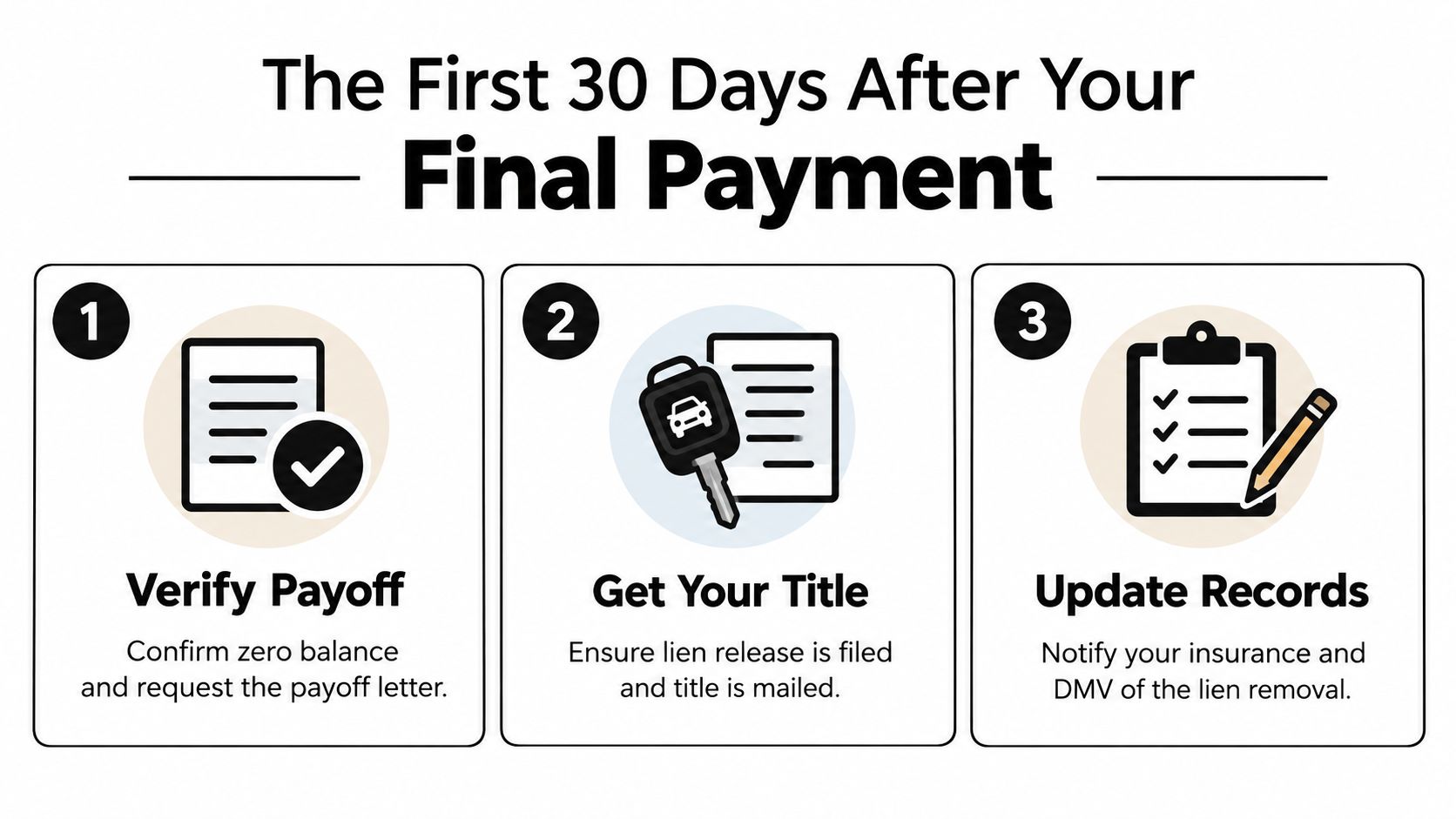
Payoff starts three separate jobs, not one. The first job is administrative cleanup, meaning the lien release, clean title, and registration record. The second is financial control, covering insurance changes and credit report accuracy. The third is strategy, deciding where the former monthly payment goes before everyday spending absorbs it.
Each bucket runs on a different clock. Title work can stall a sale or trade-in, so it can't wait. Credit reporting moves on the lender's reporting cycle, so monitoring matters more than daily checking. Cash flow decisions feel optional, but delay usually means the money disappears without a deliberate choice.
Triaging the Work Correctly
A phone confirmation of a zero balance isn't proof. Borrowers need a saved payoff confirmation, a paper trail for the lien release, and a date on the calendar to verify credit reporting. Practical example: an owner who saves the payoff letter and checks the state title record within the first month catches a missing release while lender records are fresh, instead of discovering the problem in a buyer's driveway.
Practical rule: Payoff isn't complete when the balance hits zero. It's complete when the title, credit report, insurance policy, and budget all show the loan is gone.
Post-Payoff Task Categories at a Glance
| Task Category | Example Tasks | Urgency |
|---|---|---|
| Administrative cleanup | Save payoff letter, track lien release, confirm clean title | High |
| Financial controls | Remove lender from insurance, verify closed account on credit reports | Medium |
| Cash flow strategy | Redirect former payment to savings or higher-interest debt | High, but deliberate |
Borrowers who sort tasks this way avoid the common trap of spending the freed payment immediately while ignoring the lien. Urgent paperwork comes first, passive monitoring gets a scheduled check, and strategic money decisions get an automatic transfer date. That sequencing turns an emotional milestone into a closed loop with verifiable outcomes.
Getting the Title and Lien Release in Order
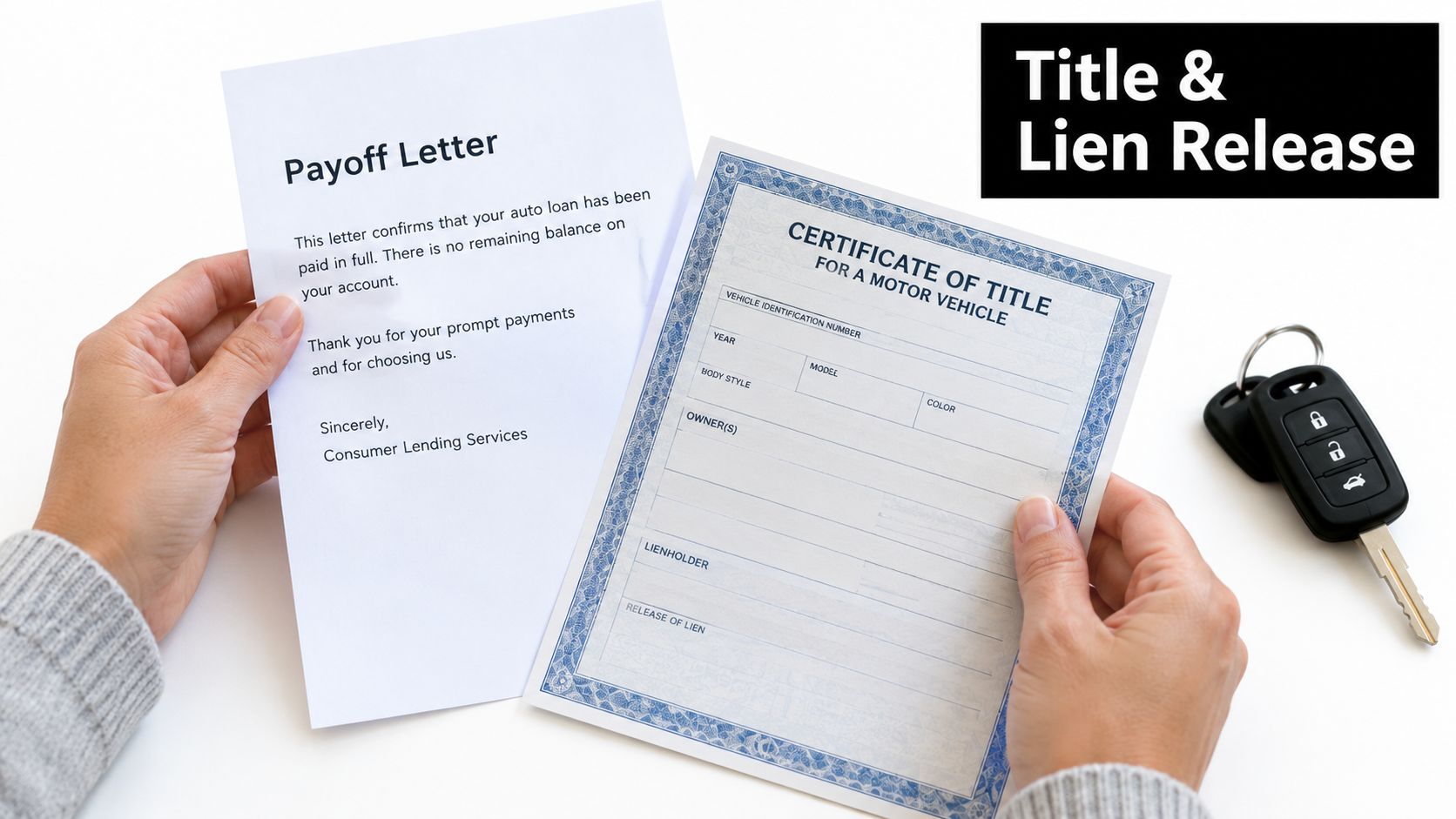
The lender's security interest doesn't vanish from government records just because the debt is paid. The lien must be formally released so ownership records show the vehicle free of that claim, and an unresolved lien can delay selling, refinancing, registering, or transferring the car, as Virginia DMV guidance on vehicle liens and title records explains. Borrowers who skip verification often learn about the problem at the worst moment.
A clear example helps. A private-party seller agrees on a price, meets the buyer, then discovers the title still lists the old lender. The buyer walks, not because money is owed, but because ownership can't transfer cleanly. A refinancing applicant hits the same wall when the payoff is confirmed but the title record hasn't been updated.
Following the Document Trail Step by Step
The workflow is straightforward, and each step produces a document worth keeping.
- Save the payoff confirmation: Retain proof showing a zero balance, the payoff date, and the vehicle identification number, then confirm the account reads paid in full.
- Ask how the release will happen: The lender should state whether the lien release goes electronically to the motor vehicle agency or arrives as a signed paper release by mail.
- Confirm agency notification: Borrowers shouldn't assume notification happened, especially in paper-title systems where the owner may need to submit documents.
- Check the title record: Verification means the state record itself shows no active lien, not merely that an envelope arrived from the lender.
- Obtain the clean title: Selling, transferring, or refinancing should wait until a title without the lender's claim is in hand or confirmed in state records.
New York requires lenders to execute and deliver the lien release no later than three business days after payment clearance and notify the DMV, according to New York Department of Financial Services guidance on obtaining a lien release. Virginia uses a different timeline, so state rules control expectations, not generic advice from a forum or a lender's call center script.
Borrowers still fuzzy on terminology benefit from reviewing what a loan payoff actually includes beyond the final payment before calling the lender. Knowing the difference between a payoff amount, a zero balance, and a lien release prevents the classic mistake of accepting verbal reassurance instead of documents.
Handling the Electronic Versus Paper Fork
Electronic-title systems are simpler because the lender notifies the agency directly and the state mails an updated title. Paper systems put more work on the owner, who may need to submit the signed release, apply for a substitute title, and pay a state fee. A lender-stamped title alone doesn't guarantee the government record changed.
A lien release in a drawer is not the same as a lien removed from the title record. Both steps matter.
If the expected deadline passes, escalation should be written, dated, and specific. The request should include the VIN, payoff date, cancelled payment evidence, and prior lender correspondence. That packet supports a correction if the lender or registry failed to update records, and it beats restarting the story on every phone call.
This isn't rare busywork. A compilation reported 1,219 complaints involving consumers unable to obtain a vehicle title after paying off a loan, as noted in Granite's guide to lien release problems and timelines. Borrowers who verify early rarely join that group.
What Really Happens to Your Credit Score
A paid-off auto loan doesn't disappear from a credit history. A car loan paid in full while in good standing can remain on a credit report for up to 10 years after closure, with a zero balance and a paid/closed status, according to Experian guidance on how long a paid auto loan remains on a credit report. During that period, on-time payments and account age may keep contributing to the profile.
That long tail surprises borrowers who expect instant rewards. Closure can produce a short-term score decline for some people because the loan no longer counts as an active installment account in the credit mix or among currently open accounts. The debt is gone, which is financially positive, but scoring models also notice the missing active loan.
Why Some Scores Dip and Others Barely Move
Borrowers with a thick credit file and other open accounts often see minimal change. Borrowers with a thin file, where the car loan was the main installment account, can notice a sharper temporary drop. Neither outcome means payoff was a mistake, and neither justifies keeping debt solely to protect a score.
Late payments follow different rules. Paying the remaining balance doesn't erase prior delinquencies, and most adverse payment information generally remains for up to seven years from the relevant delinquency, as detailed in the Experian guidance cited in the opening of this section. A borrower who struggled early in the loan keeps that history, while a borrower who paid on time preserves a positive record.
Readers puzzled by a post-payoff dip can review why paying off a loan can temporarily hurt credit for the scoring mechanics in plain language. The core point stays simple: a small, temporary move doesn't outweigh eliminating a monthly obligation and its interest cost.
Verifying the Closed Account Correctly
Timing matters. Checking reports the day after payoff usually shows stale data, because the lender hasn't reported the closure yet.
- Wait for the next reporting cycle: The lender needs time to report the account as closed and paid.
- Check all three major reports: One bureau can update while another still shows a balance.
- Confirm the details: The balance should read zero, the status should show paid or closed, and the payment history should match reality.
- Dispute errors promptly: An incorrect balance or a false late payment deserves a dispute with documentation, including the payoff confirmation.
Practical example: a borrower checks one report, sees a lingering balance, and panics. A calmer borrower waits for the reporting cycle, pulls all three reports, and disputes only the bureau still showing the wrong figure. Verification, not vigilance, is the goal. One thorough check after reporting beats daily score refreshes that create anxiety without adding information.
Insurance Changes That Actually Save Money
Insurance after payoff needs a deliberate review, not automatic cancellations. Once the lender's security interest is removed, the lender's name can generally come off the policy as loss payee. That administrative change is easy, and it's also where many borrowers stop thinking, right before making an expensive coverage mistake.
Dropping collision and full coverage saves premium dollars only until an accident, theft, or storm hits a car the owner can't afford to replace. Experian notes the lender may be removed from the insurance policy after the loan is paid, in Experian's post-payoff checklist for insurance and credit steps. Removal of the lender, however, says nothing about whether coverage levels still fit the owner's risk.
Deciding What Coverage to Keep
The decision hinges on replacement reality. If totaling the car would force a new loan at a bad moment, keeping full coverage often makes sense even without a lender requiring it. If the vehicle holds modest value and savings could replace it without debt, reducing coverage becomes a reasonable conversation with the insurer.
Practical example: an owner of an older paid-off sedan keeps full coverage because the car is essential for work and savings are thin. Another owner with a second vehicle and healthy savings drops collision after comparing the car's value against the premium. Both decisions can be right, because the risk exposure differs, not because one owner is smarter.
Required liability coverage isn't optional in either case. Cancelling it to celebrate lower costs creates legal and financial exposure that dwarfs any premium savings. Registration and insurance obligations also continue until the vehicle is legally transferred or removed from service.
Shopping Without Creating a Coverage Gap
Borrowers seeking lower premiums should compare quotes while current coverage stays active. Policy Quail offers a useful starting point to compare coverage after loan payoff without guessing which protections still matter. Quote comparisons should match coverage limits and deductibles, since a cheaper price built on weaker protection isn't a saving.
Savings test: A lower premium only counts as a win if the remaining coverage still prevents one bad day from pushing the household back into debt.
A lower premium also isn't guaranteed after payoff. Rates depend on driving record, location, vehicle, and coverage choices, not loan status alone. Treating insurance as a separate control, reviewed on purpose, produces better outcomes than assuming the insurer will reward payoff automatically.
Where to Send the Money You No Longer Owe
The freed monthly payment is the key prize of payoff, and it's also the easiest prize to waste. Without an assigned destination, the money dissolves into takeout, subscriptions, and small upgrades within a few pay cycles. Borrowers should redirect it deliberately, in priority order, starting the same month the loan payment disappears.
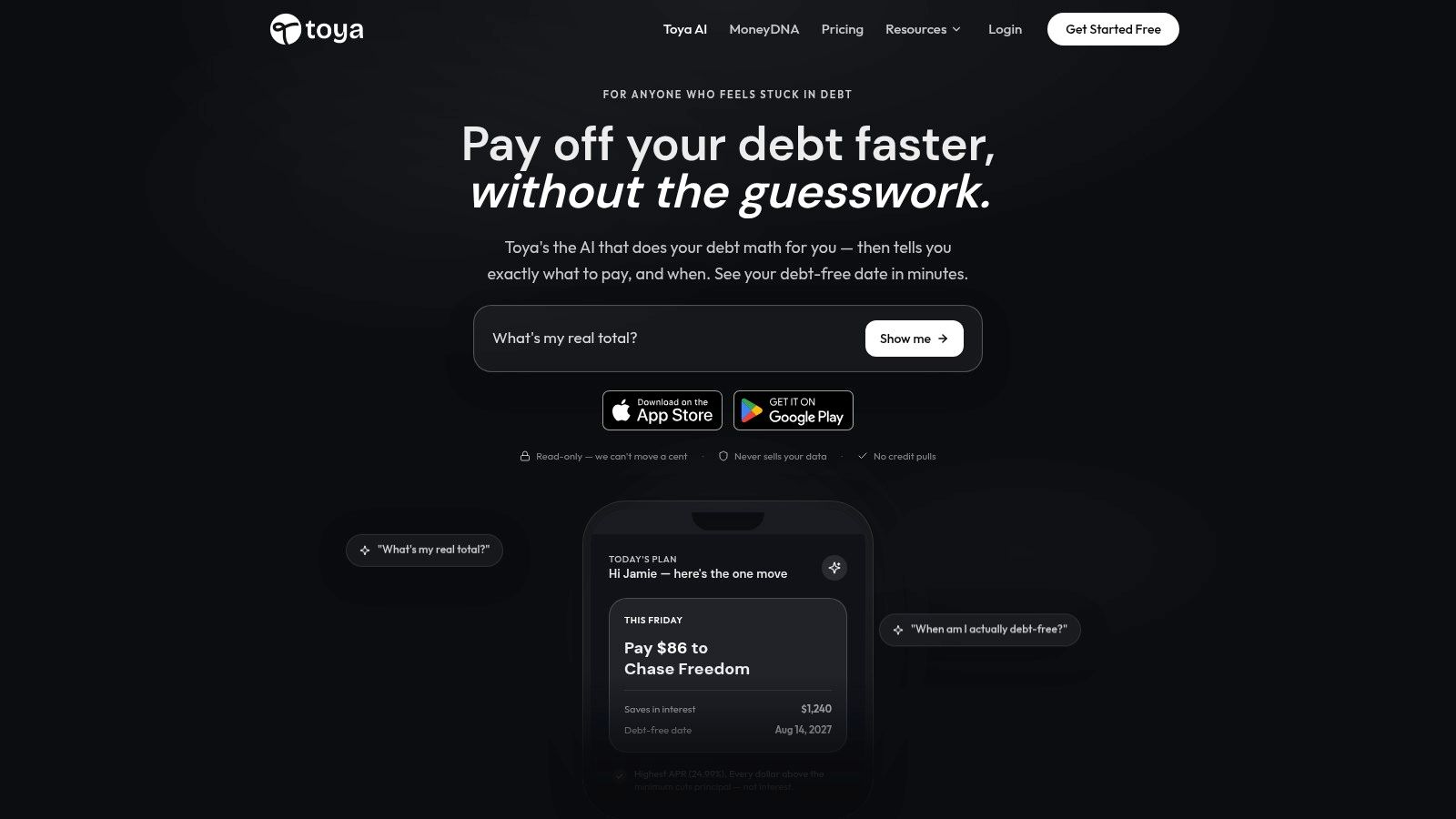
The screenshot below shows the kind of dashboard view that helps households see every balance and payment in one place before assigning new cash flow.
Ranking Destinations in Priority Order
First comes a starter emergency fund covering essential expenses for a short stretch. That cushion is what stops a transmission repair from becoming new credit card debt. Skipping it recreates the exact conditions that made the original car loan necessary.
Second, high-interest debt gets the money. Credit card balances cost far more than a paid-off car ever did, so sending the former car payment there accelerates freedom instead of funding lifestyle upgrades. Third, capturing an employer retirement match puts the cash to work with an immediate boost from the employer's contribution. Longer goals, including saving for the next vehicle in cash, follow after those foundations.
Practical example: a borrower sends the entire former payment to a vacation fund, then finances an engine repair on a high-rate card months later. The payoff win evaporates. A different borrower builds the starter cushion first, then attacks card debt, and the same repair becomes an inconvenience instead of a crisis.
Households mapping these moves alongside other goals can use long-term financial planning principles for sequencing debt and savings goals to keep short-term relief and long-term targets in the same plan. Modeling the order before committing the cash prevents emotional allocation in the first flush of relief.
The video below walks through practical thinking on redirecting freed payments, and it pairs well with a written priority list taped near the household budget.
Automation locks in the decision. An automatic transfer scheduled for the old payment date preserves the habit the loan created, except the money now builds savings or kills expensive debt. Treating the redirect as a bill owed to the future household, not as leftover cash, is what converts payoff into momentum.
Mistakes Most Borrowers Make After Payoff
Celebration is the default, and it's earned, but celebration without follow-through wastes the win. Three mistakes show up repeatedly, and each one reverses progress.
Assuming insurance costs drop automatically is the first. Insurers don't monitor loan balances and mail surprise discounts. Owners who never request quotes or review coverage keep paying yesterday's price for yesterday's risk profile. The fix takes one afternoon of comparisons, yet most households never schedule it.
Leaving the freed payment unassigned is the second. Unallocated cash doesn't stay neutral. It leaks. A slightly nicer grocery run here and a streaming upgrade there can consume the entire former payment before the borrower notices, leaving no cushion and no progress on remaining debts.
The third mistake is treating the paid-off car as a permanent free ride. Vehicles age, repairs arrive, and replacement eventually becomes necessary. Households that never fund the next car end up financing it under pressure, often after a breakdown limits their choices. Setting aside a portion of the former payment toward replacement breaks that cycle.
A paid-off car is not the finish line. It's the cheapest transportation a household will ever own, and the savings from it should be managed like it matters.
One concrete action this week beats good intentions. Requesting fresh insurance quotes, setting the automatic transfer, or confirming the title record each takes little time. Borrowers who pick one and finish it keep the payoff working long after the zero balance stops feeling exciting.
Your 90-Day Payoff Closure Checklist
A timeline turns good intentions into verifiable closure.
- Days 1 to 7: Save the payoff letter, verify the zero balance, and ask the lender in writing whether the lien release is electronic or paper.
- Days 8 to 30: Check the state title record, follow up past the applicable deadline, and obtain confirmation the lien shows satisfied, since Virginia explains a paper release can leave the lien in DMV records until the owner applies for a substitute title, per Virginia DMV guidance on lien satisfaction and substitute titles.
- Days 31 to 60: Pull all three credit reports, confirm the paid and closed status, dispute errors, and complete the insurance review.
- Days 61 to 90: Confirm the new automatic transfer posts correctly and the chosen destination, savings or debt, shows measurable progress.
Each checkpoint ends with a document or screen proving completion. When every box is verified, payoff is completely finished, financially and administratively, and the next debt becomes easier to attack with the same system.
Toya AI helps households turn a freed car payment into a clear, adaptive payoff plan across remaining cards and loans, showing how each extra payment changes the debt-free date and total interest. Borrowers ready to close the loop after car loan is paid off can start building that next plan with Toya AI and keep the momentum rolling toward the next zero balance.
Ready to start your debt-free journey?
Toya AI builds a personalized payoff plan so you can see your debt-free date and save on interest.
Get Started Free